
Why do your eyes still throb with pain even when you're wearing the darkest shades you could find? Most standard eyewear fails because it addresses surface brightness while ignoring high-intensity glare and peripheral light leaks. You're likely tired of the persistent squinting and daylight headaches that disrupt your focus. Finding the best sunglasses for light sensitive eyes is about more than just a dark tint. It's about specific optical technology designed for photophobia relief. This 2026 guide promises to show you exactly how to achieve total visual comfort in high-glare environments.
We'll analyze the critical differences between simple dark lenses and medical-grade UV400 protection. You'll learn about LIOUMO photochromic polarized sunglasses for adaptive vision and classic polarized styles that offer 99% glare reduction. This overview covers essential frame architectures, including wrap-around styles and lightweight carbon fiber materials. We're breaking down Category 4 lens density and the specific technical features required to stop eye strain. Get ready for a functional, efficiency-oriented look at the latest trends in high-performance eye protection.
Key Takeaways
- Understand the ISO 12312-1 lens category system to select between standard Category 3 and high-density Category 4 protection for targeted photophobia relief.
- Identify the best sunglasses for light sensitive eyes by prioritizing 99% polarized glare reduction and UV400 rated technical lenses.
- Use LIOUMO photochromic polarized technology for adaptive vision management and immediate relief in variable light conditions.
- Prevent peripheral light leaks and headaches by choosing wrap-around frame architectures that create a dark micro-environment for the eyes.
- Optimize visual comfort by matching specific lens VLT percentages to high-glare environments like high-altitude snow or maritime travel.
Understanding Light Sensitivity: Why Standard Sunglasses Fail
Photophobia is a neurological and physical reaction to light. It's not a mere preference for shade; it's a condition that triggers pain through the trigeminal nerve system. Standard retail sunglasses often fail because they prioritize cosmetic tint over technical Visible Light Transmission (VLT) management. Finding the best sunglasses for light sensitive eyes requires a focus on reducing VLT to levels that prevent ocular strain while maintaining high-definition clarity across varying conditions. When standard shades allow too much light through, the eye muscles remain in a constant state of contraction, leading to fatigue and tension headaches.
Visible Light Transmission determines the specific volume of light reaching the retina. Standard lenses usually sit around 15% to 20% VLT. For individuals with high sensitivity, these levels are often insufficient. Effective protection requires managing not just brightness, but also High-Energy Visible (HEV) blue light and infrared radiation. These spectrums contribute to thermal eye strain and long-term discomfort. Infrared rays create heat on the ocular surface, which exacerbates dry eye symptoms and increases sensitivity. High-performance eyewear for photophobia incorporates specialized filters that block these invisible heat-producing rays.
Common Causes of Increased Light Sensitivity
- Post-operative recovery: LASIK, PRK, and cataract surgeries leave the cornea and lens temporarily vulnerable to bright stimuli; specialized protection is essential during healing.
- Medical conditions: Chronic migraines, cluster headaches, and ocular health issues like uveitis or aniridia significantly lower the light tolerance threshold.
- Atmospheric factors: High-altitude environments, fresh snow, and large bodies of water intensify light exposure through extreme reflection and UV concentration.
The Difference Between UV Protection and Tint Density
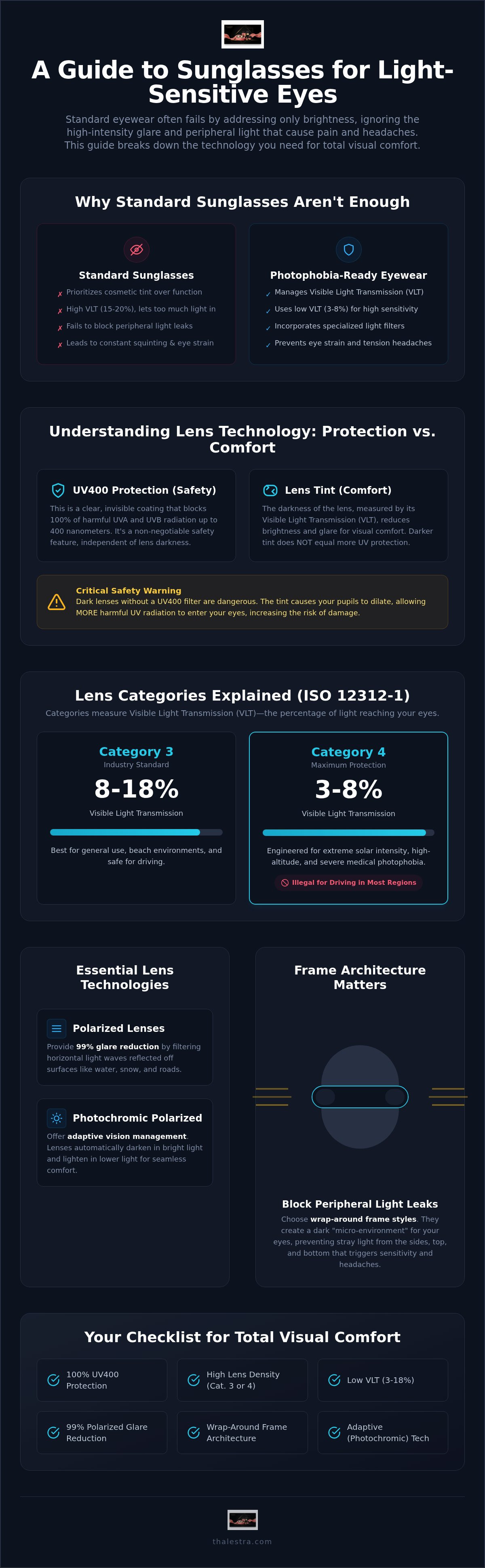
UV400 rating and lens tint are separate technical specifications. UV protection is a clear barrier against invisible radiation. Tint density is a comfort feature that reduces visible brightness. Darker lenses don't automatically provide better safety. In fact, wearing a dark lens without a UV filter is dangerous. The dangers of non-uv protected sunglasses involve the pupil dilating in the shade of the tint, which allows more harmful radiation to enter the eye directly. True relief comes from high-density, UV400-rated lenses that block glare and radiation simultaneously. Selecting the best sunglasses for light sensitive eyes means looking for Category 3 or Category 4 darkness paired with 100% UV blockage.
The Science of Lens Categories: Why Category 4 Matters
The ISO 12312-1 international standard categorizes lenses from 0 to 4 based on their light-filtering capacity. Most retail eyewear falls into Category 2 or 3. Category 3 is the industry standard for general use, beach environments, and driving. It filters roughly 82% to 92% of visible light. While sufficient for many, the best sunglasses for light sensitive eyes often utilize Category 4 specifications. These "super dark" lenses are engineered for extreme solar intensity. Finding the best sunglasses for light sensitive eyes requires understanding these technical brackets to match protection with your specific environment.
Category 4 lenses are specialized tools for high-altitude environments, glacier travel, and severe medical photophobia. They permit only 3% to 8% of light to reach the eye. This level of density provides immediate relief for individuals who find Category 3 insufficient. There is a critical safety restriction. Category 4 lenses are illegal for driving in most jurisdictions. Their extreme opacity makes it impossible to distinguish traffic light colors or see clearly into shadowed areas. For safe road use, high-quality Category 3 options like our Classic Mens Polarized Sunglasses offer the necessary protection without compromising safety.
VLT Percentages: Measuring Visual Comfort
Visible Light Transmission (VLT) measures the exact percentage of light passing through the lens. For those with extreme sensitivity, the 3% to 8% VLT range is the gold standard for comfort. This low transmission prevents the constant squinting associated with high-glare environments. Technical lens color options include:
- Grey tints: Maximum natural color perception and neutral balance for daily use.
- Brown lenses: High-contrast filtering for blue light and depth enhancement in varying light.
- Green lenses: Balanced contrast with reduced eye fatigue for prolonged outdoor activities.
UV400 vs. Category Rating
Darkness does not equate to safety. A Category 4 lens must provide a 100% UV400 rating to block harmful UVA and UVB rays. Without this, the pupil dilates behind the dark lens, inviting more radiation into the eye. It's vital to distinguish between uv400 vs polarized filters for comprehensive ocular health. High-density lenses require superior optical clarity. Premium materials maintain a crisp field of view even at the lowest VLT levels. For daily management, our Classic Mens Polarized Sunglasses provide the ideal balance of Category 3 density and technical clarity.
Polarized vs. Photochromic: Choosing Your Shield
Managing extreme photophobia requires a strategic choice between two primary lens technologies. Polarized lenses focus on light direction, while photochromic lenses respond to light volume. For many users, the best sunglasses for light sensitive eyes are those that integrate both features to handle high-glare and variable-light scenarios simultaneously. Understanding how these chemical treatments interact with your environment is the key to achieving total visual comfort without constant manual adjustments.
Polarized and photochromic technologies address different ocular pains. Polarization is a static filter designed to block blinding horizontal reflections. Photochromic technology is a dynamic reaction that changes the lens tint based on UV exposure. While some prioritize one over the other, the LIOUMO Top Quality Photochromic Polarized Sunglasses provide a hybrid solution. This combination ensures that the lens is always filtering glare while adjusting its darkness level as you move from bright sunlight into overcast or shaded areas.
Polarized Lenses: The Glare Killers
Polarized eyewear utilizes a specialized chemical film applied in a vertical pattern. This filter acts as a microscopic blind, allowing only vertical light waves to pass through to the retina. It effectively eliminates the horizontal light that bounces off flat surfaces like wet roads, car hoods, and water. This reduction in visual noise significantly lowers eye fatigue and prevents the sharp, stabbing pain often felt in high-glare environments. Lightweight polarized sunglasses for men combine comfort with high-performance glare reduction by utilizing advanced polymer filters that don't add bulk to the frame.
Photochromic Lenses: Adaptive Comfort
Photochromic lenses contain silver halide or chloride molecules that change shape when exposed to ultraviolet radiation. This molecular shift causes the lenses to darken automatically in bright conditions and return to a clearer state indoors. This technology is ideal for individuals who move frequently between different lighting environments. There is a technical limitation to consider. Most car windshields are treated to block UV rays. This prevents standard photochromic lenses from darkening fully while you are driving. For dedicated road use, static Category 3 polarized lenses remain the more reliable choice for consistent light management.
A common concern for polarized lens users is the interaction with digital displays. Because LCD and LED screens also use polarizing filters, viewing them through polarized eyewear can cause a "blackout" effect or distorted colors at certain angles. This is a technical trade-off. For those with severe light sensitivity, the medical-grade relief from environmental glare usually outweighs the minor inconvenience of tilting a smartphone screen. The best sunglasses for light sensitive eyes prioritize ocular health and pain prevention over digital screen clarity.
Frame Architecture: Blocking Peripheral Light Leaks
Standard flat frames often fail to address the primary cause of photophobic discomfort: peripheral light entry. While the front lenses might be dark, light "leaks" through the sides, top, and bottom of the frame, hitting the eye at oblique angles. This creates a high-contrast environment within the ocular space, often leading to persistent tension headaches and squinting. The best sunglasses for light sensitive eyes utilize a curved architecture to seal these gaps and create a dark, stable micro-environment for the retina. This physical barrier is as critical as the lens tint itself for total relief.
Modern frame engineering has seen a resurgence in functional side shields and high-wrap designs. These features are no longer limited to vintage designer styles or industrial safety gear. A close-fitting bridge is equally important for blocking overhead solar radiation, especially during midday hours when the sun is at its zenith. By minimizing the distance between the frame and the face, users can effectively stop the "bounce-back" glare that occurs when light reflects off the inner surface of the lens.
Wrap-Around and Sport Silhouettes
High-performance frames often feature an 8-base curve, which mimics the natural contour of the human face. This geometry provides total coverage from temple to temple, significantly reducing the volume of scattered light reaching the eyes. Thick temple arms further enhance this effect by acting as integrated blinders. These design principles are essential for outdoor enthusiasts, as seen in the best hiking sunglasses that prioritize full-field protection in unpredictable mountain environments. Our Classic Mens Polarized Sunglasses incorporate these wrap-around attributes to ensure consistent light management across the entire field of vision.
Materials for Long-Term Wear
Frame weight is a decisive factor for individuals who experience sensitivity-induced migraines. Heavy frames can create pressure points on the bridge and temples, exacerbating existing discomfort. Lightweight materials like carbon fiber offer a high strength-to-weight ratio, allowing for large, protective silhouettes that remain comfortable for 12+ hours of wear. Polycarbonate lenses offer another layer of utility, providing impact resistance and weight reduction compared to traditional glass. Technical features to look for include:
- Adjustable nose pads: These allow for a customized fit to achieve a perfect light-blocking seal against the face.
- Carbon fiber temples: Durable, flexible, and lightweight for reduced pressure on the temporal nerves.
- Hydrophilic rubber grips: Ensures the frames stay in the optimal protective position even during active use.
For those seeking adaptive protection with a lightweight feel, the LIOUMO Top Quality Photochromic Polarized Sunglasses offer a streamlined solution for all-day light management.
Selecting Your Best Sunglasses for Light Sensitive Eyes
Selecting the best sunglasses for light sensitive eyes requires a technical alignment between environmental variables and lens specifications. Efficiency in ocular protection depends on a systematic assessment of light triggers. This selection process ensures that your eyewear addresses both direct solar radiation and reflected glare. Follow this four-step protocol to identify the optimal configuration for your specific photophobia needs.
- Step 1: Identify Environment. High-glare locations like maritime environments or snowfields require intense filtration. Urban driving involves shifting shadows and dashboard reflections, requiring a balance of darkness and clarity.
- Step 2: Choose VLT Category. Visible Light Transmission is the primary comfort metric. Category 3 lenses (8% to 18% VLT) suit most daylight activities and road use. Category 4 lenses (3% to 8% VLT) are reserved for the most extreme sensitivity cases and high-altitude use.
- Step 3: Prioritize Polarized Filters. Ensure a 99% glare reduction rating to eliminate horizontal reflections from roads, car hoods, and water surfaces. This reduces the "visual noise" that leads to squinting and fatigue.
- Step 4: Select Frame Architecture. Prioritize wrap-around silhouettes or frames with thick temples. This design seals peripheral gaps and stops the light leaks that cause tension headaches.
THALESTRA.COM's Curated Solutions for Sensitivity
Our inventory focuses on high-utility eyewear designed for immediate photophobia relief. The LIOUMO Top Quality Photochromic Polarized Sunglasses offer an adaptive hybrid solution for changing light conditions, utilizing silver halide molecular technology for rapid tint transitions. For consistent, high-density protection, our Classic Mens Polarized Sunglasses utilize multi-layer cellulose triacetate (TAC) polarized lenses for superior durability and 100% UV400 protection. We also feature carbon fiber frame options with 3k weave construction. These lightweight, durable frames reduce pressure on temporal nerves, preventing the secondary headaches often caused by heavy, poorly fitted eyewear.
Care and Maintenance for High-Performance Lenses
Maintenance protocols are essential for preserving optical integrity. Scratches create microscopic light diffraction patterns that exacerbate eye strain for sensitive users. Use high-density microfiber cloths for daily debris removal. Avoid paper-based products or clothing fabrics that can mar technical anti-reflective coatings. Specialized lens cleaners are recommended over household detergents. Always store frames in a rigid protective case when not in use. Place the glasses lens-side up to prevent surface contact. Regularly inspect the frame alignment to maintain the structural seal against your face for maximum peripheral protection.
Browse our full collection of polarized and photochromic sunglasses at THALESTRA.COM to find your ideal pair today.
Optimize Your Vision for High-Glare Environments
Achieving total relief from photophobia requires a technical approach to eyewear selection. You've identified how Category 4 density and 99% polarized glare reduction work together to prevent chronic eye strain. Frame architecture remains equally vital; wrap-around styles create the necessary dark micro-environment to stop peripheral light leaks that standard shades ignore. Finding the best sunglasses for light sensitive eyes means matching these high-performance specifications to your specific daylight triggers. It's about moving beyond simple dark tints toward medical-grade UV400 protection.
Thalestra offers professional-grade collections featuring UV400 certified protection and lightweight carbon fiber frames for maximum all-day comfort. Our inventory includes the LIOUMO adaptive series and classic polarized styles designed for immediate functional relief. We provide global shipping on all orders to ensure your vision is protected regardless of location. Don't let bright light dictate your schedule or cause unnecessary pain. Experience the outdoors with total confidence and crisp visual clarity.
Shop Thalestra's High-Performance Polarized Sunglasses for Maximum Relief
Frequently Asked Questions
What are the best lens colors for light sensitive eyes?
Grey lenses are the most effective for maintaining natural color perception while reducing overall brightness. Brown or copper tints provide high-contrast filtering which is beneficial for managing blue light and glare. Green lenses offer a balanced middle ground by reducing eye fatigue during prolonged outdoor exposure. Selecting the best sunglasses for light sensitive eyes often involves choosing grey or smoke tints for maximum neutral light reduction in high-intensity daylight environments.
Can I wear Category 4 sunglasses for driving?
You cannot wear Category 4 sunglasses for driving because they are too dark for road safety. These lenses permit only 3% to 8% of visible light, making it difficult to distinguish traffic signals or see clearly into shaded areas. Most jurisdictions prohibit their use behind the wheel. For driving, stick to Category 3 polarized lenses which provide excellent glare reduction while maintaining the visibility required for safe vehicle operation and signal recognition.
Do polarized sunglasses help with photophobia?
Polarized sunglasses are essential for managing photophobia because they eliminate blinding horizontal reflections. While standard tinted lenses only reduce brightness, polarized filters stop the harsh glare from roads, water, and car hoods. This reduction in visual noise allows the eye muscles to relax, preventing the persistent squinting and tension headaches associated with light sensitivity. They are a primary component of the best sunglasses for light sensitive eyes when navigating high-glare environments.
Why do I need wrap-around sunglasses if the lenses are dark?
Wrap-around frames are necessary to block peripheral light leaks that enter from the sides and top of the eyewear. Even with dark lenses, stray light hitting the eye at oblique angles can cause significant discomfort and headaches. A curved frame architecture creates a sealed micro-environment, ensuring that the only light reaching your retina is filtered through the technical lens. This provides a consistent level of darkness across your entire field of vision for maximum relief.
Are photochromic lenses dark enough for extreme light sensitivity?
Photochromic lenses are highly effective for variable light conditions but may not be dark enough for extreme, constant sensitivity. These lenses darken in response to UV exposure, reaching Category 2 or 3 levels. However, they don't darken fully inside vehicles because windshields block the necessary UV rays. For extreme sensitivity in static environments, a dedicated Category 4 lens or a high-density polarized Category 3 lens usually provides more consistent relief than a standard transition lens.
How can I tell if my sunglasses have 100% UV protection?
You can verify UV protection by looking for a UV400 or 100% UV Protection label on the product. This rating ensures the lens blocks all light rays with wavelengths up to 400 nanometers. For absolute certainty, an optician can test the lenses using a spectrophotometer to measure the exact UV transmission. All Thalestra collections, including the LIOUMO series, are engineered with certified UV400 protection to ensure maximum ocular safety and long-term retina health.
What is the difference between VLT and UV protection?
Visible Light Transmission (VLT) measures how much visible light passes through the lens to your eye, affecting comfort and perceived brightness. UV protection refers to the filter that blocks invisible, harmful ultraviolet radiation. A lens can be perfectly clear while offering 100% UV protection, or it can be very dark without any UV protection at all. For light sensitivity, you need both high UV400 protection for safety and a low VLT percentage for visual comfort.
Should I choose glass or polycarbonate lenses for sensitivity?
Polycarbonate lenses are generally better for light-sensitive users because they are significantly lighter and more impact-resistant. This reduced weight prevents pressure-induced headaches during long-term wear. While glass lenses offer superior scratch resistance and optical clarity, their weight can cause discomfort on the nose bridge and temples. Modern polycarbonate lenses provide excellent technical performance and are the standard for lightweight frames like our carbon fiber models, ensuring durability without adding extra facial pressure.