
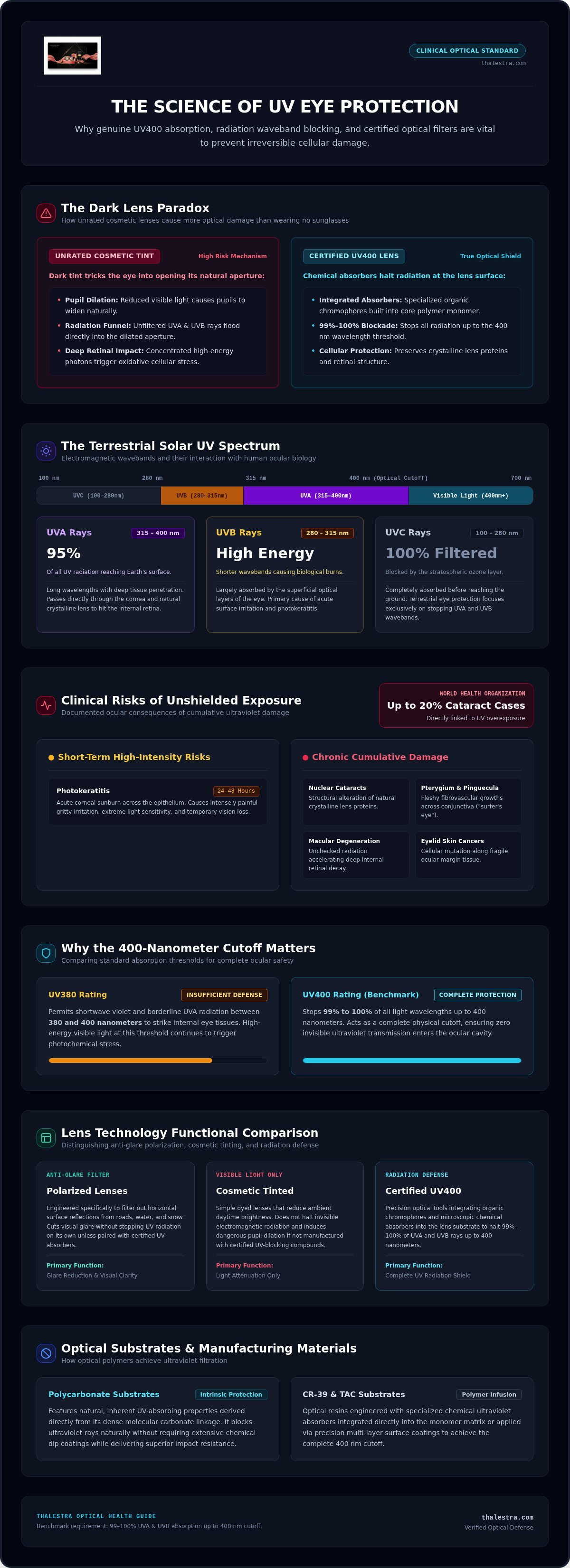
A pitch-black lens can cause more optical damage to your eyes than wearing no shades at all. It's easy to assume that deep cosmetic tints automatically guarantee complete safety under harsh sunlight. In reality, unrated dark lenses dilate your pupils, funneling hazardous, unfiltered radiation directly into your retinas. Choosing verified UV protection sunglasses isn't merely about cutting down daytime squinting; it's about preventing permanent cellular ocular damage across everyday driving, travel, and outdoor activity.
You'll discover how genuine UV400 ratings absorb light wavelengths up to 400 nanometers, how to distinguish anti-glare polarization from true ultraviolet shielding, and how to identify certified optical defense. Overexposure to UV radiation is linked to as much as 20% of cataract cases worldwide, according to the World Health Organization. We break down the biological risks of UVA and UVB exposure, examine modern safety benchmarks, and give you the exact criteria to select durable, fully protective eyewear with total confidence.
Key Takeaways
- Understand why genuine UV400 ratings serve as the optical benchmark, blocking 99 to 100 percent of UVA and UVB radiation up to 400 nanometers.
- Learn how certified UV protection sunglasses differ functionally from dark cosmetic tints and polarized filters that cut surface glare without stopping radiation.
- Identify verified optical safety markings, regulatory compliance stamps, and frame curvature specs to eliminate peripheral light leaks.
- Match dynamic photochromic elements and precision lens tints to your daily performance demands across driving, travel, and outdoor utility.
What Are UV Protection Sunglasses and Why Is Radiation Defense Essential?
True UV protection sunglasses are precision optical tools engineered to shield sensitive ocular tissue from non-visible solar radiation. Rather than merely darkening incoming light, authentic protective lenses integrate specialized organic chromophores and microscopic chemical absorbers directly into the lens monomer or through multi-layer surface coatings. These specialized compounds selectively absorb harmful invisible energy before it strikes the eye. Looking back across the broader history of UV protection in sunglasses, development has shifted from simple tinted glass used to cut harsh glare to advanced polymers engineered specifically to halt electromagnetic wavelengths at an uncompromising 400-nanometer absorption cutoff.
When unshielded light enters the visual cortex, high-energy photons trigger oxidative stress inside live cells. The resulting release of free radicals causes cumulative, irreversible damage across the delicate corneal surface and internal lens proteins.
The Spectrum of Solar Radiation: UVA vs. UVB Rays
Terrestrial sunlight contains distinct electromagnetic wavebands that interact differently with ocular biology:
- UVA (315 to 400 nm): Forms 95% of the ultraviolet radiation reaching the Earth's surface. With long wavelengths and deep tissue penetration, UVA passes directly through the cornea and natural crystalline lens to hit the internal retina.
- UVB (280 to 315 nm): Shorter, higher-energy wavelengths that are largely absorbed by the superficial layers of the eye, causing acute biological burns.
- UVC (100 to 280 nm): Completely filtered by the stratospheric ozone layer, making terrestrial protection focus entirely on UVA and UVB.
Short-Term and Long-Term Ocular Risks of Unshielded Exposure
Short-term high-intensity exposure triggers photokeratitis, an intensely painful condition comparable to a sunburn across the transparent corneal epithelium. Symptoms include severe light sensitivity, gritty corneal irritation, and temporary vision loss lasting 24 to 48 hours.
Chronic cumulative exposure carries far heavier long-term risks. Solar photons alter structural proteins inside the crystalline lens, accelerating nuclear cataract formation. In fact, research published by the World Health Organization attributes up to 20% of global cataract cases directly to UV overexposure. Constant environmental irritation also causes pterygium (surfer's eye) and pinguecula, which are fleshy fibrovascular growths extending across the conjunctiva onto the cornea. Beyond external growths, unchecked radiation accelerates macular degeneration and fuels skin cancers along the fragile eyelid margins. Understanding the hidden dangers of non-UV protected sunglasses ensures you avoid dark cosmetic filters that compromise natural optical defense.
How UV400 Ratings Work to Shield Your Eyes
A UV400 rating indicates that an optical lens stops 99 to 100 percent of all light wavelengths up to 400 nanometers. This technical threshold guarantees complete absorption across both the UVA and UVB radiation bands. Medical guidelines and expert recommendations for sunglasses establish UV400 as the baseline requirement for preventing chronic photothermal and photochemical ocular damage. Rather than relying on simple cosmetic surface dips, legitimate UV protection sunglasses utilize chemical dyes and ultraviolet-absorbing compounds integrated straight into the core optical polymer.
Without this chemical barrier, clear or lightly tinted plastic permits high-energy waves to flood past the pupil unobstructed.
Understanding the 400-Nanometer Optical Cutoff
Human visible light begins at roughly 400 nanometers along the electromagnetic spectrum. Any rating lower than this figure, such as UV380, permits shortwave violet and borderline UVA radiation between 380 and 400 nanometers to strike internal eye tissues. High-energy visible light at this threshold generates significant cellular stress. A certified 400-nanometer cutoff acts as a complete physical barrier, ensuring zero invisible ultraviolet transmission enters the ocular cavity.
Lens Material Matters: Polycarbonate, CR-39, and TAC
The manufacturing substrate directly determines how an optical lens achieves full ultraviolet filtration:
- Polycarbonate: Features intrinsic UV absorption properties due to its dense molecular carbonate linkage, blocking rays naturally without extensive chemical dip treatments while offering high impact resistance.
- CR-39 (Columbia Resin #39): A lightweight optical plastic that transmits untreated UV light in its raw state; it requires heated chemical dye baths during manufacturing to absorb wavelengths up to 400 nanometers.
- Triacetate Cellulose (TAC): A multi-layer laminated optical structure widely utilized in polarized lenses, embedding dedicated UV-absorbing film layers directly alongside polarizing filters.
To ensure total visual defense during travel, driving, or everyday outdoor transit, review the verified optical specifications across the curated collection at thalestra.com.
Comparing Lens Technologies: Polarized vs. Tinted vs. UV Blocking
Optical manufacturers deploy diverse treatments across consumer eyewear, yet these technologies solve entirely different vision problems. Tint darkness governs visible light transmission (VLT), dictating how much ambient illumination reaches your retinas. In contrast, genuine UV protection sunglasses depend on dedicated chemical filters that intercept high-energy invisible photons regardless of lens shade. Confusing glare control with ultraviolet defense remains a common optical mistake.
| Technology | Primary Function | Blocks Glare? | Blocks UV Radiation? |
|---|---|---|---|
| Standard Tint | Dims overall visible brightness | No | Only if UV400 dyes are infused |
| Polarized Filter | Neutralizes horizontal light reflections | Yes | Only when paired with UV400 layers |
| Photochromic | Adapts tint density to ambient ultraviolet | Optional | Inherent 100% UV400 baseline |
| UV400 Treatment | Absorbs UVA/UVB up to 400 nanometers | No | Yes (100% absorption) |
The Peril of Dark Tinted Lenses Without UV Filters
Wearing cheap, dark-tinted shades lacking UV absorption presents severe optical hazards. Dim ambient light behind dark lenses tricks the brain into triggering pupillary dilation. With pupils expanded wide behind unrated dark glass, ambient ultraviolet radiation streams straight through to the internal crystalline lens and retinal tissue. In practice, a crystal-clear lens carrying verified UV400 filtration protects your ocular health far more effectively than an untreated dark grey cosmetic lens.
How Polarization Enhances Visual Comfort and Contrast
Polarized lenses feature a microscopic chemical film stretched horizontally across the substrate to block blinding horizontal reflections. Sunlight scattering off flat asphalt, wet pavement, or open water creates intense optical glare that washes out detail and strains ocular muscles. Anglers gain sharp underwater visibility and strike detection using dedicated polarized fishing sunglasses along open shorelines. While polarization eliminates painful surface glare and relieves muscle strain, it functions independently of UV shielding and must be layered alongside UV400 filters.
Photochromic Adaptive Lenses for Dynamic Sunlight Conditions
Dynamic environments require adaptable optical solutions. Photochromic technology embeds microscopic silver halide or naphthopyran molecules within the lens matrix that alter their physical structure when exposed to outdoor ultraviolet radiation. When direct solar rays strike, the lenses darken smoothly within seconds; moving indoors or entering shaded cover triggers an inverse reaction back toward clarity. Active riders rely heavily on responsive photochromic cycling sunglasses to maintain uninterrupted road contrast through shifting forest canopies and open highways.
How to Choose and Verify Authentic UV Protection Sunglasses
Confirming authentic optical safety requires moving past superficial aesthetics to audit technical specifications, regulatory markings, and structural coverage. Reputable UV protection sunglasses carry permanent markings stamped directly onto the inner temple arm rather than relying solely on removable adhesive stickers. Beyond visual stamps, the most conclusive method to verify optical safety involves having an independent optical professional test your lenses using an optical photometer or UV spectrometer, which measures exact electromagnetic transmission up to 400 nanometers within seconds. Preserving these optical barriers also demands proper lens hygiene; review how to clean polarized sunglasses to prevent abrasive scratches or chemical degradation from stripping away delicate multi-layer coatings.
Verifying Regulatory Standards and Certification Labels
Legitimate manufacturers build eyewear to satisfy rigid geographical safety baselines:
- European Standard (CE / EN ISO 12312-1): Confirms compliance with European personal protective equipment directives. Shipments to EU markets enforce EN ISO 12312-1:2022+A11:2024 standards covering optical transmittance, refractive properties, and strict limits on nickel release under EN 14138:2026.
- American Standard (ANSI Z80.3): Reaffirmed in 2023, this benchmark mandates nonprescription eyewear to block at least 99% of UVB and 95% of UVA while meeting strict impact resistance thresholds enforced by the FDA.
- Australian Standard (AS/NZS 1067): Enforces some of the planet's strictest UV absorption metrics due to intense southern hemisphere solar radiation.
Disregard generic stickers marked "UV absorbing" that lack specific standard designations or clear manufacturer traceability.
Frame Architecture and Peripheral Sunlight Leakage
Even premium optical glass fails if frame architecture allows ambient sunlight to enter unobstructed around the lens margins. Scattered, oblique radiation leaking through the top, sides, and bottom of narrow frames accounts for up to 20% of total ocular radiation exposure. This phenomenon, known as the peripheral light focusing effect, concentrates reflected rays directly onto the nasal cornea.
High-wrap sporty contours, thick side temples, and oversized designs drastically curb this scattered exposure. You can effectively balance comprehensive coverage with classic fashion profiles by choosing oversized men’s aviator sunglasses engineered with expansive teardrop lenses that physically shield the entire orbital socket from peripheral bounce.
Upgrade your everyday visual defense by exploring the verified optical catalog at thalestra.com today.
Selecting the Best UV Eyewear for Your Lifestyle and Daily Use
Tailoring your eyewear to specific activities ensures optimal visual acuity alongside complete optical safety. Daily commuting, endurance athletics, and open-air travel impose very different physical demands on frames and lenses. Drivers, for instance, need high-contrast lenses that eliminate blinding highway reflections without distorting digital dashboard instruments or heads-up LCD screens. Meanwhile, outdoor athletes require shatterproof materials, secure non-slip facial contact, and wind protection. Selecting the right UV protection sunglasses means aligning specific optical treatments with your personal performance needs. You don't have to sacrifice style for safety, either; you can easily match certified radiation defense with timeless aesthetics by choosing bold vintage designer sunglasses that pair iconic silhouettes with full-spectrum filtration.
Choosing Lens Tints for Varied Light Conditions
Different lens colors alter contrast, depth perception, and visible light transmission:
- Neutral Grey: Lowers overall brightness while preserving true color fidelity across bright, open environments. Ideal for everyday driving and intense midday sun.
- Brown and Amber: Absorbs high-energy blue wavelengths to heighten depth perception and edge contrast. Excellent for driving, trail sports, and mixed sun-and-shade terrain.
- Yellow and Rose: Optimizes target definition in flat, diffused lighting. Best suited for overcast mornings, heavy fog, and dawn or dusk commutes.
Performance Frames: Durability, Grip, and Ergonomics
Even the sharpest optics fail if the frames constantly slide down your nose bridge during movement. High-grade polymer frames engineered from lightweight TR90 nylon or impact-resistant polycarbonate provide all-day comfort without tension headaches. Hydrophilic rubber nose pads and flexible temple tips increase their grip as perspiration rises, keeping the frame anchored during intense activity.
Frame materials must also handle harsh outdoor environments. Corrosion-resistant metal alloys, stainless steel barrel hinges, and UV-stabilized resins prevent premature warping and pitting caused by skin acids, ocean salt spray, and extreme summer temperatures. To secure reliable visual protection across driving, outdoor work, or weekend getaways, explore certified UV400 designs and shop the Thalestra sunglasses collection today.
Upgrade to Certified Optical Defense for Every Journey
Long-term ocular wellness begins with verified optical physics, not cosmetic lens tinting. Remember that genuine UV400 absorption stops 99 to 100 percent of harmful UVA and UVB radiation, keeping cellular damage and chronic eye conditions at bay. Polarized filters handle blinding surface glare, but they can't replace the continuous biochemical barrier provided by dedicated ultraviolet-absorbing compounds. Pairing expansive frame architecture with certified lens filters ensures complete protection from both direct overhead rays and peripheral light bounce.
Securing durable, precision eyewear shouldn't be complicated. Take charge of your optical safety with certified UV400 full-spectrum radiation blocking, advanced photochromic and polarized lens options, and dependable global direct-to-consumer delivery. Step out into the brightest sunlight knowing your vision remains sharp, comfortable, and completely shielded against every environmental demand. Explore high-performance UV400 sunglasses at Thalestra to outfit your daily rotation with modern, certified UV protection sunglasses today.
Frequently Asked Questions
Do all dark sunglasses offer full UV protection?
No, lens tint darkness has zero correlation with ultraviolet protection. Lens color only controls visible light transmission, dictating how dark your surroundings appear. In fact, wearing dark lenses lacking UV-absorbing chemicals forces your pupils to dilate wider, funneling higher concentrations of unfiltered radiation straight into internal retinal tissues. Always confirm authentic UV400 labeling rather than relying on deep cosmetic tints.
What is the practical difference between UV400 and polarized lenses?
UV400 lenses shield eye tissue from cellular radiation damage, while polarized lenses filter out blinding horizontal surface glare. A UV400 rating provides essential biological defense by blocking 99 to 100 percent of UVA and UVB wavelengths up to 400 nanometers. Polarization utilizes a chemical film to neutralize reflections bouncing off water, snow, and asphalt. High-performance UV protection sunglasses combine both features for total clarity and safety.
Can clear or lightly tinted lenses effectively block ultraviolet rays?
Yes, completely clear or lightly tinted lenses can deliver 100% ultraviolet protection. Because ultraviolet radiation exists outside the human visible spectrum, an optical barrier doesn't need to be dark to be effective. Optical substrates like polycarbonate naturally absorb UV light, while other plastics are infused with transparent chemical absorbers during manufacturing. This allows full radiation defense without darkening your visual field in overcast or indoor environments.
Do UV-blocking coatings wear off or degrade over time?
UV-blocking capabilities don't fade simply from absorbing ambient sunlight, but external surface treatments can degrade from physical wear. When UV chromophores are melted directly into the lens polymer, radiation defense lasts the lifetime of the sunglasses. However, applied topical coatings can slowly wear away if cleaned with household chemicals or wiped with abrasive clothing. Storing eyewear in protective cases preserves these microscopic layers.
Are expensive designer sunglasses safer for eyes than affordable pairs?
Higher price tags do not necessarily provide superior optical safety. Luxury prices usually reflect designer licensing, fashion branding, and specialized frame aesthetics rather than superior ultraviolet absorption. An accessible pair of UV protection sunglasses certified for UV400 compliance delivers the exact same cellular radiation defense as four-figure luxury eyewear. Baseline optical safety depends entirely on verified filtration standards, not retail cost.
Why do eyes get sunburned, and how do sunglasses prevent it?
Eyes become sunburned when high-energy UVB radiation penetrates and damages the cellular structure of the clear cornea. This condition, called photokeratitis, develops after intense exposure to direct sun or environmental reflections from water and snow, causing sharp eye pain and temporary vision loss. Certified sunglasses physically intercept these shortwave rays before they contact the ocular surface, completely preventing acute photochemical burns.