
Dark lenses without verified UV protection do far more damage to your eyes than wearing no sunglasses at all. When deep tint tricks your pupils into dilating, unfiltered radiation floods straight into your retina. Knowing how to tell if sunglasses are uv400 is the only reliable way to separate genuine optical defense from cheap cosmetic plastic.
It's natural to feel skeptical when ordering eyewear online. Flimsy peel-off stickers, vague catalog claims, and constant confusion between polarized anti-glare filters and true ultraviolet blocking make it hard to trust what you're buying. You need absolute certainty that your daily frames block harmful wavelengths up to 400 nanometers before trusting them under bright sunlight.
This verification guide reveals how to accurately test and verify genuine UV400 sunglasses protection to safeguard your vision. We break down simple at-home checks, professional photometer testing, and official optical markings like ISO 12312-1:2022 so you can select tested, high-performance eyewear with complete confidence.
Key Takeaways
- True UV400 certification guarantees 99% to 100% absorption of all light rays up to 400 nanometers, defending against both dangerous UVA and UVB radiation.
- Polarized glare filtration does not equal UV defense; lenses can eliminate blinding surface reflections while offering zero cellular eye protection.
- Learn reliable protocols on how to tell if sunglasses are uv400 using domestic UV light checks, certified packaging audits, and professional optician photometer scans.
- Decode frame arm markings with precision by recognizing authentic optical benchmarks such as ISO 12312-1:2022, ANSI Z80.3 standards, and mandatory CE category stamps.
- Upgrade your visual defense with performance frame architectures and multi-functional optical options, including dynamic photochromic lenses built for shifting outdoor conditions.
What Does UV400 Protection Mean for Your Eyes?
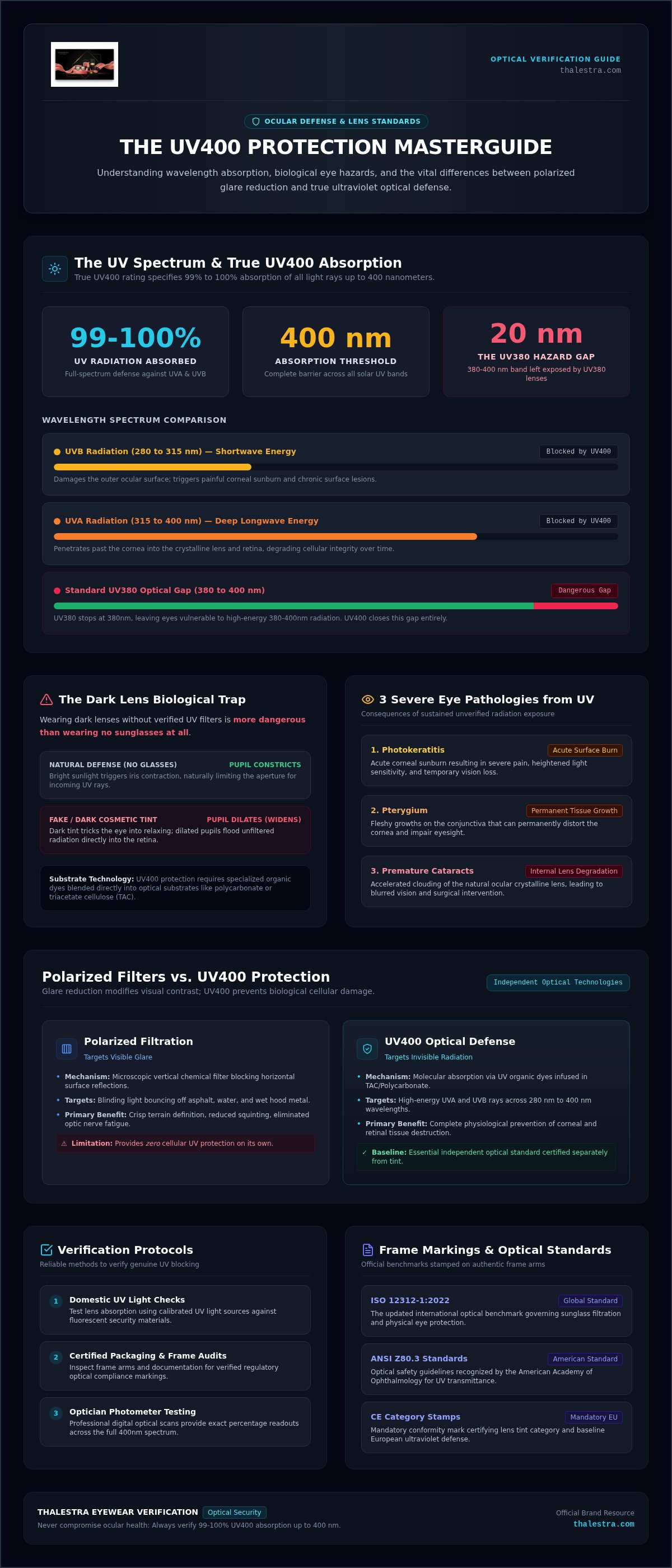
A true UV400 rating specifies that an optical lens absorbs 99 to 100 percent of all ultraviolet light rays with wavelengths up to 400 nanometers, completely blocking both UVA and UVB radiation. While sunglasses have been a popular fashion accessory across global trends, their fundamental purpose remains ocular defense. Cosmetic tinting softens ambient glare, but knowing how to tell if sunglasses are uv400 ensures your lenses provide verified physiological protection against irreversible solar damage.
UVA vs UVB: The Invisible Spectrum Explained
Solar radiation reaches the eyes across distinct ultraviolet bands that inflict different types of tissue damage:
- UVB radiation (280 to 315 nm): High-energy shortwave rays that damage the outer ocular surface, triggering painful corneal sunburn and chronic surface lesions.
- UVA radiation (315 to 400 nm): Longwave radiation that penetrates deep past the cornea, reaching the crystalline lens and the retina to degrade cellular integrity over time.
Standard UV380 protection filters light only up to 380 nanometers. This technical threshold leaves eyes exposed to high-energy radiation between 380 and 400 nanometers. True UV400 lenses eliminate this optical gap by absorbing the entire ultraviolet band before it touches your pupils.
Why Dark Lenses Without UV400 Increase Eye Damage
Dark lenses that lack ultraviolet filters create a dangerous biological hazard. When dark tint cuts visible brightness, your irises instinctively relax and your pupils dilate. This widening opens the pupil aperture wider than normal, allowing unfiltered ultraviolet radiation to flood directly into your vulnerable internal eye tissues.
Wearing cheap, dark-tinted plastic without certified UV blockers turns your lenses into an ocular trap. Understanding the dangers of non-uv protected sunglasses helps you avoid three severe chronic eye conditions caused by sustained UV radiation:
- Photokeratitis: Acute corneal burns resulting in severe pain, light sensitivity, and temporary vision loss.
- Pterygium: Fleshy, permanent tissue growths on the conjunctiva that can distort the cornea and impair eyesight.
- Premature Cataracts: Accelerated clouding of the natural eye lens, leading to blurred vision and surgical intervention.
Learning how to tell if sunglasses are uv400 keeps you from mistaking visual shade for genuine optical security.
Polarized vs UV400: Decoding Eyewear Technology Differences
Polarization targets visible glare; UV400 targets invisible cellular radiation. One modifies optical contrast, while the other prevents biological tissue destruction. Confusing the two leaves your vision exposed. A sunglass lens can feature exceptional polarization while carrying zero ultraviolet protection. Following clear American Academy of Ophthalmology recommendations, UV400 absorption is an independent optical baseline that must be verified separately from any anti-glare capability. Understanding how to tell if sunglasses are uv400 begins with dissecting these two completely different optical technologies.
How Polarized Filters Eliminate Surface Glare
Direct sunlight scatters in all directions. When it strikes horizontal surfaces like asphalt, water, or wet hood metal, the waves reflect horizontally. This creates harsh, blinding surface glare. Polarized lenses solve this by integrating a microscopic chemical filter oriented vertically. This chemical grid blocks horizontal reflections while allowing vertical light rays to pass cleanly through.
The result is immediate visual comfort:
- Crisp terrain definition during highway driving and marine activities.
- Eliminated squinting and reduced optic nerve fatigue over long exposure hours.
- Enhanced color saturation across high-contrast environments.
Glare reduction drastically sharpens your sight picture, but it doesn't block high-energy radiation. Glare reduction without UV blocking gives you false security under direct sun.
The Science of Lens UV Absorption Layers
Ultraviolet blocking relies on molecular absorption rather than directional light filtering. Manufacturers blend specialized UV400 organic dyes directly into molten optical substrates like polycarbonate or triacetate cellulose (TAC). Clear optical lenses with these chemical compounds absorb 100 percent of UVA and UVB rays up to 400 nanometers without needing any visible dark tint at all.
High-performance protective eyewear fuses these technologies into a multi-layer composite build:
- Outer hard coat: High-density anti-scratch protection.
- Polarizing core: Stretched polyvinyl alcohol (PVA) film blocking horizontal glare.
- UV-absorbing substrate: Resin core infused with 400nm radiation blockers.
- Hydrophobic topcoats: Oleophobic outer layers repelling dirt and water spots.
Because harsh chemical cleaners can degrade these bonded lens layers over time, review how to clean polarized sunglasses to preserve optical integrity. If you want guaranteed factory integration of both technologies, explore verified polarized eyewear at Thalestra for multi-layer lens builds that combine active glare reduction with complete UV400 optical defense.
How to Test if Sunglasses Are UV400 at Home and in Stores
Verifying optical defense requires a structured testing approach. You don't have to rely on blind faith or cheap stickers; you can confirm optical safety through a simple sequential protocol. From basic surface audits to lab-grade wavelength scans, learning practical methods for how to tell if sunglasses are uv400 gives you absolute certainty before stepping into intense sunlight.
The UV Flashlight and Fluorescent Card Test
This rapid screening method requires an inexpensive 365nm to 395nm ultraviolet LED flashlight and a fluorescent surface, such as an optical test card, credit card hologram, or state ID.
- Activate the target: Direct the UV beam onto the card to confirm that the security markings or fluorescent coating glow brightly.
- Intercept the beam: Place the sunglass lens directly between the flashlight and the fluorescent target.
- Observe the result: A genuine UV400 lens absorbs the beam entirely, causing the fluorescent glow on the card to disappear instantly. If the target continues to glow through the lens, ultraviolet rays are leaking through.
The Currency Banknote Verification Method
Modern paper currency features embedded ultraviolet security threads and fluorescent micro-fibers invisible under normal room light. These markers react immediately to blacklight exposure, making paper money an accessible diagnostic tool at home.
Shine your UV light onto the bill to illuminate the bright security thread. Next, position your sunglass lens between the light source and the paper. If the glowing fibers vanish and appear dark, your lens successfully blocks the emitted ultraviolet wavelength. Keep in mind that while this test confirms significant UV absorption, consumer flashlights cannot pinpoint the exact 380nm to 400nm cutoff margin.
Professional Photometer and Spectrophotometer Testing
Digital bench equipment provides indisputable optical proof. Most retail optometry counters and optical labs maintain tabletop spectrophotometers or digital lens meters that analyze lenses in under 30 seconds.
The technician places your frame onto the sensor arm, and the unit transmits a calibrated light spectrum through the substrate. The digital display charts exact visible light transmission alongside your precise UV absorption percentage up to 400 nanometers. This rapid, non-destructive test is the definitive benchmark for verifying unbranded marketplace finds, vintage eyewear, or unverified imports.
Reading Frame Markings, Labels, and Regulatory Standards
Peel-off stickers are easily faked, but permanent factory markings along the inner frame provide an authentic audit trail. Legitimate manufacturers laser-etch or stamp compliance codes directly onto the inside temples. Knowing how to tell if sunglasses are uv400 requires cross-referencing these physical engravings against established international optical benchmarks.
Essential Regulatory Marks to Look For
Examine the inner temple arms under direct light to identify key manufacturing and safety designations:
- CE Mark: Confirms conformity with European Union personal protective equipment standard EN ISO 12312-1. On authentic marks, the "C" and "E" are shaped by two overlapping circles with distinct spacing; counterfeit "China Export" symbols place the letters almost touching.
- UKCA Mark: Verifies adherence to United Kingdom post-Brexit optical safety standards.
- Standard References: Inscriptions citing ANSI Z80.3 (United States) or AS/NZS 1067.1 (Australia).
- Specification Codes: Permanent stamps reading "UV400", "Cat.3", lens dimensions, or model batch numbers.
Lens Filter Categories vs UV Protection
International standard ISO 12312-1:2022 classifies sunglasses into five filter categories (0 through 4). These categories measure Visible Light Transmission (VLT), which is the physical darkness of the tint. They do not measure ultraviolet filtration:
- Category 0 to 1 (43% to 100% VLT): Clear to light fashion tints intended for overcast conditions or indoor styling.
- Category 2 (18% to 43% VLT): Medium-density tint engineered for partial sun and variable urban environments.
- Category 3 (8% to 18% VLT): Standard dark tint delivering optimal glare absorption for open water, beach use, and daytime driving.
- Category 4 (3% to 8% VLT): Extremely dark specialty filters built exclusively for high-altitude mountaineering and desert expeditions. These lenses are hazardous and illegal for operating motor vehicles.
A Category 1 lens with an infused UV400 compound blocks 100 percent of UV rays, while an unrated Category 4 dark lens can expose dilated eyes to severe damage. Prioritize frames that combine Category 3 glare filtration with an explicit UV400 stamp. Browse verified protective eyewear collections at Thalestra to secure precision-marked frames manufactured to strict global optical benchmarks.
Choosing Verified UV400 Sunglasses: Features and Lens Tech
Confirming optical ratings is step one; choosing the right frame architecture ensures those ratings actually shield your vision in real-world environments. You now understand how to tell if sunglasses are uv400 through lab scans and physical stamps. Matching those verified filters with smart optical configurations and broad physical coverage stops ambient light from bypassing your defenses altogether.
Frame Coverage: Stopping Peripheral UV Infiltration
Lenses can absorb 100 percent of direct rays while still leaving your eyes vulnerable around the frame perimeter. Research reveals that up to 20 percent of ocular ultraviolet exposure originates from top and side scattering. Sun reflects upward off pavement, sand, and water straight behind flat lenses.
Engineered frame profiles eliminate this vulnerability:
- Curved wrap designs: Hug facial contours closely to form a continuous physical barrier against lateral reflections.
- Sculptural acetate frames: Thick temples block side light infiltration across bright urban environments.
- Broad coverage profiles: Extended teardrop teardown structures, such as men's aviator sunglasses, shield vulnerable lower orbital tissue against upward ground bounce.
Adaptive Photochromic and Polarized Innovations
Dynamic environments demand responsive lens tech. Photochromic lenses integrate optical dye compounds that react chemically to ambient ultraviolet radiation. Indoors, the lenses stay transparent or lightly tinted. Step outside under solar light, and the molecular structure shifts rapidly, darkening the substrate within seconds to match variable light conditions.
Pairing photochromic adaptation with true UV400 resin ensures constant 100 percent ultraviolet blocking across both clear and tinted states. Multi-layer triacetate cellulose (TAC) or polycarbonate cores fuse these dynamic photochromic dyes alongside polarized glare cores. This unified stack delivers impact durability, zero optical distortion, and absolute UV defense in a single lightweight lens build.
The Smart Buyer Checklist for Online Eyewear Shopping
Evaluating digital specs before buying eliminates counterfeit guesswork. Keep this practical checklist handy before adding frames to your cart:
- Check technical specs: Demand explicit confirmation of 99% to 100% absorption up to 400nm, not just vague "UV protection" claims.
- Verify lens substrate: Confirm optical-grade TAC, polycarbonate, or specialized resins embedded with UV blockers.
- Demand structural transparency: Look for published regulatory compliance listings citing ISO 12312-1 standards.
Shop with total confidence by exploring classic polarized sunglasses from Thalestra or check out our full lineup of tested frames. Explore verified UV400 polarized sunglasses at Thalestra to guarantee precision-engineered eye health and modern performance styling.
Secure Complete Optical Defense for Every Environment
Dark tint alone provides zero biological defense against invisible solar radiation. Genuine ocular safety demands verified wavelength absorption that stops UVA and UVB rays before dilated pupils absorb long-term tissue damage. Mastering how to tell if sunglasses are uv400 through frame stamps, currency checks, and optical scans ensures you never compromise on clear visual health.
Quality eyewear must back aesthetic design with certified performance specs. Thalestra pairs precision optical testing across advanced polarized and photochromic frames, securing complete 100% UVA and UVB protection up to 400 nanometers on every pair. Get rapid direct-to-consumer delivery with transparent optical specifications built for driving, sport, and daily wear.
Equip your eyes with authentic optical safety. Shop Verified UV400 Polarized Sunglasses at Thalestra and step outside with absolute confidence.
Frequently Asked Questions
Can you tell if sunglasses are UV400 just by looking at them?
No, you cannot verify protection with the naked eye. Ultraviolet radiation is completely invisible, and UV-absorbing chemical compounds blended into lens resins are entirely transparent. Visual inspection of lens darkness, tint hue, or mirror coatings won't confirm safety. Reliable methods for how to tell if sunglasses are uv400 require auditing certified temple markings, executing a targeted UV blacklight card test, or testing them on a calibrated digital photometer.
Does a darker lens tint mean better UV protection?
No, lens tint darkness only affects Visible Light Transmission (VLT), not ultraviolet absorption. A pitch-black cosmetic lens without certified chemical blockers actually harms your eyes because it triggers pupil dilation, allowing unfiltered radiation to reach internal retinal layers. Conversely, a pale amber or lightly tinted Category 1 lens with infused UV400 compounds blocks 100 percent of harmful UVA and UVB radiation without issue.
Can an optician test my sunglasses for UV protection?
Yes, professional optical clinics and retail eyecare shops can verify your sunglasses in seconds. Most locations have digital lens meters or spectrophotometers that emit a controlled light beam through the lens substrate. The instrument immediately displays exact transmission numbers and confirms whether your lenses absorb radiation up to 400 nanometers. Technicians can typically run this non-destructive diagnostic check over the counter without altering your frames.
Do polarized sunglasses automatically provide UV400 protection?
No, polarized filters and ultraviolet blockers are two distinct lens technologies. Polarizing films block horizontal glare reflected off flat surfaces like roads and water to enhance visual clarity. However, polarization does not absorb ultraviolet waves on its own. Sunglasses can easily be polarized without offering any UV protection. You must always confirm independent UV400 compliance regardless of whether the lenses feature anti-glare polarization filters.
Does UV protection on sunglasses wear off over time?
Factory UV protection infused directly into polycarbonate or TAC resin does not evaporate or degrade simply from sunlight exposure. However, deep scratches, harsh chemical solvents, or extreme heat exposure can damage protective surface coatings. If your lenses become severely scratched or pitted over several seasons of heavy wear, microscopic gaps can allow unfiltered rays through. Replacing compromised lenses ensures your eyes remain fully protected.
What is the difference between 100% UV protection and UV400?
There is effectively no difference; both terms signify the highest optical safety benchmark for consumer eyewear. The designation "UV400" means the optical lens completely blocks light wavelengths up to 400 nanometers. This wavelength threshold covers 100 percent of all harmful UVA and UVB radiation. When researching how to tell if sunglasses are uv400, either label indicates full compliance with strict global standards like ANSI Z80.3 and ISO 12312-1.
Can clear lenses have a UV400 rating?
Yes, clear lenses can provide full UV400 defense. Ultraviolet-absorbing chemicals are naturally transparent dyes blended directly into the lens polymer during manufacturing. Because UV radiation falls outside the visible spectrum, a lens does not require any visible tint to absorb 100 percent of UVA and UVB wavelengths. Clear computer glasses and transparent safety spectacles regularly incorporate full 400nm protection while transmitting ordinary visible light.