
The brightest indoor spotlight will never darken your adaptive glasses, yet a cloudy, sunless afternoon turns them deep charcoal. That is because adaptive lenses react to invisible ultraviolet radiation, not visible light brightness. If you've ever wondered why your lenses stay clear behind a treated car windshield, or felt confused telling photochromic tint changes apart from polarized glare filtration, the frustration is common. Having photochromic lens technology explained through practical optics cuts through marketing ambiguity, showing exactly how smart tinting functions across dynamic environments.
You'll discover the UV-triggered molecular chemical reactions that drive rapid darkening, clear up persistent optical myths, and learn how extreme heat or freezing cold alter kinetic performance. We break down the vital science governing variable dye layers, vehicle safety glass barriers, and polarized combinations so you can confidently select the right adaptive eyewear for driving, sports, and daily travel.
Key Takeaways
- Photochromic lens technology explained: learn how invisible ultraviolet photons trigger reversible molecular transformations in organic dyes to adjust tint density automatically.
- Separate polarization from photochromism to understand why dynamic light-filtering dyes and horizontal glare-blocking filters serve two distinct optical functions.
- Unpack vehicle windshield UV-blocking barriers and thermal bleaching dynamics to see why standard adaptive eyewear remains clear behind automotive glass and shifts kinetics in extreme heat.
- Evaluate impact-resistant optical polymers, UV400 filtration ratings, and dual-action hybrid designs to select ideal adaptive eyewear for driving, outdoor sports, and travel.
What Is Photochromic Lens Technology and How Does It Work?
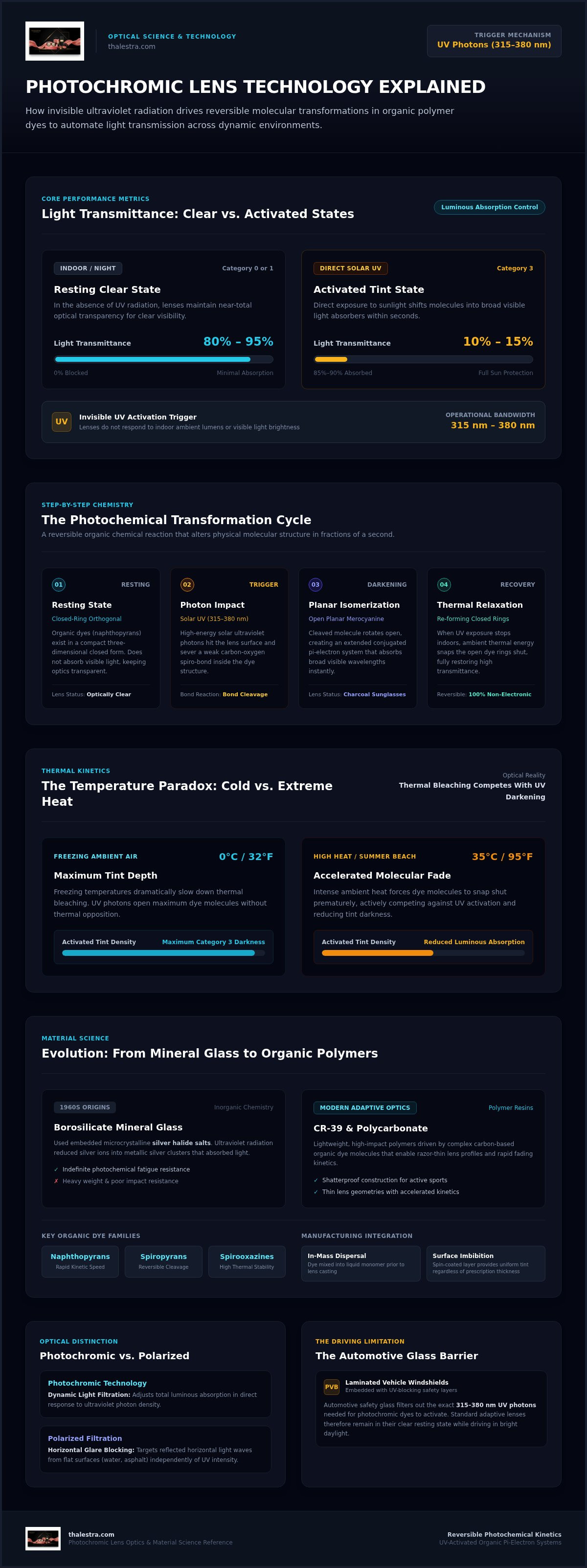
Photochromic lenses are optical surfaces engineered to darken reversibly upon exposure to ultraviolet radiation. Unlike traditional fixed-tint sunglasses that maintain an unvarying tint density regardless of weather, dynamic lenses actively shift luminous absorption. Having photochromic lens technology explained begins with a clear operational reality: the darkening reaction is driven by invisible UV photon absorption between 315 and 380 nanometers, not standard indoor ambient lighting or visible lumens. Step into direct sunlight, and transparent lenses transition into protective sun filters within seconds.
The Core Definition of Photochromic Eyewear
At its foundation, photochromic lens technology represents variable light filtration built directly into an optical substrate. These smart surfaces operate across standard optical categories:
- Clear State (Category 0 or 1): Transmits 80% to 95% of available light indoors or at night for high optical clarity.
- Activated State (Category 3): Restricts light down to 10% to 15% luminous transmittance under intense solar UV exposure, matching standard dark sunglass performance.
Manufacturers integrate this functionality through two primary engineering methods. Embedded in-mass technology disperses photochromic dye compounds directly throughout the base liquid monomer before casting. Alternatively, surface imbibition or spin-coating applies an ultra-thin layer of photoactive chemistry across the front lens surface, providing uniform tint activation regardless of prescription thickness variations.
Historical Evolution from Mineral Glass to Modern Polymers
Adaptive optics originated in the 1960s using heavy borosilicate mineral glass embedded with microcrystalline silver halide salts. When exposed to ultraviolet radiation, silver ions reduced into metallic silver clusters that absorbed visible light. While these glass lenses resisted photochemical fatigue indefinitely, their substantial weight and poor impact resistance limited widespread sports and fashion utility.
Optical manufacturing shifted toward lightweight organic polymer resins such as CR-39 and high-impact polycarbonate. Modern formulations rely on organic molecular families like naphthopyrans, spiropyrans, and spirooxazines. These complex carbon-based molecules allow shatterproof construction, razor-thin lens geometries, and accelerated kinetic fading speeds essential for everyday active eyewear.
The Science Inside the Lens: Chemical Reactions and Optical Dynamics
Getting photochromic lens technology explained at the molecular level reveals a continuous chemical tug-of-war. Adaptive optics do not use microchips or electrical currents. Instead, they harness reversible organic photochemistry embedded within polymer substrates. When ambient conditions shift, billions of carbon-based molecules alter their physical shape in fractions of a second to control light transmission.
Step-by-Step: The Photochemical Molecular Transformation
The transformation from transparent glass to protective sunglass follows a strict four-stage sequence:
- Resting State: Organic dye molecules like naphthopyrans exist in a closed-ring, orthogonal configuration. In this compact three-dimensional shape, they do not absorb visible light, keeping the lens optically clear.
- Photon Impact: High-energy solar ultraviolet photons (315 to 380 nm) hit the lens surface, severing a weak carbon-oxygen spiro-bond.
- Planar Isomerization: Bond cleavage forces the molecule to rotate into an open, planar merocyanine structure. This creates an extended conjugated pi-electron system that absorbs broad visible wavelengths, producing instant, visible darkening.
- Thermal Relaxation: When UV exposure ceases indoors, thermal energy forces the open bonds to re-form, snapping the dye rings shut and restoring clear transmittance.
Thermal Kinetics: Why Temperature Dictates Lens Darkness
Ambient temperature controls the speed and ultimate density of this reaction. Photochemical darkening is driven by UV light, but thermal bleaching happens simultaneously through ambient heat. Higher thermal energy accelerates molecular closure, competing directly against UV activation.
This dynamic creates a well-documented optical paradox: lenses get significantly darker in freezing winter air than on blistering summer beaches. At 0°C (32°F), thermal bleaching slows down, allowing UV photons to open maximum dye molecules for Category 3 darkness. At 35°C (95°F), extreme heat forces rapid fadeback, preventing the lenses from reaching full saturation. Clinical overviews like the American Academy of Ophthalmology's evaluation of photochromic lenses confirm that ambient temperature directly shapes real-world optical responsiveness.
Modern polymer matrices balance flexible nano-spaces with structural rigidity to stabilize kinetic speeds across shifting climates. For reliable outdoor protection across varied lighting, pair your adaptive lenses with robust UV400 filtration. Explore practical outdoor options through adaptive sunglasses collections engineered for shifting light conditions.
Photochromic vs Polarized Lenses: Key Optical Differences
Shoppers frequently conflate light-reactive lenses with anti-glare filters. While both improve visual comfort outdoors, they operate on completely distinct physical principles. Understanding photochromic lens technology explained side-by-side with polarization prevents buying the wrong eyewear for driving, water sports, or high-altitude activities.
| Feature | Photochromic Lenses | Polarized Lenses |
|---|---|---|
| Core Function | Dynamic variable tinting via UV absorption | Blocks horizontal reflective blind-glare |
| Indoor Usability | Fades to clear (Category 0 or 1) | Remains fixed dark tint; unsuitable indoors |
| Glare Reduction | Reduces overall brightness omnidirectionally | Eliminates reflected glare off water and asphalt |
| UV Filtration | 100% UVA/UVB absorption standard | Requires explicit UV400 coating layer |
Distinguishing Variable Light Transmission from Horizontal Glare Blocking
Polarized lenses incorporate a stretched polyvinyl alcohol film containing aligned microscopic iodine crystals. This structure acts like a microscopic Venetian blind, absorbing harsh horizontally polarized waves reflecting off flat wet highways, snowfields, and open water. Standard photochromic lenses absorb incoming light evenly in all directions. They effectively reduce excessive luminance, but they cannot eliminate intense blinding surface sheen on their own. Regardless of lens format, ensuring full UV400 shielding remains vital. Unfiltered dark lenses dilate pupils while admitting harmful solar radiation, compounding the dangers of non-uv protected sunglasses.
The Rise of Dual-Action Polarized Photochromic Eyewear
Optical engineers solved this tradeoff by stacking adaptive dyes directly onto polarizing filter matrices. Hybrid designs like the LIOUMO Top Quality Photochromic Polarized Sunglasses combine active molecular light adjustment with horizontal glare elimination. Rather than swapping frames when weather shifts, wearers gain variable Category 1-to-3 transmission paired with complete reflective surface cancellation.
This dual functionality shines in rapid-motion sports. Road cycling, open-water fishing, and alpine trail running demand instant shifts between bright clearings and deep shade. The American Academy of Ophthalmology notes that pairing proper optical filtration with glare defense substantially reduces eye fatigue. Athletes tracking variable terrain can consult specialized gear advice within photochromic sunglasses for cycling to match frame venting and lens responsiveness to their training demands.
Real-World Limitations: Driving, Response Speeds, and Lifespan
Every optical solution carries engineering trade-offs. While adaptive lenses eliminate the hassle of juggling multiple frames throughout an active day, practical environmental constraints still dictate their real-world utility. Looking at photochromic lens technology explained through everyday usage scenarios reveals why these smart coatings behave differently behind automotive glass, how fast they truly transition, and when chemical fatigue sets in.
The Vehicle Windshield Dilemma: Blocked UV Rays
The single most frequent complaint among new photochromic wearers is that their glasses refuse to darken while driving. The root cause is not defective lens chemistry; it is modern automotive glass engineering. Standard windshields are built from laminated safety glass featuring an internal polyvinyl butyral (PVB) interlayer. This structural laminate blocks between 96% and 99% of ambient UVA and UVB radiation to safeguard vehicle interiors and passengers.
Because traditional photochromic dyes depend strictly on ultraviolet photon absorption to break their molecular spiro-bonds, stepping inside a car effectively starves them of the energy needed to shift tints. Even under direct mid-afternoon glare, conventional adaptive eyewear stays predominantly clear behind the wheel.
Optical labs address this limitation using hybrid dye molecules calibrated to trigger at 400 to 430 nanometers, reacting to lower-spectrum visible violet light alongside UV. However, for continuous highway glare and reflective dashboard blinding, relying on dedicated fixed-tint driving eyewear remains the practical benchmark. Keep a set of Classic Mens Polarized Sunglasses inside your vehicle console for dependable, instant daytime glare management. Browse our driving polarized sunglasses collection for purpose-built road optics.
Activation Times, Fadeback Speed, and Longevity
Adaptive speed has accelerated dramatically across recent generations, yet transition intervals remain asymmetrical between darkening and clearing cycles:
- Darkening Activation: Lenses darken rapidly upon direct sunlight contact, reaching substantial Category 2 or 3 sun tint within 25 to 60 seconds.
- Fade-Back Recovery: Returning to indoor clarity takes considerably longer. As ambient thermal energy steadily drives molecular relaxation, the transition from dark sunglasses back to 70% or greater clear luminous transmittance typically takes between two and five minutes.
Beyond daily transition speeds, organic photochromic dyes possess a finite functional lifespan. Daily cycles of UV bond cleavage and thermal relaxation cause gradual photo-oxidation, known across the eyewear industry as photochemical fatigue. After 24 to 36 months (2 to 3 years) of standard daily wear, organic dye matrices show slower kinetic reaction speeds and retain a slight permanent baseline residual tint, indicating it is time for a replacement.
How to Choose the Right Photochromic Sunglasses for Your Lifestyle
Selecting adaptive eyewear requires aligning material durability, tint geometry, and optical coatings with your primary outdoor pursuits. Having photochromic lens technology explained across physical substrates allows you to bypass generic retail marketing and choose performance-tailored frames. Whether gearing up for endurance cycling, cross-country travel, or casual weekend recreation, balancing the right resin with proper UV defense guarantees visual comfort.
Matching Lens Substrates and Colors to Your Activities
Base material determines optical clarity and impact resistance. Compare standard formulations to match your daily activity level:
- Polycarbonate: The premier choice for athletics. Highly impact-resistant, shatterproof, and naturally thin, making it essential for cycling, trail running, and high-velocity ball sports.
- CR-39 Resin: Offers exceptional optical Abbe value for minimal chromatic aberration. Ideal for casual lifestyle wear, though it lacks the shatterproof impact rating of polycarbonate.
- Trivex: Combines sharp optical purity with high tensile strength and ultralight weight, suited for rimless designs and all-day endurance use.
Lens hue shapes contrast and depth perception. Neutral grey tints reduce brightness evenly, preserving natural color balance across driving corridors and open trails. Brown and amber tints filter scattered blue light, sharpening contrast and depth perception across golf courses, changing dirt trails, and variable cloud cover. Regardless of tint shade, verify certified UV400 ratings to ensure complete blocking of UVA and UVB wavelengths up to 400 nanometers.
Investing in Streamlined, High-Utility Adaptive Eyewear
Modern direct-to-consumer catalogs offer ready-to-wear adaptive sports and casual frames without lengthy prescription wait times. Dual-action models deliver maximum utility by stacking dynamic light response onto an anti-glare foundation. The LIOUMO Top Quality Photochromic Polarized Sunglasses provide this exact hybrid capability, combining rapid UV-activated tint transitions with vertical polarization for open water, wet highways, and alpine travel.
Maintaining the integrity of external optical coatings ensures consistent performance season after season. Salt spray, skin oils, and abrasive dust break down microscopic anti-reflective and hydrophobic surfaces if wiped dry. Keep optical surfaces pristine using professional maintenance steps outlined in how to clean polarized sunglasses.
Discover ready-to-ship performance optics matched to your lifestyle. Shop curated driving, leisure, and sports models directly through the Thalestra eyewear catalog for fast international shipping.
Upgrade Your Daily Vision with Next-Generation Adaptive Optics
Having photochromic lens technology explained clarifies the chemistry shaping dynamic everyday vision. You now understand how ultraviolet photons trigger reversible molecular transformations, why ambient temperature and car windshield laminates shift reaction speeds, and why pairing variable dyes with polarization gives you uncompromised optical defense against harsh glare.
Don't settle for static lenses when you can access precision UV400 and light-adaptive protection engineered for active lifestyles. Whether you want multi-purpose driving, sport, and travel frames or resilient dual-action hybrids, modern optical polymers ensure you stay prepared for every lighting shift. Experience rapid direct-to-consumer order fulfillment with convenient worldwide shipping. Explore adaptive photochromic and polarized sunglasses at Thalestra to secure clear, effortless vision wherever your route leads.
Frequently Asked Questions
Do photochromic lenses work behind a car windshield?
Standard photochromic lenses do not darken behind a car windshield. Automotive windshields use laminated safety glass with an internal polyvinyl butyral layer that blocks over 96% of ultraviolet radiation. Because traditional photochromic dyes require UV photon exposure to activate, the glass starves them of the energy needed to shift tints. For dependable daytime driving, keep a dedicated pair of fixed-tint polarized sunglasses in your vehicle.
Can photochromic lenses replace everyday polarized sunglasses?
Standard photochromic lenses cannot fully replace polarized sunglasses because they don't filter blinding horizontal surface glare. Basic adaptive optics reduce overall brightness omnidirectionally, leaving your eyes vulnerable to harsh reflections bouncing off water, wet pavement, or car hoods. To replace dedicated sunglasses, choose dual-action hybrid designs like LIOUMO Top Quality Photochromic Polarized Sunglasses, which unite light-reactive tinting with a dedicated glare-blocking filter.
How long do photochromic lenses take to turn clear indoors?
Most modern photochromic lenses take between two and five minutes to return to a clear state indoors. While darkening occurs rapidly within 25 to 60 seconds of sunlight exposure, fading back depends on ambient heat to close the open molecular dye bonds. Warmer indoor spaces accelerate this relaxation process, while air-conditioned or cold rooms slightly prolong the clearing time.
What happens to photochromic lenses in freezing winter temperatures?
Freezing winter temperatures cause photochromic lenses to turn noticeably darker and clear up much more slowly. Sub-zero air suppresses the thermal bleaching reaction that normally closes the dye molecules under heat. Because thermal relaxation stalls in cold weather, solar ultraviolet rays force the organic dyes into maximum saturation, often driving the lenses to deep Category 3 sunglass density on snowy afternoons.
Do photochromic glasses lose their ability to darken over time?
Yes, photochromic glasses gradually lose their reactive performance after two to three years of daily wear. Having photochromic lens technology explained highlights the reality of photochemical fatigue. Thousands of UV activation and thermal fadeback cycles slowly oxidize organic dye compounds like naphthopyrans. Over time, lenses exhibit slower kinetic speeds, reach lower tint density outdoors, and retain a faint baseline indoor tint.
Is UV400 protection included automatically in all photochromic lenses?
Quality photochromic lenses provide UV400 protection automatically because their optical polymers and photoactive chemical dyes absorb ultraviolet radiation up to 400 nanometers. Even when the lenses remain fully transparent indoors or on overcast mornings, the underlying optical matrix blocks 100% of UVA and UVB rays, preventing eye strain and long-term ocular damage without needing a visibly dark tint.
Can you get photochromic lenses without a prescription?
Yes, you can easily purchase non-prescription photochromic lenses in ready-to-wear outdoor and sports frames. Direct-to-consumer catalogs offer factory-assembled non-prescription designs, avoiding optical office visits or prescription lab fees. Ready-to-wear models like LIOUMO Top Quality Photochromic Polarized Sunglasses ship directly to your door, providing full UV400 defense and automatic tint adjustments straight out of the package.