
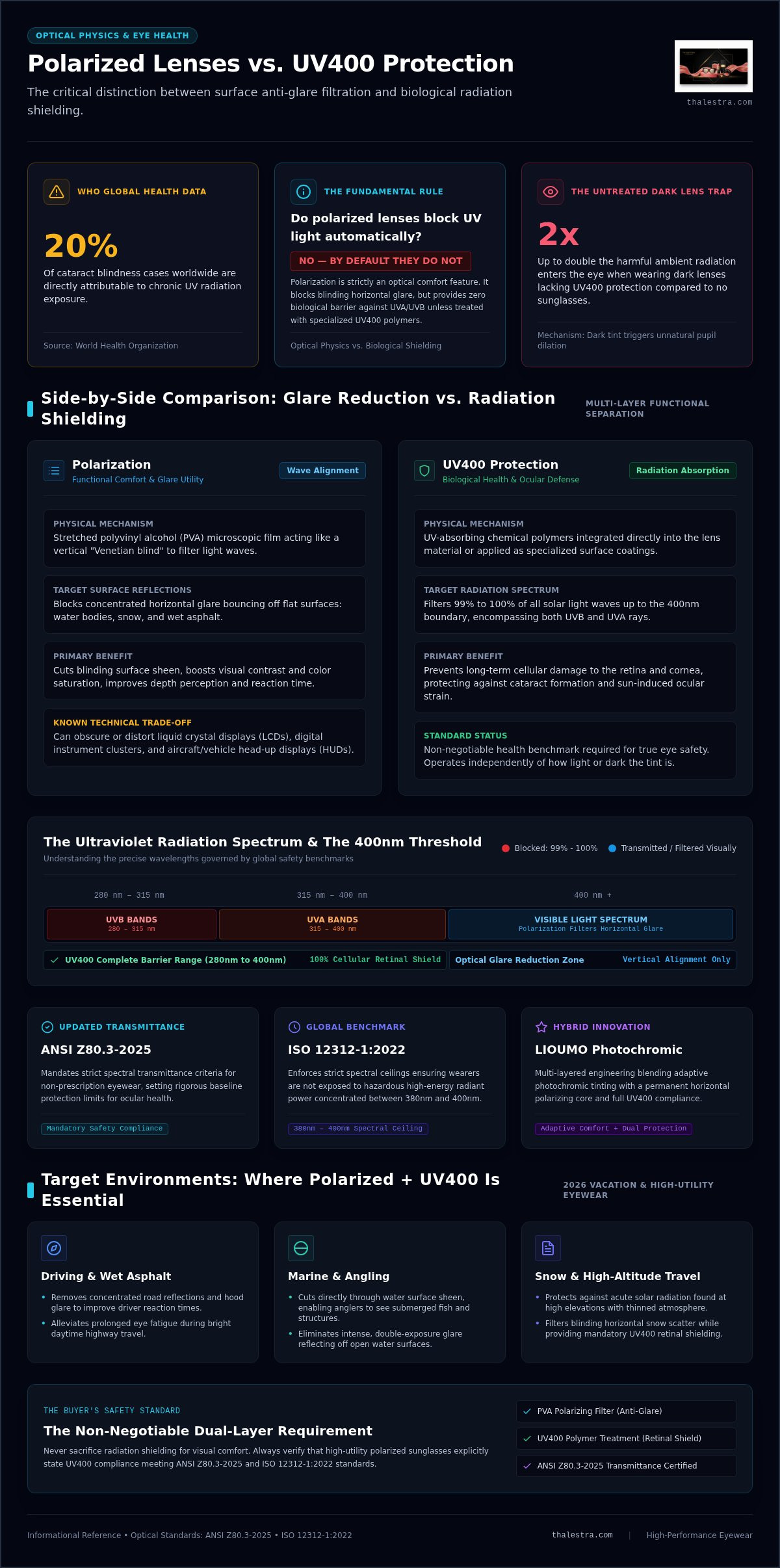
The World Health Organization estimates that 20% of cataract blindness cases worldwide are directly attributable to chronic UV exposure. Many travelers mistakenly believe that dark tints or polarized filters provide complete radiation shielding. So, do polarized lenses block uv light automatically? The short answer is no. Polarization is a functional comfort feature. It eliminates horizontal glare from water, snow, and wet asphalt. It doesn't provide a biological barrier against UVA or UVB rays unless the lens material is specifically treated with UV400 polymers.
You deserve clear, glare-free vision without the fear of permanent retinal damage or sun-induced headaches. We understand the confusion over technical lens labels and the need for reliable 2026 vacation eyewear. This article delivers the essential facts on the difference between anti-glare utility and radiation safety. We cover the new ANSI Z80.3-2025 standards, the critical 400nm filtration threshold, and high-performance hybrid options like the LIOUMO photochromic series. You'll finish with the confidence to select high-utility sunglasses that protect your eyes while maintaining a modern, trend-aware style.
Key Takeaways
- Distinguish between anti-glare utility and radiation shielding to answer the essential question: do polarized lenses block uv rays by default?
- Understand mandatory ANSI Z80.3-2025 and ISO 12312-1:2022 standards for certified UV400 filtration and spectral transmittance.
- Identify the mechanics of horizontal glare reduction versus the biological protection provided by UV-absorbing polymers.
- Select high-performance hybrid lens technologies for 2026 vacation safety, fishing, and high-altitude travel environments.
- Ensure total retinal safety by combining anti-glare polarization with non-negotiable UV400 protection standards.
Defining Polarized Lenses and UV Protection Standards
Understanding the technical distinction between glare reduction and radiation shielding is vital for 2026 eye safety. Many consumers assume that a darker lens or a polarized filter automatically provides full solar protection. However, the question "do polarized lenses block uv?" requires a nuanced answer. While polarization significantly improves visual clarity by eliminating blinding reflections, it acts as a comfort feature rather than a biological shield. True safety depends on specific lens polymers or coatings designed to absorb high-energy ultraviolet rays.
Modern sunglass lens construction and optical standards now prioritize multi-layered designs that separate these two distinct functions. High-utility eyewear must balance the physics of light wave alignment with the biological necessity of radiation absorption to provide total protection. This dual-layer approach is standard in trending performance collections designed for high-exposure environments.
What is Polarization?
Polarization utilizes a specialized microscopic filter, typically a stretched polyvinyl alcohol film, to manage light wave alignment. When sunlight hits flat surfaces like water, snow, or wet asphalt, it scatters horizontally, creating intense, concentrated glare. Polarized filters act like a vertical "Venetian blind," allowing only vertical light waves to pass through while blocking the horizontal ones. This technology is a core feature in high-utility eyewear where the primary objective is eliminating blinding reflections during high-glare activities like driving or boating.
What is UV400 Protection?
UV400 protection serves as the non-negotiable industry benchmark for ocular health. It signifies that a lens filters 99% to 100% of all light waves up to 400 nanometers. This range covers both UVB (280 to 315 nm) and UVA (315 to 400 nm) radiation. UV400 is the essential barrier against solar radiation that prevents long-term cellular damage to the retina and cornea. Without this certification, dark lenses can actually be dangerous. They cause the pupil to dilate, which allows up to double the harmful ambient radiation to penetrate the eye interior compared to wearing no sunglasses at all.
The updated ANSI Z80.3-2025 standard mandates strict transmittance criteria for non-prescription eyewear. Global benchmarks, including ISO 12312-1:2022, also enforce spectral ceilings to ensure users aren't exposed to the high-energy radiant power found in the 380nm to 400nm band. THALESTRA.COM’s LIOUMO Top Quality Photochromic Polarized Sunglasses meet these rigorous requirements, blending adaptive tinting with a permanent horizontal polarizing core and full UV400 compliance. This combination ensures that users don't have to choose between visual comfort and long-term health.
The Mechanics of Polarization: How Anti-Glare Technology Works
Sunlight travels in waves that vibrate in all directions. When these rays strike flat horizontal surfaces like wet roads, car hoods, or water bodies, they reflect as concentrated horizontal light. This creates blinding glare. Polarization functions through a microscopic chemical filter applied to the lens. This filter acts like a vertical "Venetian blind." It allows only vertical light waves to reach the eye while absorbing the disruptive horizontal ones. According to the American Academy of Ophthalmology's guide to polarized lenses, this process is purely optical and distinct from radiation filtration.
Beyond glare removal, polarized technology enhances contrast and color saturation. Landscapes appear sharper. Depth perception improves. However, this filtering can interfere with liquid crystal displays (LCDs). Pilots and drivers might notice that digital instrument clusters or head-up displays appear dark or distorted when viewed through polarized filters. This is a technical trade-off for superior outdoor visual clarity.
Glare Reduction for Driving and Sport
Visual comfort directly impacts safety. By removing road surface reflections, polarized lenses reduce eye strain and improve driver reaction times. This utility is equally critical for marine environments. Anglers use these filters to cut through the water’s surface sheen. This allows them to see submerged structures and fish with high precision. For those planning a trip, checking a polarized sunglasses for fishing guide helps in selecting the right lens tint for specific water conditions. You can browse our collection of high-utility eyewear to find frames designed for these demanding environments.
The Technical Limitations of Polarization
A common misconception is that darker polarized lenses offer better safety. This is false. So, do polarized lenses block uv rays on their own? They don't. Polarization is a comfort feature for light quality, not a biological shield. While high-end materials like polycarbonate or Triacetate Cellulose (TAC) are often used in construction, the polarizing film itself doesn't stop radiation. UV400 protection must be integrated separately into the lens substrate or as a dedicated coating. Without this addition, even the most expensive polarized filters leave the retina vulnerable to solar damage. Choosing Classic Mens Polarized Sunglasses ensures you get the anti-glare benefits combined with mandatory safety standards.
UV400 Protection vs. Polarization: A Side-by-Side Comparison
A functional breakdown of lens technology reveals two distinct performance paths. Visual clarity and biological safety serve different roles in eye care. Consumers often mistake visual comfort for biological shielding, leading to the frequent query: do polarized lenses block uv rays automatically? The answer is negative. Polarization is a comfort-driven filter for glare reduction. UV400 is a health-driven barrier for radiation absorption. Understanding these differences is essential for 2026 eye safety standards.
- Function: Polarized filters block horizontal light waves. UV400 coatings absorb invisible radiation.
- Primary Benefit: Polarization provides visual clarity. UV400 provides disease prevention.
- Necessity: Polarization is optional for comfort. UV400 is mandatory for long-term health.
- Detection: Look for "UV400" or "100% UV Protection" labels on product tags. Polarization is typically denoted by a separate "P" or "Polarized" sticker.
The Dangers of Non-UV Protected Lenses
Wearing dark-tinted or polarized sunglasses without a certified UV filter is a significant health risk. Tinted lenses reduce visible light, which triggers a biological response: the pupil dilates. This opening allows more light into the eye interior. If the lens lacks a UV-absorbing polymer, it allows up to double the harmful radiation to reach the retina compared to wearing no sunglasses at all. This exposure increases the risk of cataracts and photokeratitis. The FDA sun safety and UV protection guidance emphasizes that lens darkness does not indicate protection levels. For more details, read our guide on the dangers of non-uv protected sunglasses to protect your vision.
Synergy: The Benefits of Combining Both Technologies
Total eye comfort requires a dual-tech approach. Combining polarization with UV400 protection eliminates squinting while shielding cellular DNA from solar damage. This synergy is vital for frequent outdoor users, travelers, and professional drivers. It reduces glare-induced headaches and prevents long-term ocular diseases like pterygium. THALESTRA.COM ensures both standards are met by integrating high-density polarizing films into UV400-certified polycarbonate lens substrates for all premium models. This design philosophy provides a high-utility gateway to trending aesthetics and uncompromising safety. Selecting the right 2025/2026 vacation gear ensures your eyes remain healthy in high-exposure environments.
Selecting the Best Lens Tech for Driving, Fishing, and Travel
High-exposure environments demand specific optical specifications. In high-altitude alpine regions, UV intensity increases roughly 4% for every 1,000 feet of elevation. Fresh snow reflects up to 85% of ambient radiation. Tropical beach settings present similar risks. Water bodies reflect 10% to 25% of solar rays directly into the eye. In these conditions, UV400 certification is a non-negotiable safety requirement. But do polarized lenses block uv rays by themselves? They do not. Polarization manages the blinding horizontal glare from the water or snow, while the UV400 polymer absorbs the phototoxic radiation. Combining these features ensures both visual comfort and biological protection.
Long-distance road trips require lenses that reduce eye strain and improve reaction times. Using anti-glare sunglasses for driving eliminates dangerous reflections from wet asphalt and car hoods. For variable light conditions, LIOUMO Top Quality Photochromic Polarized Sunglasses offer an adaptive solution. These lenses adjust tint density based on ambient UV levels. They provide a seamless transition from bright highways to shaded forest roads. High-utility frames built with TR90 high-tensile polymers or carbon fiber offer the thermal stability and flexibility needed for active lifestyles.
Vacation Eyewear Essentials
Match your lens technology to your 2026 travel destination. Tropical environments benefit from Category 2 or 3 polarized lenses for maximum color saturation. Alpine environments require close-fitting or wraparound profiles to block side-scatter radiation. Lightweight frame materials ensure all-day comfort during transit. You can find vintage designer sunglasses that integrate these modern technical specs with iconic silhouettes. Prioritize high-utility features over brand mythology to ensure total eye safety.
Maintenance for Longevity
Polarized filters and UV coatings are precision layers. Exposure to salt water, chlorine, or harsh chemicals can cause delamination of the polarizing film. Micro-scratches on the lens surface compromise the integrity of the radiation shield. Always store your Classic Mens Polarized Sunglasses in a protective hard case when not in use. Review our professional guide on how to clean polarized sunglasses to prevent optical degradation. Proper care extends the life of your performance eyewear and maintains its safety rating. Shop the 2026 vacation collection to secure your pair of high-performance sunglasses today.
THALESTRA.COM Polarized Sunglasses: High-Performance Vision and Style
THALESTRA.COM operates as a fast-paced, digital-native gateway to high-performance eyewear. We prioritize immediate value and technical utility for a global audience. Our curated selection for 2025 and 2026 travelers blends modern aesthetics with functional specifications. While many consumers ask, "do polarized lenses block uv?" we ensure our products provide a clear answer through integrated multi-layer technology. Every pair in our inventory combines high-density anti-glare filters with mandatory radiation shielding.
The Classic Mens Polarized Sunglasses represent a timeless design choice. They offer essential horizontal glare reduction for daily use and long-distance driving. For users in adaptive light environments, the LIOUMO Top Quality Photochromic Polarized Sunglasses range provides rapid transition kinetics. These lenses adjust tint density based on ambient UV levels and temperature. This eliminates the need to swap frames when moving between indoor and outdoor settings. It's a pragmatic solution for the modern traveler.
Engineered for Utility
We focus on high-strength, ultralight materials. Our frames utilize carbon fiber and TR90 high-tensile polymers. These materials offer thermal stability in sub-zero alpine conditions and superior flexibility for high-impact activities. The THALESTRA.COM design approach is functional and direct. We cater to an international demographic with multilingual product descriptions and streamlined order tracking. Whether you are fishing in tropical waters or driving through high-altitude passes, these frames provide all-day comfort without bridge pressure.
- Rapid-delivery e-commerce logistics for global reach.
- Modular, high-utility specifications for performance needs.
- Trend-aware silhouettes for 2025/2026 vacation collections.
- Lightweight construction for all-day active wear.
The THALESTRA.COM Quality Guarantee
Ocular safety is our primary technical standard. We verify full UV400 compliance across all core collections. This ensures 100% UVA and UVB protection, covering the entire solar spectrum up to 400 nanometers. Our verification process addresses the common consumer concern: do polarized lenses block uv light? By integrating UV-absorbing polymers directly into the lens substrate, we ensure that polarization never comes at the expense of radiation safety. Our products meet the revised ANSI Z80.3-2025 and ISO 12312-1:2022 benchmarks. Durability is built into every layer, from scratch-resistant UV coatings to the high-density polarizing core.
You can browse our full range of vacation-ready eyewear to find the perfect balance of performance and style. Shop the 2026 Polarized Collection to secure high-utility eye protection for your next destination.
Secure Your Vision for 2026
Visual safety depends on distinguishing between surface glare and cellular radiation damage. While many travelers ask, do polarized lenses block uv rays, the answer lies in specific lens polymers rather than tint density. Polarization provides essential comfort by removing blinding reflections from roads and water. UV400 certification provides the mandatory biological shield required to prevent cataracts and long-term retinal damage. High-performance eyewear must integrate both technologies to meet modern safety benchmarks like ANSI Z80.3-2025.
Thalestra delivers high-utility eyewear designed for the modern global merchant aesthetic. Our curated collections feature UV400 certified lenses and lightweight carbon fiber options for maximum durability in active environments. We provide free international order tracking for a streamlined, efficient purchasing experience. Secure your pair today to ensure total eye safety for your upcoming 2026 travel destinations. It's time to prioritize functional specs over brand mythology.
Upgrade your vision with Thalestra Polarized Sunglasses and enjoy clear, protected sight in every environment.
Frequently Asked Questions
Do all polarized sunglasses have UV protection?
No, polarization is not a substitute for radiation shielding. While many high-quality lenses include both features, do polarized lenses block uv rays by default? The short answer is no. Polarization is a vertical microscopic filter designed to eliminate horizontal glare from surfaces like water or wet asphalt. Unless the manufacturer adds a UV-absorbing polymer or coating, the lens provides zero protection against UVA and UVB rays. Always verify the UV400 rating on the product tag.
Can I test if my sunglasses are polarized at home?
You can verify polarization using a digital LCD screen, such as a smartphone or computer monitor. Hold the sunglasses in front of the screen and look through the lenses. Slowly rotate the glasses to a 90-degree angle. If the lenses are polarized, the screen will appear to turn dark or completely black at a certain point. This happens because the vertical filter in the lens blocks the light emitted by the digital display.
Is UV400 the same as polarization?
UV400 and polarization are two entirely different optical technologies. UV400 is a biological safety feature that filters out 99% to 100% of light waves up to 400 nanometers, shielding your retinas from radiation. Polarization is a visual comfort feature that manages light quality by removing blinding reflections. High-utility eyewear, like the Classic Mens Polarized Sunglasses, integrates both standards to ensure you get clear vision alongside mandatory health protection for 2026 travel.
Are polarized lenses better for your eyes than regular ones?
Polarized lenses are superior for visual comfort and reducing glare-induced headaches. They enhance contrast and color saturation in bright environments, making them ideal for fishing or driving. However, they aren't better for health unless they are also UV400 certified. A regular lens with UV protection is safer than a polarized lens without it. For the best results, choose hybrid models that combine anti-glare filters with certified radiation absorption.
What happens if I wear polarized glasses without UV protection?
Wearing polarized glasses without UV protection is riskier than wearing no sunglasses at all. The dark tint causes your pupils to dilate, which is a natural response to lower light levels. Because the pupil is wider, it allows more light into the eye interior. Without a UV400 filter, harmful UVA and UVB radiation can penetrate deep into the retina, potentially doubling your exposure and increasing the risk of long-term ocular diseases.
Do polarized lenses help with night driving?
Polarized lenses are generally not recommended for night driving. While they are excellent for reducing daytime glare, the polarizing film reduces the total amount of light reaching your eyes. At night, this can impair your ability to see low-contrast objects or hazards in the road. For nighttime use, specialized clear lenses with anti-reflective coatings are more effective at managing headlight glare without compromising your overall visibility and safety.
How do I know if my sunglasses are UV400 rated?
The most reliable way to identify a UV400 rating is by checking for a specific manufacturer label or sticker on the lens. Look for terms like 100% UV Protection, UV400, or compliance with ANSI Z80.3-2025 standards. If the glasses lack this documentation, you should assume they do not provide radiation shielding. Many optical retailers also have UV meters that can test the lens's spectral transmittance to confirm its safety level.
Are photochromic lenses also polarized?
Photochromic lenses are not polarized by default, but modern hybrid options are available. Standard photochromic lenses change tint density based on UV exposure, becoming darker in the sun and clear indoors. Products like the LIOUMO Top Quality Photochromic Polarized Sunglasses combine this adaptive technology with a permanent polarizing core. This dual-function design manages both changing light intensities and persistent horizontal glare, providing a high-utility solution for travelers and drivers.