
What if your current eyewear is the primary reason for your driving fatigue and visual stress? 70% of consumers report being bothered by glare while driving. Blinding dashboard reflections and sudden light shifts when entering tunnels create dangerous visibility gaps. This technical comparison of polarized vs photochromic for driving reveals why traditional lens choices often fail behind modern UV-protected windshields. You deserve an active-adaptive vision strategy that eliminates road glare while instantly adjusting to changing weather conditions.
Visual clarity and road safety are the priorities. Most standard photochromic lenses remain inactive inside vehicles. Windshield glass blocks the UV rays required for transition. High-performance LIOUMO top quality photochromic polarized sunglasses solve this "windshield problem" through integrated dual-layer technology. You'll master the technical differences between polarization efficiency and light-adaptive responsiveness. This 2026 lens technology overview covers everything from carbon fiber frame comfort to digital dashboard compatibility. It's a direct, functional breakdown of high-utility features designed for maximum driver performance and single-pair convenience on long hauls.
Key Takeaways
- Technical distinction between horizontal light wave filters and UV-sensitive molecular reactions for road clarity.
- Impact of UV-blocking automotive glass on standard lens activation and cabin visibility.
- Selection criteria for polarized vs photochromic for driving based on commute patterns and vehicle display technology.
- Performance benefits of LIOUMO hybrid technology combining constant polarization with adaptive tint shifts.
- Compatibility checks for Head-Up Displays and digital dashboards to prevent screen blackout during operation.
Polarized vs Photochromic Lenses: The Core Technical Differences
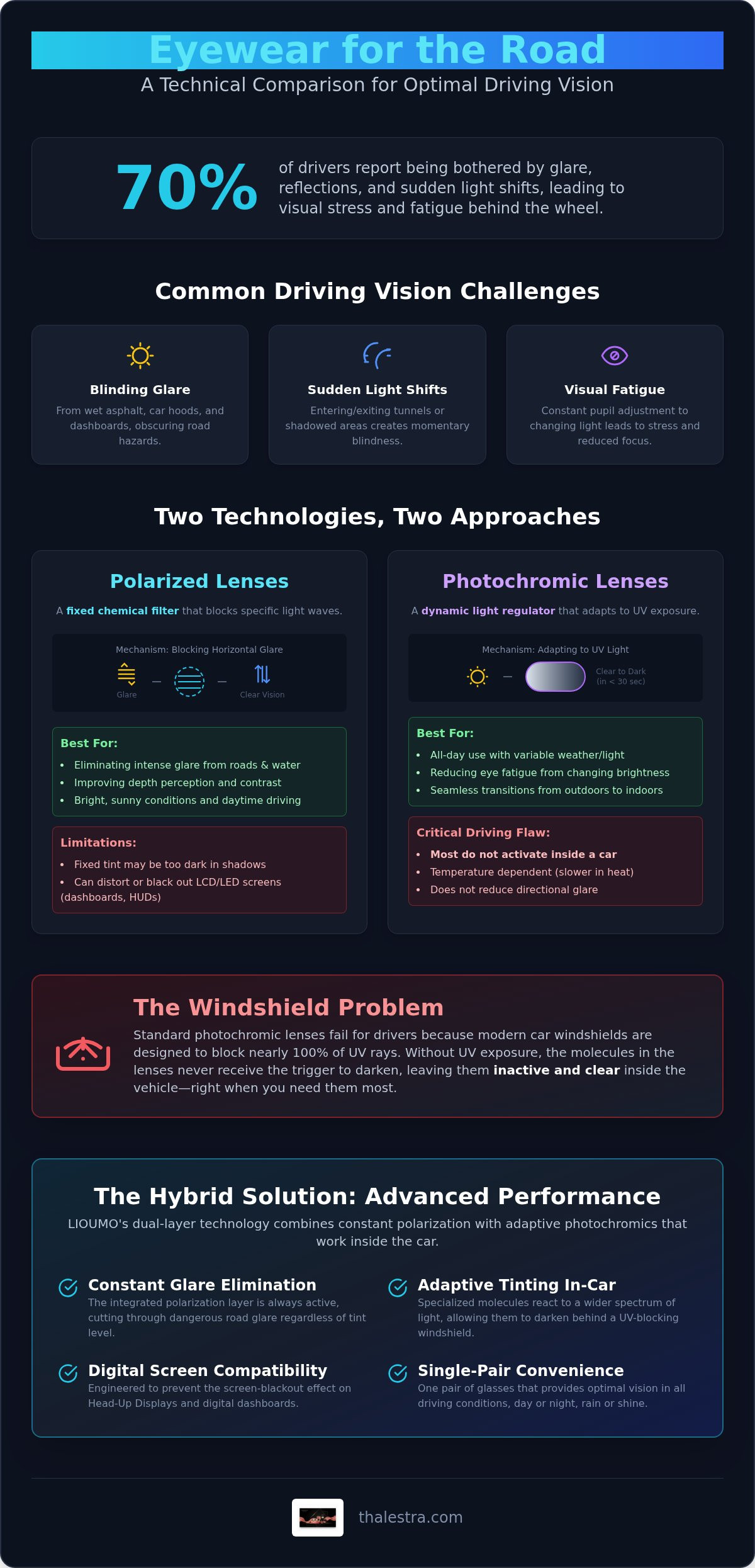
Selecting the right eyewear requires a technical understanding of light management. The debate of polarized vs photochromic for driving centers on two distinct optical technologies. Polarized lenses function as a fixed chemical filter. They target specific light angles to neutralize reflections. Photochromic lenses operate as a dynamic light regulator. They utilize reactive molecules to adjust tint density based on environmental conditions. One provides constant glare defense. The other offers variable light intensity control. High-performance driving demands both sharp contrast and consistent visual comfort.
How Polarized Lenses Eliminate Road Glare
Polarization technology utilizes a microscopic vertical grid embedded within the lens material. This filter blocks horizontal light waves. Sunlight reflecting off flat surfaces like wet asphalt, car hoods, or glass becomes horizontally polarized. This creates blinding white glare that obscures road hazards. A polarized lens acts as a gatekeeper. It only allows vertical light to pass through. This mechanism significantly improves depth perception and reduces reaction times during high-speed maneuvers. It is a high-utility solution for mid-day sun and reflective road conditions.
The Mechanism of Photochromic Adaptive Vision
Modern photochromic lens technology relies on silver halide or carbon-based molecules. These structures are UV-sensitive. When exposed to ultraviolet radiation, the molecules change shape and expand. This expansion increases the lens tint density, darkening the glass. In 2026, advanced molecular structures allow for rapid transition speeds. Lenses now clear in under 30 seconds when moving to low-light environments.
Temperature remains a critical technical factor. Photochromic reactions are thermal-dependent. Cold weather slows molecular movement, often resulting in darker tints in winter conditions. For drivers, this means adaptive vision that responds to cloud cover and sun position. Key performance attributes include:
- Automatic Tint Adjustment: Seamless transition from Category 0 to Category 3 darkness.
- UV Protection: Integrated 100% UVA/UVB blocking regardless of tint level.
- Visual Consistency: Maintenance of steady light levels to prevent eye fatigue.
While standard photochromics manage brightness, they don't filter the directional light that causes glare. This technical gap is why many professionals recommend hybrid LIOUMO top quality photochromic polarized sunglasses. These specialized lenses combine the vertical filter of polarization with the molecular reactivity of photochromism. It creates a comprehensive vision strategy for the modern road environment. You get the glare-cutting power of a fixed filter with the adaptive convenience of a smart lens.
The Driving Dilemma: Glare Reduction vs. Light Adaptation
Driving environments are volatile. Wet pavement, low sun angles, and variable cloud cover create constant visual disruptions. Standard fixed-tint sunglasses often fail these tests. They're frequently too dark in shadowed areas and too light during peak glare. This mismatch forces your pupils to dilate and contract repeatedly. The result is eye fatigue and reduced situational awareness. When considering polarized vs photochromic for driving, you're choosing between two different solutions for these road stressors. Professional drivers prioritize vision systems that maintain steady light levels without sacrificing contrast.
Safety implications are significant. The "blind second" occurs during rapid light shifts, such as entering or exiting tunnels. A lens that doesn't adapt quickly enough leaves the driver momentarily vulnerable. High-utility eyewear must address these specific pain points:
- Dashboard Glare: Reflections off interior plastics and glass instrument clusters.
- Wet Road Mirages: Horizontal light bouncing off rain-slicked asphalt surfaces.
- Low Sun Hazards: Blinding light during early morning and late afternoon commutes.
When Polarization Wins on the Road
Polarization is the gold standard for high-glare environments. It is particularly useful for driving because it neutralizes light reflecting off car hoods and wet pavement. This filter allows you to see through the windshields of oncoming vehicles, identifying driver intent more clearly. It's an essential safety feature for coastal or rainy regions. For those seeking classic aesthetics with technical performance, the Wayfarer Style Polarized Sunglasses provide superior glare blocking in a proven frame design. These lenses ensure sharp detail and high-contrast perception in the most challenging sunlight conditions.
The Convenience of Photochromic Lenses for Commuters
Photochromic technology offers a seamless transition for the daily commuter. You move from a dark parking garage to a sun-drenched highway without removing your eyewear. This single-pair convenience eliminates the distraction of swapping glasses while operating a vehicle. While the technology is similar to the adaptive vision found in the Photochromic Cycling Sunglasses Guide, driving-specific versions are tuned for the unique light environment of a car cabin. These lenses maintain a base level of clarity in low light while darkening automatically as UV exposure increases. This ensures your eyes remain relaxed during long-distance travel through shifting weather patterns. Check the latest THALESTRA.COM LIOUMO performance collections for advanced light-adaptive solutions.
The Windshield Problem: Why Standard Photochromics Often Fail
Automotive glass technology prioritizes passenger safety and climate efficiency. Modern laminated windshields incorporate specialized interlayers that block 99% of UV-B rays. This creates a functional barrier for standard photochromic lenses. These lenses rely on high-energy ultraviolet radiation to trigger molecular expansion. Inside the vehicle cabin, the lens remains in a dormant state. It fails to darken despite intense visible sunlight. This activation gap is a primary consideration when evaluating polarized vs photochromic for driving performance.
Temperature also dictates lens efficiency. Cabin climate control systems often maintain a steady 21 degrees Celsius (70 degrees Fahrenheit). While colder temperatures typically enhance photochromic darkness, the lack of UV exposure inside a car overrides this thermal benefit. Drivers often experience "ghosting," where the lens tint is too light to provide meaningful relief from dashboard glare or road reflections. This mismatch results in visual discomfort during long-distance travel.
UV-A vs. UV-B and Lens Activation
Photochromic molecules respond to specific wavebands of light. UV-B radiation (280-315nm) provides the primary energy for traditional lens transitions. The UV-Shielding Effect describes the total filtration of ultraviolet radiation by automotive glass which prevents traditional photochromic molecules from expanding. While some UV-A light (315-400nm) penetrates side windows, it's insufficient for full activation. Outside the vehicle, these lenses reach Category 3 darkness. Inside, they rarely exceed Category 1. This results in a 50% to 70% reduction in tint effectiveness compared to open-air use.
Solutions for the Modern Cockpit
The 2026 evolution of drive-wear technology addresses these limitations. High-performance lenses now utilize visible-light-reactive molecules. These structures respond to the blue-violet spectrum that passes through standard glass. This ensures the lens darkens even when UV rays are absent. You can verify your current eyewear performance using the "open door" test. Hold your glasses outside the vehicle for 30 seconds. Compare that darkness level to the tint achieved while sitting behind the wheel.
To maximize visibility, consider these tech specs:
- Visible Light Activation: Lenses reacting to the 400-450nm light spectrum.
- Hybrid Integration: Constant polarization layers that don't depend on light levels.
- Side-Window Sensitivity: Optimization for light entering through non-laminated side glass.
Standard photochromics often leave drivers under-protected. High-utility alternatives like LIOUMO top quality photochromic polarized sunglasses provide a constant base tint. They combine chemical filtration with active-adaptive tech. This ensures consistent eye protection regardless of windshield UV-blocking properties. It's the most efficient way to maintain visual clarity in a high-tech cockpit environment.
Practical Decision Guide: Which Lens for Your Drive?
Choosing between polarized vs photochromic for driving requires an audit of your specific vehicle and route. East-west commutes during sunrise or sunset demand high-efficiency glare reduction. Drivers in high-altitude desert regions face intense UV levels but minimal horizontal reflections. Conversely, coastal commuters deal with constant light bouncing off water and wet asphalt. Long-distance comfort is equally critical. For extended sessions behind the wheel, selecting lightweight sunglasses for men reduces bridge pressure and temple fatigue. Carbon fiber or thin-profile titanium frames pair best with high-index driving lenses for a weightless feel. This technical audit of polarized vs photochromic for driving simplifies the selection process for the professional driver.
The Polarized LCD Conflict
Cross-polarization creates a significant technical hurdle in modern cockpits. Polarized filters block light at specific angles. This often aligns with the polarization of liquid crystal displays (LCDs). You might experience "blackout" zones on your GPS, infotainment screen, or digital instrument cluster. Older 2020-era LCDs are most susceptible to this effect. While 2026 vehicle models often use "polarization-friendly" Head-Up Displays (HUDs), testing is mandatory. Tilt your head 45 degrees while viewing the screen. If the display disappears, polarization is conflicting with your vehicle tech. Photochromic lenses don't use directional filters and remain 100% compatible with all digital interfaces.
Performance Comparison Summary
A functional breakdown helps determine the correct vision strategy for your environment:
- Polarized: Superior for midday sun, wet roads, and coastal glare. High contrast but potential digital screen interference.
- Photochromic: Ideal for variable cloud cover, early dawn, and urban routes with frequent tunnels. Full digital display compatibility.
- Hybrid LIOUMO Tech: The multi-purpose solution. Maintains 90% polarization efficiency while adapting tint for tunnel safety and changing weather.
Your driving environment dictates the hardware. Urban commuters with frequent underpasses benefit from the rapid clearing speeds of photochromic tech. Highway drivers facing the afternoon sun need the fixed filtration of polarized glass. To secure the best of both worlds, shop LIOUMO top quality photochromic polarized sunglasses for a streamlined, high-performance driving experience. Match your lens tech to your dashboard and route for zero-compromise road safety.
The Hybrid Solution: Polarized-Photochromic Lenses
The historical conflict of polarized vs photochromic for driving concludes with the 2026 emergence of hybrid optical systems. LIOUMO Top Quality Photochromic Polarized Sunglasses represent the current professional standard for road safety and visual clarity. These lenses eliminate the binary choice between glare filtration and light adaptation. They integrate a permanent vertical chemical filter with a light-reactive molecular coating. This ensures that even in low-light conditions or heavy cloud cover, horizontal reflections from wet roads and car hoods remain neutralized. It is a high-performance vision strategy designed for efficiency and immediate value for the global driver.
Why Hybrid is the Ultimate Driving Gear
LIOUMO hybrid technology utilizes visible-light-sensitive molecules to bypass the UV-shielding effect of modern laminated windshields. While standard photochromics stay dormant behind automotive glass, these technical-grade lenses react to the broader light spectrum. They maintain a base level of polarization while shifting tint density automatically. This allows the lens to darken behind the wheel even when 99% of UV-B rays are blocked. You receive constant glare protection combined with active-adaptive light management. LIOUMO hybrid technology for 2026 provides a zero-compromise optical solution that maintains 90% polarization efficiency regardless of the current lens tint level. It prevents the "blind second" when exiting high-brightness highways into shaded underpasses or tunnels.
Choosing Style and Substance
High-utility eyewear must pair advanced lens tech with aerospace-grade frame materials. THALESTRA.COM integrates LIOUMO hybrids with specialized carbon fiber frames for maximum long-drive comfort. This provides a lightweight, durable solution that resists temple fatigue and bridge pressure during long-haul operation. These models combine vintage designer aesthetics with contemporary technical specifications for the modern driver. Every pair ensures maximum road safety through a streamlined, modular design approach.
- High-Density Polarization: Integrated layers for 90% efficiency in all light states.
- UV400 Protection: Blocks 100% of UVA and UVB radiation automatically.
- Rapid Transition: Molecular reaction speeds optimized for urban and highway environments.
- Carbon Fiber Durability: Lightweight frames designed for high-volume, daily professional use.
- Global Accessibility: Worldwide shipping and order tracking for immediate product availability.
Explore the Classic Men’s Polarized Collection and LIOUMO hybrids at THALESTRA.COM to upgrade your vision strategy today. Match your lens technology to the demands of the modern cockpit for total visual control.
Master Your Road Vision with 2026 Hybrid Tech
Road safety requires more than a standard tint. This technical comparison of polarized vs photochromic for driving proves that hybrid systems offer the highest utility for the modern cockpit. Traditional photochromic lenses often fail behind UV-blocking windshields; however, LIOUMO visible-light activation ensures your tint adapts regardless of automotive glass specifications. You've identified the core differences between vertical glare filtration and molecular light adaptation. This active-adaptive strategy eliminates blinding reflections while maintaining full digital dashboard compatibility.
Functional performance meets professional design. Secure UV400 certified protection and lightweight carbon fiber frames for your next long-haul journey. THALESTRA.COM provides high-volume, trend-aware eyewear with immediate global availability. Shop LIOUMO Photochromic Polarized Driving Sunglasses now and benefit from worldwide tracked shipping. Your drive deserves technical precision and zero-compromise clarity. Enjoy the road with confidence and superior visual control.
Frequently Asked Questions
Do polarized sunglasses work for night driving?
Polarized sunglasses are not suitable for night driving because they reduce light transmission significantly. Most polarized lenses utilize a Category 3 tint, which is too dark for low-light environments. Wearing them at night impairs your ability to see hazards, pedestrians, and road markings. While they block glare from oncoming headlights, the overall loss of visibility creates a safety risk. Drivers should use clear or specialized night-vision lenses instead.
Why do my photochromic lenses stay clear inside my car?
Standard photochromic lenses stay clear because modern laminated windshields block 99% of UV-B radiation. These lenses require direct UV exposure to trigger the molecular reaction that darkens the glass. Without this ultraviolet energy, the molecules remain dormant. This is a common issue when comparing polarized vs photochromic for driving performance. To solve this, you need visible-light-reactive technology found in specialized LIOUMO top quality photochromic polarized sunglasses.
Can I get polarized and photochromic features in the same lens?
Yes, hybrid technology combines both features into a single optical system. LIOUMO top quality photochromic polarized sunglasses utilize a permanent polarization filter for constant glare reduction alongside a light-reactive layer for variable tint. This provides a comprehensive vision strategy for all light conditions. These lenses maintain 90% polarization efficiency even when the tint is at its lightest. It is the professional standard for 2026 long-distance driving and high-performance road use.
Do polarized lenses interfere with my car’s heads-up display (HUD)?
Polarized lenses often interfere with Head-Up Displays and digital instrument clusters due to cross-polarization. This occurs when the lens filter aligns with the display's own polarization, causing the screen to appear black or distorted. While many 2026 vehicle models use polarization-friendly HUD technology, older LCD systems remain problematic. You can check compatibility by tilting your head 45 degrees; if the display disappears, the polarized filter is blocking the light.
Are photochromic lenses better than polarized for foggy conditions?
Photochromic lenses with yellow or amber base tints are generally superior for foggy conditions. These tints enhance contrast and depth perception in flat-light environments. Polarized lenses focus on blocking horizontal glare from the sun, which is less prevalent in heavy fog. However, a hybrid lens provides the best balance. It offers the contrast-boosting benefits of an adaptive tint while remaining ready to block glare if the sun breaks through the mist.
How long do photochromic lenses take to change while driving?
In 2026, advanced photochromic molecules transition from clear to dark in approximately 30 seconds under direct light. The clearing process is slower, typically taking 90 to 120 seconds when entering a tunnel or garage. Temperature affects this speed; colder weather results in faster darkening but slower clearing. High-performance driving lenses are optimized for rapid responsiveness to ensure visual continuity during sudden light shifts on the highway or in complex urban environments.
Are polarized lenses safer for highway driving than standard tint?
Polarized lenses are significantly safer for highway driving than standard non-polarized tints. They eliminate blinding glare from car hoods and wet asphalt, which improves reaction times and reduces eye strain. Standard tints only reduce overall brightness without filtering the specific light angles that cause visual obstructions. By neutralizing horizontal reflections, polarized technology allows you to see through the windshields of other vehicles to anticipate driver movements more effectively.
What is the best lens color for driving in bright sunlight?
Gray and brown are the best lens colors for bright sunlight driving. Gray lenses provide the most accurate color perception and are ideal for general use in intense light. Brown or copper tints enhance contrast and depth perception, making them highly effective for spotting road hazards and changes in pavement texture. Both colors are available in the LIOUMO top quality photochromic polarized sunglasses collection, offering specialized performance for different driving environments.