
Adaptive lenses operate on a finite molecular budget. Every darkening cycle consumes a fraction of the lens's functional life. You've likely noticed your glasses staying dark indoors or reacting slowly during daily commutes. It's a common performance drop. If you see a permanent yellowish tint or sluggish fade-back, you're rightfully asking how long do photochromic lenses last. Most modern 2026 molecules maintain peak efficiency for two to three years before UV fatigue sets in.
Discover the exact technical factors behind lens degradation and molecular exhaustion. This guide details reaction speed benchmarks, heat sensitivity impacts, and UV400 protection standards. We analyze the signs of permanent lens failure and provide actionable steps to maximize your current eyewear utility. You'll get a full breakdown of replacement timelines for high-performance LIOUMO polarized sunglasses and other vacation-ready gear. Expect a direct look at the science of lens fatigue and the modern solutions for maintaining clear, responsive vision.
Key Takeaways
- Determine how long do photochromic lenses last by understanding the typical 24-to-36-month molecular budget of adaptive eyewear.
- Recognize early signs of lens fatigue including incomplete clearing indoors and permanent yellowish oxidation on the lens coating.
- Prevent premature molecular failure by avoiding high-heat environments like car dashboards and using UV-blocking hard cases for storage.
- Maximize visual clarity and durability by upgrading to modern 2026 standards featuring integrated polarization and UV400 protection.
What is the Average Lifespan of Photochromic Lenses?
Standard industry expectations place the optimal performance window between 24 and 36 months. For high-utility users, the core question of how long do photochromic lenses last depends on the specific molecular budget of the adaptive coating. High-quality 2026 tech ensures consistent darkening cycles, yet environmental variables eventually trigger performance drops. Non-prescription eyewear, such as LIOUMO Top Quality Photochromic Polarized Sunglasses, follows distinct wear patterns compared to daily prescription frames. Vacation-ready gear often faces intense, concentrated UV exposure during travel, which differs from the steady, low-level exposure of daily-wear glasses. This high-intensity usage can influence the speed of molecular exhaustion.
The Science of Molecular Exhaustion
Grasping what photochromic lenses are involves analyzing silver halides or specialized carbon molecules embedded in the lens matrix. These molecules physically change shape when hit by UV radiation to block visible light. After thousands of these structural shifts, the molecules lose their original elasticity. This "burn out" effect means the molecules can no longer return to their fully transparent state. Molecular fatigue is the primary cause of lens failure where reactive molecules lose the ability to transition between clear and dark states. Once this threshold is reached, the lens becomes permanently compromised, offering slower reaction times and reduced darkness levels.
Expected Performance Decline Over Time
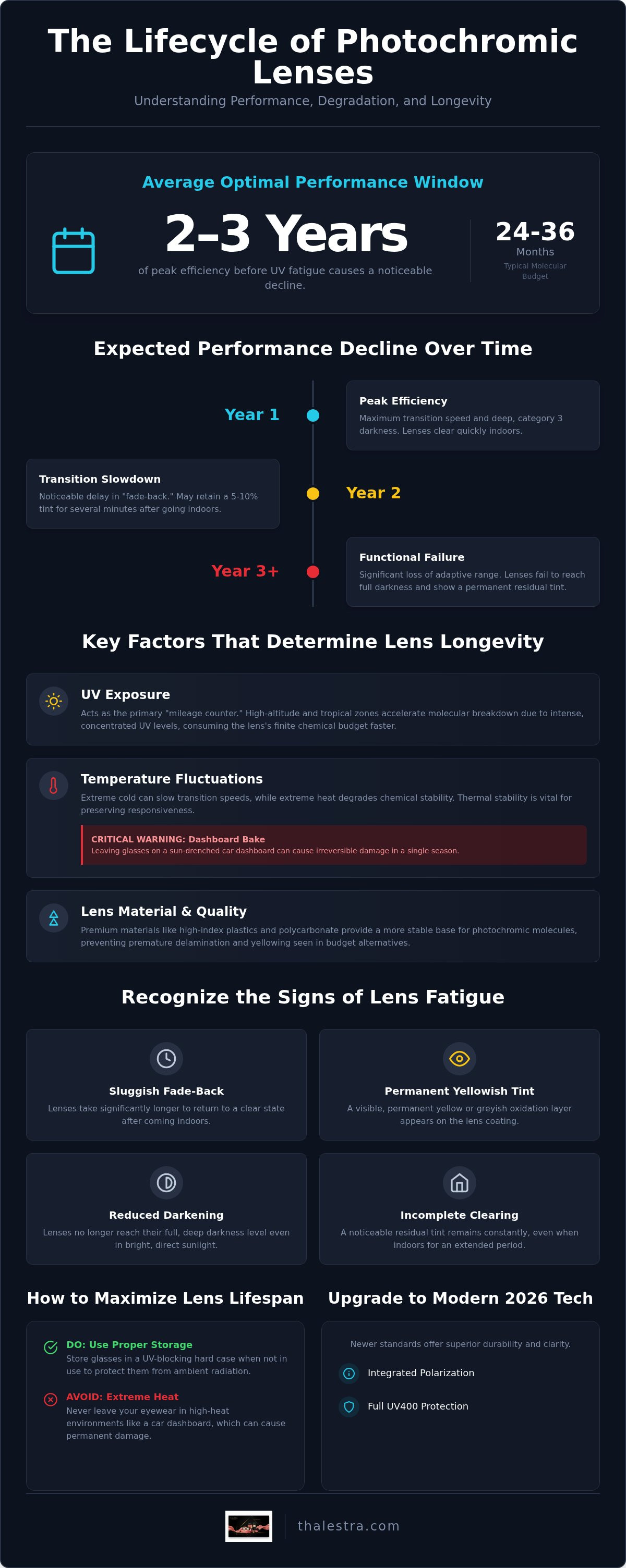
Lens degradation follows a predictable three-year cycle based on average UV exposure hours.
- Year 1: Peak Efficiency. Maximum transition speed and deep category 3 darkness. Lenses clear quickly upon entering indoor environments.
- Year 2: Transition Slowdown. Noticeable delay in the "fade-back" process. Lenses may retain a 5% to 10% tint for several minutes after UV exposure ends.
- Year 3+: Functional Failure. Significant loss of adaptive range. Lenses fail to reach full darkness and often exhibit a permanent residual tint, usually appearing as a yellowish or greyish oxidation layer.
For international travelers and outdoor enthusiasts, monitoring these benchmarks is essential for maintaining visual clarity. Replacing "burnt out" lenses with modern 2026 tech ensures your eye protection remains responsive and effective during high-glare activities. Modern LIOUMO brand options provide the high-performance adaptive utility needed to replace aging, sluggish eyewear.
Key Factors That Determine How Long Your Lenses Last
UV exposure functions as the primary mileage counter for adaptive eyewear. Total radiation hours directly dictate how long do photochromic lenses last before molecular fatigue occurs. High-altitude environments and tropical zones deliver intense, concentrated UV levels that accelerate chemical breakdown. Conversely, temperate climates with lower overall exposure may extend the functional life of the lens coating. Every darkening cycle consumes a fraction of the chemical agility stored within the lens matrix.
Temperature fluctuations represent a critical performance trade-off. Extreme heat forces molecules to return to a clear state more rapidly, yet persistent exposure to high temperatures degrades the chemical stability of the photochromic layer. Leaving glasses on a sun-drenched car dashboard, often called dashboard bake, can cause irreversible damage in a single summer season. Extreme cold poses a different challenge, often locking molecules in a dark state and slowing transition speeds significantly. Maintaining thermal stability is vital for preserving the responsiveness of the adaptive molecules.
Lens material selection impacts long-term durability. High-index plastics and impact-resistant polycarbonate offer different levels of chemical adhesion for photochromic treatments. Premium 2026 lens constructions prioritize stable bonding to prevent the delamination or yellowing often seen in budget alternatives. High-quality materials ensure the photochromic molecules remain evenly distributed throughout the lens life.
Environmental Impact on Chemical Stability
High-intensity UV regions trigger rapid molecular switching. This frequent shape-shifting leads to faster exhaustion compared to urban environments with significant shade. Tropical vacation spots combine high UV with humidity and heat, creating a harsh environment for adaptive molecules. In sub-zero conditions, the molecules become sluggish, requiring more energy to transition back to clear indoors. These environmental stressors dictate the replacement cycle for frequent travelers.
The Role of Polarization in Lens Longevity
Modern polarized photochromic sunglasses integrate multiple functional layers to manage light. While the polarization filter primarily targets horizontal glare, it does not directly shield the photochromic molecules from UV-driven fatigue. However, high-quality hybrid lenses often feature superior hard-coatings that protect the entire lens stack from environmental oxidation. Choosing a high-performance LIOUMO model ensures you get a resilient, multi-layered system designed for longevity. Maintaining your eyewear in a dedicated hard case when not in use is the most effective way to preserve molecular agility. For those seeking reliable, travel-ready protection, exploring the latest vacation sunglasses provides access to durable 2026 lens technology.
How to Tell if Your Photochromic Lenses Are Wearing Out
Recognizing the end of a lens's functional cycle is critical for maintaining visual safety. While you now know how long do photochromic lenses last in theory, real-world symptoms provide the definitive replacement signal. Performance degradation usually manifests through specific visual and functional cues that indicate molecular fatigue. Monitoring these signs helps you track how long do photochromic lenses last in your specific climate and usage pattern.
- The Yellowing Effect: Permanent oxidation of the adaptive coating. This results in a muddy, yellowish tint that distorts color perception even in low-light conditions.
- Incomplete Clearing: Aging molecules often get stuck in a semi-activated state, leaving a 10-15% residual tint indoors. This lack of transparency strains the eyes during screen work.
- Slow Transition Speed: Reaction times exceeding 60 seconds in direct sun. Healthy 2026 lenses should hit peak darkness in approximately 30 seconds.
- Reduced Maximum Darkness: Failure to provide adequate Category 3 glare protection. The lenses may only reach a light grey shade rather than a deep, protective tint.
The Visual Inspection Checklist
Perform a detailed surface audit to identify structural breakdown. Look for delamination, which appears as peeling, bubbling, or cracking at the edges of the lens. Blotchiness or uneven darkening across the surface indicates that the photochromic molecules are no longer distributed uniformly. For high-performance utility, compare your current frames against the benchmarks in our photochromic cycling sunglasses guide to see if your reaction times still meet professional standards. Physical wear often precedes total chemical failure.
Functional Testing at Home
Simple diagnostic tests confirm if your molecules are "burnt out." The Sun vs. Shade test involves timing how long it takes for the lens to hit 80% darkness under direct noon sun. If it exceeds 60 seconds, the chemical response is failing. Use the White Paper test by placing your "clear" glasses on a sheet of bright white printer paper. Any visible yellow or grey cast confirms oxidation. These results help determine if photochromic lenses are worth it for another season or if it's time to upgrade to modern LIOUMO Top Quality Photochromic Polarized Sunglasses. Don't compromise on vision; once the molecules stop moving, the lens is effectively a standard tinted glass with poor clarity.
Maintenance Tips to Extend the Life of Adaptive Eyewear
Maintenance habits directly influence how long do photochromic lenses last by preserving the structural integrity of the light-sensitive molecules. While the chemical budget is finite, improper care accelerates the transition from peak performance to functional failure. Consistent maintenance protocols ensure the 24-to-36-month window remains a reality rather than a best-case scenario. Protecting the adaptive layer from environmental and chemical stressors is the most effective way to maintain transition speed.
Optimal Storage Solutions
Dark, cool environments preserve molecular agility by preventing unnecessary light-triggered cycles. Every minute your glasses spend darkening while sitting on a table is a minute of molecular life consumed without benefit. Hard cases provide a total UV block, effectively pausing the molecular wear process during periods of inactivity. Stationary exposure is particularly damaging. Leaving glasses in direct sunlight while not in use leads to uneven heating and localized molecular fatigue. For those traveling with high-performance vacation sunglasses, a dedicated protective case is a mandatory accessory. Avoid the dashboard bake at all costs. High vehicular heat causes rapid chemical degradation, often leading to the permanent yellowing effect mentioned in previous sections.
Safe Cleaning Protocols
Cleaning frequency dictates the clarity and longevity of the lens surface. Salt spray, skin oils, and environmental dust create a gritty layer that can cause microscopic pitting if not removed correctly. This pitting disrupts the even distribution of light, affecting how the photochromic molecules react to UV stimulus. Beach use requires immediate rinsing with fresh water to prevent salt crystals from bonding to the adaptive coating. Use only high-density microfiber cloths for daily debris removal. Ultrasonic cleaners are generally safe for modern 2026 frames, yet the focus should remain on avoiding abrasive chemical contact. Alcohol-based cleaners serve as the primary catalyst for the premature breakdown of specialized adaptive coatings, stripping away protective layers and inducing permanent lens clouding. Stick to pH-neutral lens sprays or mild, additive-free dish soap to ensure the longest possible lifespan for your eyewear. If your current pair is already showing signs of sluggishness despite proper care, it's time to upgrade to high-performance photochromic gear from our latest collection.
Choosing Your Next Pair: Modern 2026 Photochromic Tech
Modern 2026 lens technology prioritizes rapid molecular recovery and integrated glare filters. When evaluating how long do photochromic lenses last, consider that starting with a higher baseline of material quality extends the functional window. Essential features include UV400 protection standard, high-impact polycarbonate construction, and specialized adaptive coatings. These elements prevent the early onset of oxidation and maintain peak transparency for longer durations. High-performance adaptive utility. Rapid transition speed. Total UV blockage.
Integrated polarization provides a critical layer of utility for driving and outdoor activities. While the photochromic molecules manage light intensity, the polarized filter eliminates horizontal glare. This dual-action system reduces eye strain and improves reaction times in high-glare environments. High-performance frames now utilize carbon fiber and modern polymers for a lightweight, durable fit that survives frequent travel cycles. These materials resist the warping and structural fatigue common in budget frames, ensuring the lens alignment remains precise throughout the product's life.
What to Look for in a Replacement Pair
Look for a Category 0 to Category 3 transition range for maximum versatility. This ensures lenses are completely clear indoors while reaching significant darkness in peak sun. Frame selection matters for durability; pick lightweight carbon fiber or modern polymers that resist warping. Ensure you select frames that complement different face shapes for optimal coverage. This is especially vital for overcast driving sunglasses where peripheral light management is key. Modern 2026 coatings are engineered for better adhesion, reducing the risk of the delamination and peeling seen in older tech. High-utility users should prioritize these reinforced layers to maximize how long do photochromic lenses last in high-UV environments.
Thalestra Product Spotlight: LIOUMO Photochromic Polarized Sunglasses
LIOUMO Top Quality Photochromic Polarized Sunglasses represent the 2026 standard for adaptive eyewear. These feature high-performance polarized filters combined with rapid-transition molecules. Ideal for international travelers needing one-pair solutions for varying light conditions. Thalestra focuses on high-volume, trend-aware inventory to ensure immediate availability. Global shipping provides a streamlined gateway for replacing worn-out gear quickly. These models feature UV400 protection as a baseline requirement, ensuring total ocular safety against UVA and UVB rays. The modular design allows for efficient replacement, keeping your vision clear during vacation and daily commutes. Fast-moving digital marketplace. Speed of information. Direct value delivery. Discover the latest vacation sunglasses for men to find your next high-performance pair.
Upgrade Your Vision with 2026 Adaptive Technology
Molecular fatigue represents an inevitable threshold for all photochromic eyewear. Most high-performance lenses reach their functional limit within 24 to 36 months of regular UV exposure. By identifying early signs of oxidation and sluggish transition speeds, you can maintain optimal visual safety during travel and daily commutes. Proper storage in UV-blocking hard cases and avoiding high-heat environments like car dashboards are the most effective ways to preserve chemical agility. Understanding how long do photochromic lenses last ensures you never compromise on clarity or reaction speed when it matters most.
Modern 2026 standards prioritize rapid recovery and high-contrast polarization. Transitioning to newer technology provides a significant boost in comfort and protection levels. UV400 Rated Protection. Polarized Adaptive Lens Tech. Global Order Tracking. These features represent the baseline for contemporary vacation-ready gear. Upgrade your vision with LIOUMO Photochromic Polarized Sunglasses at Thalestra for a streamlined, high-utility experience. Keep your perspective sharp and your eyes protected with the latest in adaptive optics.
Frequently Asked Questions
Do photochromic lenses stop working if you don't use them?
Storage doesn't stop degradation entirely. Molecules eventually lose reactive potential due to environmental oxidation even without UV activation. Keeping eyewear in a dark, climate-controlled case preserves molecular agility for longer durations. Unused lenses stored for several years may still show slower reaction times than fresh inventory. High-utility gear like vacation sunglasses should be used within their peak three-year window for maximum performance and reliable protection.
Why do my transition lenses take longer to clear in the winter?
Thermal sensitivity dictates clearing speed. In colder temperatures, the molecules become physically sluggish. This requires more thermal energy to return to a clear state. While they get darker in the cold, the fade-back process takes significantly longer than in summer. This is a standard technical characteristic of adaptive coatings. Understanding this helps manage expectations during winter commutes or high-altitude travel where temperatures remain consistently low.
Can I leave my photochromic sunglasses in a hot car?
Avoid leaving adaptive eyewear in hot vehicles. High temperatures trigger a "reverse reaction" that prevents lenses from reaching full darkness. Persistent heat exposure also breaks down the chemical bond between the photochromic layer and the lens material. This leads to premature yellowing and permanent cloudiness. Always use a hard case and store your glasses in a cool, shaded area to maximize how long do photochromic lenses last during summer seasons.
How do I know if my lenses are 'burnt out'?
Look for a permanent 10-15% residual tint indoors. If your lenses fail to clear completely or exhibit a yellowish oxidation layer, they are effectively "burnt out." Another sign is a reaction time exceeding 60 seconds in direct sunlight. Once the molecular budget is exhausted, the lenses lose their protective utility. Replacing these with modern LIOUMO polarized sunglasses ensures your vision remains responsive and clear in all lighting conditions.
Do all photochromic lenses eventually turn yellow?
Yellowing is a common sign of molecular oxidation. After approximately 24 to 36 months of UV cycling, the silver halides or carbon molecules lose their structural integrity. This result is a permanent, muddy tint that distorts color perception. High-quality 2026 coatings delay this process through better chemical stabilization. However, all photochromic treatments eventually reach this stage of functional failure after thousands of darkening cycles and exposure to air.
Does the brand of the lens affect how long it lasts?
Manufacturing quality directly impacts longevity. Premium brands like LIOUMO utilize stabilized molecules and advanced bonding agents to resist environmental fatigue. Budget alternatives often use thinner coatings that oxidize rapidly in high-UV zones. When calculating how long do photochromic lenses last, the initial investment in top-tier tech usually translates to a longer functional lifespan. Better adhesion prevents the delamination and blotchiness common in lower-grade optics during frequent travel use.
Can I fix photochromic lenses that have stopped changing color?
Molecular fatigue is irreversible. There are no sprays, coatings, or treatments that can reactivate "burnt out" photochromic molecules. Once the chemical agility is lost, the lens matrix is permanently compromised. Attempting to buff or clean the surface will not restore the internal chemical reaction. Replacement is the only functional solution for maintaining Category 3 darkness and rapid transition speeds during outdoor activities and vacation travel.
Is it worth buying photochromic lenses if they only last 3 years?
The utility of adaptive eyewear justifies the three-year replacement cycle. For international travelers, the convenience of a single pair for all light conditions outweighs the periodic cost. UV400 protection remains constant even if the transition speed slows down slightly. Modern 2026 tech provides high-performance utility that simplifies gear management. View the replacement as a necessary update for maintaining peak visual clarity and eye health.