
Why carry two pairs of glasses when one intelligent lens handles the transition from a dim airport lounge to the blinding glare of a desert sun? Most active men agree that the constant swap between clear frames and sunglasses is a massive productivity killer during travel. You've likely heard about the classic disadvantages of photochromic lenses, such as sluggish transition speeds or the frustrating clear lens effect while driving through a UV-shielded windshield. These pain points often lead to skepticism regarding their real-world utility for high-stakes environments.
In 2026, adaptive vision technology has officially reached the efficiency threshold. Modern high-speed reactive molecules now darken in under 30 seconds, effectively overcoming the lag times of previous generations. This guide explores how the latest eyewear solutions, including LIOUMO top quality photochromic polarized sunglasses, deliver high-performance UV400 protection that works even inside vehicles. You'll discover how to maximize your gear efficiency, validate the cost-savings of a single-pair strategy, and decide if polarized photochromic versions are the right fit for your high-speed lifestyle.
Key Takeaways
- Discover how 2026 adaptive molecules provide seamless transitions from indoor clarity to outdoor UV400 protection in under 30 seconds.
- Analyze how modern technology overcomes the classic disadvantages of photochromic lenses, including improved performance behind car windshields.
- Evaluate the cost-efficiency of single-pair eyewear solutions that eliminate the logistical frustration of switching between clear frames and sunglasses.
- Identify the specific performance benefits of the LIOUMO series for travelers seeking high-speed reactive tech and polarized glare reduction.
What Are Photochromic Lenses? Defining Adaptive Vision Tech
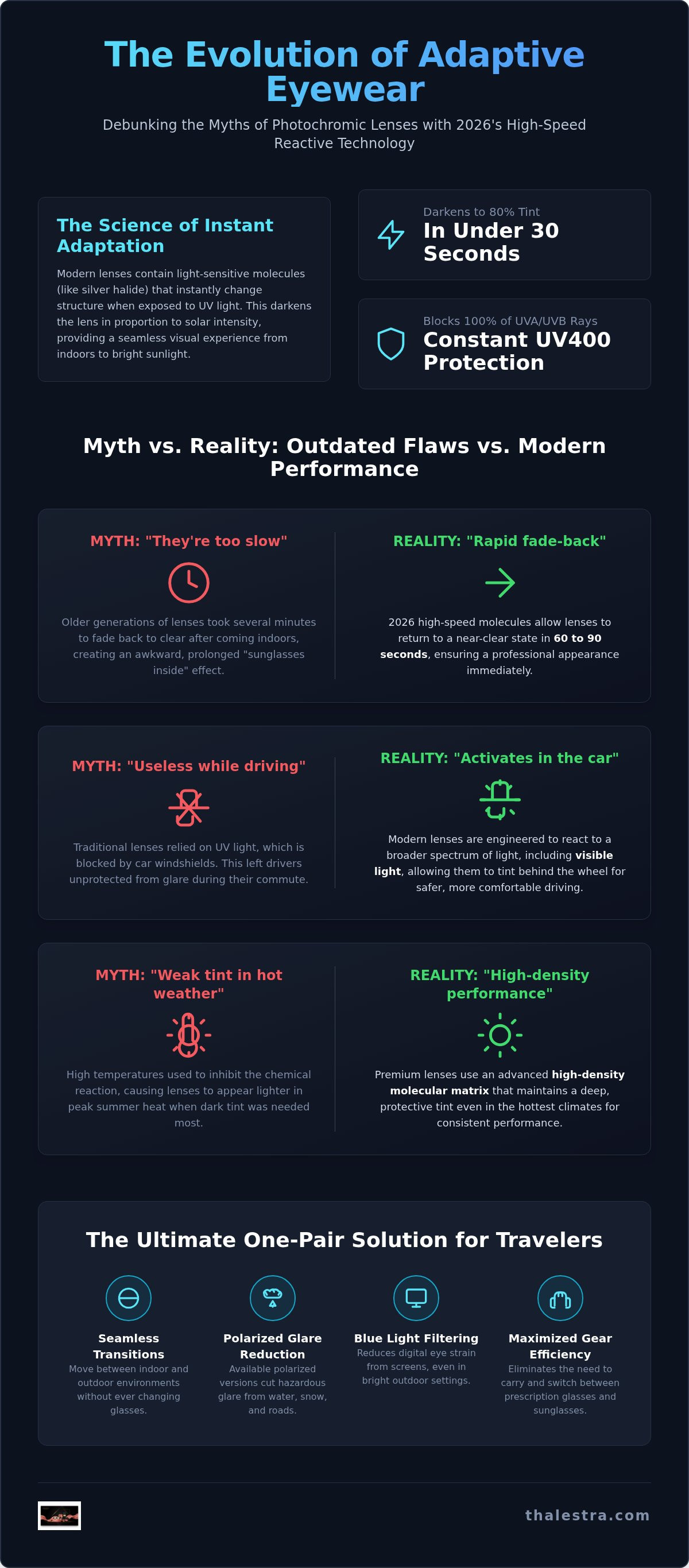
Adaptive vision technology represents a major leap in optical efficiency for 2026. What Are Photochromic Lenses? Essentially, these are high-performance eyewear components that automatically adjust tint levels based on real-time UV radiation exposure. Unlike static sunglasses, these lenses utilize embedded light-sensitive molecules that react instantly to solar intensity. This design eliminates the constant need for manual eyewear swaps during travel or high-speed transitions between indoor and outdoor environments. Historically, the disadvantages of photochromic lenses included slow response times and poor performance in high-heat climates. However, 2026 tech, specifically found in the LIOUMO series, utilizes high-speed reactive molecules to reach 70-80% tint in under 30 seconds.
The Science of Light-Reactive Molecules
Modern lenses incorporate silver halide or chloride molecules directly within the lens matrix. When UV photons strike these molecules, they undergo a chemical structural change, increasing lens density to block visible light. This process scales linearly with UV intensity. Higher solar radiation triggers a darker, more protective state. The activation state of a photochromic lens represents the specific level of tint reached when molecules change shape in response to ultraviolet energy. This modular approach ensures optimal visibility across varying lighting environments without user intervention. The efficiency gain is immediate. No more fumbling for a second case while hiking or driving.
UV400 Protection and Eye Health Safety
High-quality adaptive eyewear provides constant 100% UVA and UVB blockage. This protection remains active even when the lenses appear completely clear indoors. By filtering out harmful radiation and high-energy visible (HEV) light, these lenses significantly reduce long-term eye fatigue and strain. The 2026 standards for vacation-ready eyewear prioritize this dual-action defense. Modern photochromic options now integrate blue light filtering to combat digital eye strain from mobile devices used in bright outdoor settings. This makes them a versatile tool for the modern traveler. You get a single-pair solution that manages glare, UV risk, and digital clarity simultaneously. While the classic disadvantages of photochromic lenses involved limited car-windshield activation, the newest generations react to a broader spectrum of light for improved utility.
- Constant UV400 protection regardless of tint level
- Integrated blue light filtering for 2026 digital lifestyles
- High-speed molecules for rapid under-30-second adaptation
- Reduced glare in polarized photochromic versions for active men
Myth-Busting: Debunking Common Photochromic Misconceptions
Outdated technical limitations often fuel the perceived disadvantages of photochromic lenses. Many travelers still recall older lens generations that remained frustratingly dark in dim hotel lobbies or failed to activate entirely during long road trips. 2026 adaptive vision technology effectively dismantles these myths through molecular-level engineering and broader light-spectrum sensitivity. Modern active men now prioritize single-pair efficiency over the inconvenience of carrying multiple cases. Selecting the right gear requires moving past these four common misconceptions.
- Fade-Back Speed: Older lenses stayed dark for several minutes indoors; 2026 variants clear in a fraction of that time.
- Vehicle Performance: Standard windshields block UV, but modern car-compatible lenses react to visible light for better driving tint.
- Style Perceptions: Adaptive tech is no longer restricted to purely functional frames. Designer-curated styles now dominate the market.
- Tint Density: While temperature affects molecules, premium high-density lenses achieve deep tinting even in peak summer heat.
The Indoor Fade-Back Speed Reality
The most frequent complaint involves the "stuck in the dark" effect when walking indoors. Current 2026 benchmarks for premium reactive molecules demonstrate a return to a clear state within 60 to 90 seconds. Factors such as ambient temperature and previous UV saturation levels influence this speed. High-performance molecules found in Thalestra products utilize a more volatile chemical structure to accelerate this transition. Entry-level lenses often lag behind, sometimes taking up to three minutes to clear. This delay reinforces the negative reputation of older tech. Selecting high-speed molecules ensures a professional appearance immediately upon entering a building. Efficiency is the priority here.
Driving and Windshield UV Blocking
Standard automotive windshields incorporate UV-blocking layers that prevent traditional photochromic lenses from darkening. This remains one of the primary disadvantages of photochromic lenses for daily commuters. Specialized 2026 variants now react to visible light in addition to UV radiation. This allows for significant tinting even behind UV-protected car glass. For those spending hours behind the wheel, reviewing a guide on the best photochromic sunglasses for driving men is essential for safety. These lenses provide the necessary contrast for high-speed navigation. Additionally, utilizing sunglasses for overcast driving ensures consistent visibility when UV levels are low but glare remains high. Modern drivers no longer have to settle for static, non-adaptive lenses.
Performance Analysis: Speed, Temperature, and Polarized Options
Optical performance in 2026 is measured by how effectively a lens manages Visible Light Transmission (VLT). Standard adaptive lenses typically offer a VLT range from 85% in their clear state down to approximately 10% to 15% when fully activated. Modern high-speed molecules have set a new benchmark, reaching 70% to 80% of their maximum tint in under 30 seconds. This rapid response is critical for active men moving through high-contrast environments. While the durability of these reactive molecules is finite, users can expect peak performance for two to five years depending on UV exposure frequency. Understanding these technical specifications helps users overcome the traditional disadvantages of photochromic lenses and select gear that matches their specific activity levels.
The Impact of Temperature on Transition Speed
Temperature sensitivity remains a core characteristic of photochromic technology. Molecular movement is driven by thermal energy. In high-heat environments, such as tropical 2026 summer destinations, heat actually encourages the molecules to revert to their clear state more quickly. This creates a competing reaction where the lens struggles to reach its darkest possible tint. Conversely, in cold, sunny conditions, the molecules remain in their darkened state more easily. This is why skiers often notice their lenses becoming exceptionally dark on the slopes. For 2026 vacation planning, travelers should expect slightly lighter tints in extreme desert heat compared to temperate mountain climates. High-performance molecules in the LIOUMO series are specifically engineered to maintain better density in warmer conditions than entry-level alternatives.
The Power of Polarized Photochromic Lenses
Combining polarization with adaptive tinting is the ultimate 2026 eyewear hack. While the photochromic molecules manage overall brightness, the integrated polarization filter eliminates horizontal glare from water, roads, and snow. This dual-layer protection is essential for high-stakes activities. For example, using photochromic sunglasses for cycling allows riders to maintain visual acuity when darting between shaded forest trails and open, sun-drenched roads. The polarization prevents "white-out" glare from the pavement while the tint adjusts to the canopy cover. This synergy provides significant benefits for:
- Driving: Reducing dashboard reflections and road glare simultaneously.
- Fishing: Seeing through the water surface while protecting against overhead sun.
- Hiking: Navigating rocky terrain where shadows and bright spots alternate rapidly.
One of the primary disadvantages of photochromic lenses in the past was the lack of polarization, but 2026 hybrid models have solved this limitation. You get the convenience of a single pair without sacrificing the specialized glare reduction required for high-performance outdoor use.
Cost-Benefit Framework: Is the Investment Worth It?
Evaluating the total cost of ownership for adaptive eyewear requires looking past the initial price tag. While some perceive the higher entry point as one of the disadvantages of photochromic lenses, the math changes when compared to purchasing two separate high-performance pairs. A single-pair strategy eliminates the need for separate clear optical frames and dedicated sunglasses. This consolidation reduces the risk of loss or damage during transit, a common issue for active men on 2025-2026 vacations. Maintenance is straightforward. These lenses require standard microfiber cleaning and protection from extreme heat to preserve molecular integrity. Storage in a hard case when not in use prevents accidental UV exposure and extends the reactive lifespan.
One Pair Efficiency vs. Two Pair Complexity
The logistical burden of switching frames every time you step outside creates friction for busy urban professionals. Transitioning to a single-frame solution streamlines your everyday carry setup. For travelers, reducing luggage bulk is a primary driver for adopting adaptive tech. Instead of managing multiple cases, you carry one versatile item. Over a 24-month period, the efficiency of a single pair, especially when opting for durable LIOUMO top quality photochromic polarized sunglasses, outweighs the cost of maintaining two distinct sets of eyewear. Direct-to-consumer models further enhance this value by removing traditional retail markups and middleman fees.
Who Should (and Should Not) Buy Photochromic
Adaptive vision technology is ideal for hikers, cyclists, and international commuters who encounter rapidly changing light conditions. The ability to move from a subway station to a bright city street without pausing is a significant productivity gain. However, certain use cases still benefit from dedicated, static sunglasses. Professional drivers or individuals in static high-glare environments, such as marine pilots, may prefer the consistent density of non-adaptive polarized lenses. The 2026 trend forecast indicates a 5.2% CAGR in the optical lens market, driven largely by men seeking these multi-functional, vacation-ready solutions. Despite the historical disadvantages of photochromic lenses, the modern 30-second transition speed makes them the default choice for the efficiency-minded traveler.
Ready to upgrade your travel gear? Explore the LIOUMO series for high-performance adaptive vision.
The Thalestra Solution: Premium Adaptive Eyewear
Thalestra provides a streamlined gateway to high-performance adaptive vision. The LIOUMO series represents the peak of 2026 optical efficiency, specifically engineered for active men who demand gear that keeps pace with a global lifestyle. By utilizing high-speed reactive molecules, these lenses ensure rapid transitions between environments, effectively neutralizing the traditional disadvantages of photochromic lenses. Every pair features full UV400 certification, providing 100% UVA and UVB blockage regardless of the current tint level. This commitment to safety ensures maximum eye protection during 2026 vacations and high-exposure outdoor activities. Global accessibility is a core priority, with streamlined ordering and real-time tracking available for international customers seeking vacation-ready eyewear.
LIOUMO Photochromic Polarized Performance
The technical specifications of the LIOUMO series focus on extreme durability and all-day comfort. Frame materials include aerospace-grade carbon fiber and ultra-lightweight alloys. These materials provide a high strength-to-weight ratio, ensuring the frames remain comfortable during long travel days or intense physical activity. The adaptive lenses are paired with modern silhouettes, including contemporary square and refined aviator styles. This design-forward approach addresses one of the common disadvantages of photochromic lenses, which was the lack of trend-aware frame options. You get the functional benefit of 30-second activation speeds housed in a professional, modern aesthetic. Polarization is integrated to manage horizontal glare, making these the ultimate tool for varied terrain.
Ordering Your 2026 Vacation Essentials
Selecting the ideal frame requires matching the silhouette to your face shape and specific activity profile. Thalestra offers a curated selection of 2025 Vacation Sunglasses For Men that prioritize efficiency and style. The direct-to-consumer (D2C) model ensures that you receive premium lens technology without the significant price markups found at traditional retail outlets. This pricing efficiency allows travelers to invest in high-quality gear while maintaining a lean travel budget. Global shipping networks facilitate rapid delivery to your destination, ensuring you are prepared for any lighting condition. The process is designed for speed, mirroring the rapid-reaction technology found within the lenses themselves.
- Direct-to-Consumer Value: Premium tech without middleman fees.
- Carbon Fiber Construction: Maximum durability for high-speed lifestyles.
- Rapid Transition: Under 30-second darkening for seamless movement.
- Global Reach: Efficient international shipping for 2026 travelers.
Shop the 2026 Photochromic Collection at Thalestra to secure your high-performance adaptive eyewear today.
Secure Your High-Performance Adaptive Gear
Adaptive vision technology has officially moved past the historical limitations of the last decade. By integrating high-speed reactive molecules and polarization, modern eyewear provides a seamless transition from urban shade to intense solar glare in under 30 seconds. This efficiency-first approach effectively eliminates the classic disadvantages of photochromic lenses, such as slow fade-back speeds and poor performance behind vehicle windshields. You don't need to manage multiple cases or risk losing expensive sunglasses during transit.
The LIOUMO series delivers high-performance lens technology, UV400 certified protection, and lightweight frame construction. Choosing a single-pair strategy reduces luggage bulk and simplifies your daily carry. With worldwide shipping and precise order tracking, securing professional-grade eyewear for your next expedition is straightforward and fast. High-volume digital marketplaces have made these premium features accessible without traditional retail markups.
Upgrade your vision with Thalestra's Photochromic Collection and experience the clarity of 2026 adaptive tech. Simplifying your travel gear has never been more efficient.
Frequently Asked Questions
Do photochromic lenses work as well as regular sunglasses in bright sun?
Yes, high-performance adaptive lenses reach 70-80% tint in under 30 seconds, providing comparable protection to category 3 sunglasses. While extreme heat over 100 degrees can limit maximum darkness, 2026 reactive molecules maintain better density than older tech. For most travelers, the convenience of automatic adjustment outweighs the slight difference in peak darkness. They ensure consistent visibility across changing light environments without requiring manual frame swaps.
How long do photochromic lenses typically last before they stop changing?
Most photochromic lenses maintain peak performance for two to five years with regular use. Over time, the reactive molecules embedded in the lens material undergo fatigue from constant structural changes. You might notice a slightly slower transition speed or a faint residual tint in the clear state after three years. Replacing your eyewear every 24 to 36 months ensures you benefit from the latest 2026 transition speed benchmarks.
Can I use photochromic glasses for night driving?
You can safely use photochromic glasses for night driving because they return to a clear state in the absence of UV light. Premium 2026 lenses achieve a visible light transmission (VLT) of approximately 85% when deactivated. This provides the same clarity as standard clear optical lenses. They don't interfere with low-light visibility, making them an efficient single-pair solution for 24-hour use during international travel or late-night commutes.
Why don't my transition lenses get dark inside my car?
Standard automotive windshields are treated with UV-blocking layers that prevent the ultraviolet radiation required to trigger photochromic molecules. This lack of activation is one of the primary disadvantages of photochromic lenses for daily drivers. To solve this, you must choose specialized 2026 car-compatible lenses that react to visible light rather than just UV. These models, like the LIOUMO series, ensure significant tinting even behind protected vehicle glass.
Are photochromic lenses better for your eyes than regular lenses?
Adaptive lenses offer superior eye health benefits by providing constant 100% UVA and UVB blockage regardless of their current tint level. They reduce long-term eye fatigue by automatically managing light intensity, which prevents squinting in variable conditions. Modern 2026 versions also integrate blue light filtering for digital screen use. This multi-layered protection makes them more versatile than regular static lenses for maintaining visual comfort throughout the day.
Do photochromic lenses come in different colors like grey or brown?
Photochromic lenses are widely available in grey and brown tints to suit different visual requirements. Grey lenses provide neutral color perception and are ideal for general outdoor activities. Brown lenses enhance contrast and depth perception, making them a popular choice for fishing or golf. Selecting the right color depends on your specific environment. Both options utilize the same high-speed 2026 reactive tech found in the LIOUMO series for rapid adaptation.
What is the difference between photochromic and polarized lenses?
Photochromic lenses manage overall brightness by changing their tint level based on light intensity. Polarized lenses use a fixed filter to eliminate horizontal glare from surfaces like water or wet roads. While they serve different functions, the disadvantages of photochromic lenses are often solved by combining both technologies. Polarized photochromic hybrids provide the ultimate vision solution by reducing blinding glare while simultaneously adjusting to ambient light levels.