
Gradient lenses for different light conditions have a fixed tint that is darker at the top and lighter at the bottom. The upper section reduces brightness from above, while the lighter lower section makes nearby details easier to see. Unlike photochromic lenses, gradient lenses don’t adjust automatically as the light changes.
That tint pattern is worth understanding before choosing sunglasses for daily wear or outdoor activities. Color matters too: gray is designed to keep color perception neutral, while brown and amber tints can increase contrast and depth perception. Gradient tint and polarization can also be combined, but they address different visual effects.
This guide explains how gradient lenses work, what different colors can mean for vision and style, and when a gradient or polarized option may suit your plans. You’ll also learn why UV protection depends on lens materials, how changing light affects comfort, and how photochromic lenses compare.
Key Takeaways
- Compare lens colors by how they affect contrast and color perception, not just by appearance.
- For driving, consider how the gradient’s lighter lower section affects dashboard visibility and whether the tint preserves traffic-light colors.
- Choose polarization to reduce reflected glare from roads, water, or snow; remember that polarized lenses can affect how some screens look.
- Look for UV-blocking materials, since a gradient tint alone doesn’t filter UV rays.
- Match the lens to your routine: everyday wear, changing light, and bright outdoor settings call for different features.
How Different Gradient Lens Colors Affect Style and Vision?
Choose a color for the visual effect you want, then select tint darkness to suit your setting. Brown can add contrast outdoors, while gray keeps colors more neutral. The lens’s top-to-bottom fade also affects how much light reaches your eyes.
Top-to-Bottom Tint Gradients
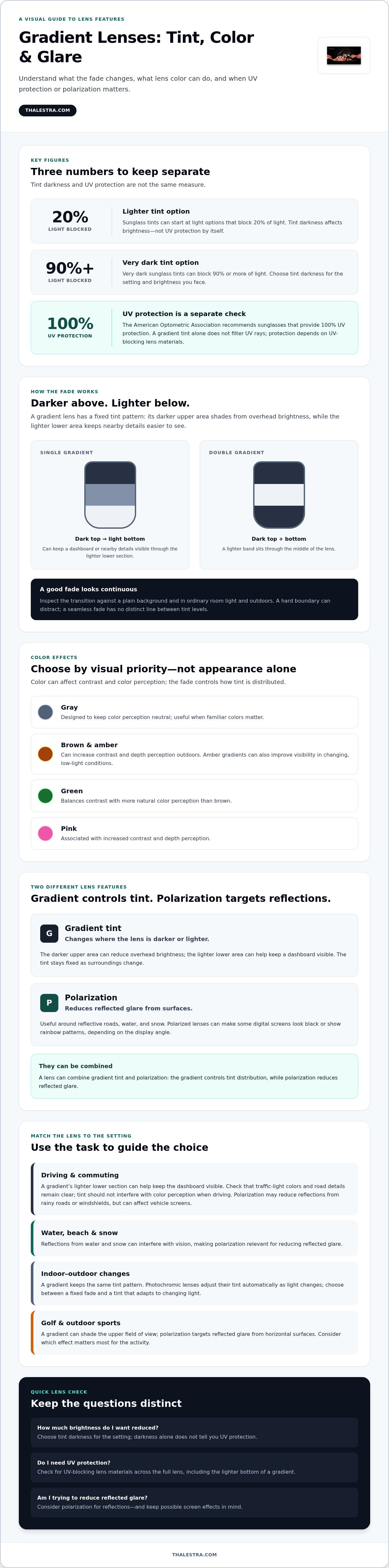
A gradient lens is darker across the top and fades lighter toward the bottom. This pattern shades your eyes from overhead light while keeping the lower part clearer for nearby details, such as a phone or dashboard. A double-gradient design is darker at both the top and bottom, with a lighter band through the middle. Inspect the fade across the full lens: a quality transition looks seamless, without a distinct line between tint levels.
Check the transition in ordinary room light and outdoors. Hold the lens against a plain background, then shift your gaze from the darker upper area to the bottom. A hard boundary can distract from your view, while an even fade looks continuous. Gradient sunglasses have a fixed tint pattern, so the lighter lower section stays lighter rather than changing with the surroundings.
Choosing Color and Tint Darkness
Choose a color based on the visual priorities of your usual setting. Brown and amber tints can increase contrast and depth perception outdoors; green is described as balancing contrast with more natural color perception than brown. Pink tints are also associated with increased contrast and depth perception. Gray is a practical choice when neutral color perception matters, such as when distinguishing familiar colors in the landscape.
Tint darkness affects brightness, not UV protection by itself. Sunglass tints can range from light options that block 20% of light to very dark options that block 90% or more. A lighter fade may preserve visibility in the lower visual field, while a darker tint can be more comfortable in intense brightness. Match the choice to where you’ll wear the glasses, not just the color of the frame.
Check the lens’s UV-blocking materials separately from its tint. The American Optometric Association recommends sunglasses that provide 100% UV protection. A gradient tint alone doesn’t filter UV rays, but a lens made with UV-blocking materials can protect across the full surface, including its lighter bottom. Polarization can also be combined with a gradient tint; it reduces reflected glare, while the gradient controls tint distribution.
Photochromic lenses work differently: their tint adjusts automatically as light changes, while gradient lenses retain a fixed dark-to-light pattern. If the light shifts during the day, photochromic lenses adapt; if you prefer consistent shade above and a lighter lower section, a gradient may suit your routine. Amber gradients can also improve visibility in changing, low-light conditions.
Gradient Sunglasses vs Polarized Sunglasses: What's the Difference?
Gradient describes how tint is distributed across a lens; polarization reduces reflected glare. The distinction matters for driving, outdoor activities, and screen use because each feature affects vision differently.
The cost of prescription gradient lenses varies with the prescription and the lens and frame features you choose. There isn’t one fixed price for every pair; lens design and materials affect the final cost.
Gradient tint can reduce sunlight glare while leaving the dashboard easier to see through the lighter lower section. Polarized lenses instead reduce reflections from surfaces such as roads, water, and snow. They can also make some digital screens look black or show rainbow patterns, so screen visibility may change with the display angle.
Use Across Activities and Settings
Lens choice depends on the light and reflective surfaces in each setting. During a commute, a gradient’s lighter lower zone can keep the dashboard visible while its darker top reduces overhead brightness. At the beach, on water, or in snow, polarized lenses reduce reflections that can interfere with vision.
Golf and other outdoor sports involve changes in direction, view, and sunlight. A gradient can shade the upper field of view, while polarization targets reflected glare from horizontal surfaces. For fishing or boating, water reflections make polarization especially relevant. When shopping or walking between indoor and outdoor spaces, a fixed gradient stays the same tint; it doesn’t adapt automatically like photochromic lenses.
Driving Suitability and Local Requirements
For driving, suitable lenses should keep the dashboard clear and allow reliable recognition of traffic-light colors. The American Optometric Association recommends that sunglass tint shouldn’t interfere with color perception when driving. A gradient can help keep the dashboard visible, but its tint must still let the driver distinguish signals and road details.
Before driving, look through the lens at the dashboard and traffic signals in daylight. Check that the dashboard remains readable through the lighter lower area and that the tint doesn’t distort signal colors. Local driving requirements can differ, so use lenses appropriate to the rules where you drive. Polarization may reduce reflections from rainy roads or windshields, but it can affect digital screens in the vehicle.
For a practical comparison, view a road, a reflective window, and a dashboard through each lens style. Gradient sunglasses manage tint distribution; polarized sunglasses reduce reflected glare. Some lenses combine both technologies, so the choice isn’t always either-or. Match the feature to your main task: dashboard visibility, glare reduction, or frequent screen viewing.
Choosing lenses for everyday wear or outdoor performance
Match sunglasses to the light you face most often: changing indoor and outdoor settings, or sustained brightness and reflected glare. A gradient keeps its tint pattern fixed, so the darker top and lighter lower area behave consistently as you move between places.
For everyday wear, consider a commute that takes you from a bright sidewalk into a shaded store. The lighter lower lens can make a phone, menu, or nearby object easier to see while the upper section shades sunlight. Gradient sunglasses can suit these transitions, but they don’t automatically change tint when the surroundings become darker.
At work, consider how often you move between windows, indoor lighting, and outdoor spaces. A fixed gradient can reduce overhead brightness outside, while its lighter bottom allows closer viewing. If you regularly enter dim rooms, the darker upper section may feel less suitable until your eyes adjust. Photochromic lenses offer a different approach because their tint adjusts automatically as light changes.
Outdoor reading is a practical use for gradient lenses. At a café table, the upper section can shade sunlight while the clearer lower zone helps you read a book or menu. For phone or tablet use, check the screen through the lens from your usual viewing angle. Polarized lenses can make some digital screens appear black or show rainbow patterns, so polarization may affect screen visibility.
For extended time in direct sunlight, such as lying on a beach, solid-tint sunglasses may be a better match than a gradient with a lighter lower section. On water, snow, or roads, reflected glare can be a greater concern; polarized lenses reduce glare from these surfaces. A gradient and polarization can also be combined, pairing a top-to-bottom tint fade with glare reduction.
- Daily commuting: Consider the dashboard, phone, and changing shade along your route.
- Outdoor reading: Check whether the lighter lower area keeps text comfortable to see.
- Beach or snow: Consider solid tints or polarization for sustained brightness and reflected glare.
UV protection remains separate from tint style. The American Optometric Association recommends sunglasses that provide 100% UV protection. A gradient pattern alone doesn’t filter UV rays; UV-blocking materials are needed across the lens, including its lighter lower portion. For a final choice, compare the lens in the conditions you actually use: a screen outdoors, a printed page, and a shaded indoor space.
How Do Gradient Tints Actually Work?
A gradient tint places more color at the top of the lens and less toward the bottom. This design changes where brightness is reduced across your field of view.
How Gradient Tints Transition
In a gradient lens, tint concentration is strongest at the top, then fades lighter toward the bottom. The transition can be subtle or more noticeable, but a quality lens has no distinct line dividing tint levels. A smooth fade matters because your eyes move across different areas of the lens during ordinary tasks. A gradual shift keeps the visual change even as you look from a distance toward something close.
Look across the lens against a plain background to assess the fade. A clear band or abrupt change suggests a less seamless transition. Gradient eyewear may also use a double-gradient design, with darker tint at both the top and bottom and a lighter area between them. Each pattern distributes shading differently across your field of view.
Gradient and Solid Tint Design
A solid tint uses a similar shade across the lens, reducing brightness evenly from top to bottom. A gradient instead concentrates darker tint in one area, leaving another area lighter. This difference affects how the lens feels in use: solid tints provide consistent shading, while gradients balance a darker upper view with a brighter lower view. Choose based on whether even brightness reduction or varied shading better suits the activity.
For example, a solid tint can suit extended time in direct sunlight, such as relaxing on a beach. A gradient may be more useful when you want a darker upper lens but still need a lighter lower area for close viewing. Neither design automatically indicates UV protection. That depends on the lens materials, not the tint pattern.
Color adds another visual effect. Gray gradient lenses reduce brightness while maintaining natural color balance, making them useful when neutral color perception matters. Brown and amber tints can block blue light and increase contrast and depth perception. Green is described as offering balanced contrast and more natural color perception than brown, while blue can provide a distinct style choice. Tint color affects visual perception; the gradient determines where the lens is darker.
Gradient and solid tints can both be combined with polarization. Polarization reduces reflected glare, while tint design controls the distribution of shading. A polarized gradient lens therefore combines two separate features rather than making the fade itself stronger. In bright outdoor conditions, consider both the tint pattern and whether reflections are the main issue. For everyday eyewear, focus on the visual tasks you perform through the lighter or darker lens areas.
Gradient lenses for changing light conditions
Gradient lenses keep a fixed tint pattern, so they don’t adjust as clouds pass or you move indoors. Amber gradients can improve visibility in changing, low-light conditions, but a darker tint may reduce useful light on a cloudy day.
Changing Light Conditions
A gradient lens maintains its darker upper area and lighter lower area as the surrounding light changes. This fixed pattern can suit a route with bright sky above and shade below, such as a walk beside tall buildings. Choosing gradient lenses for different light conditions means considering the direction of sunlight as well as its brightness. The tint won’t adapt automatically when the sky darkens.
Under a bright, overcast sky, the darker top still shades overhead light, while the lighter bottom allows a clearer view of nearby objects. On a route from sunlight into a shop, however, the pattern stays unchanged. That consistency can support visual tasks, but repeated indoor and outdoor transitions may feel less comfortable than with an automatically adjusting tint.
Low-Light and Cloudy Conditions
Gradient lenses can suit cloudy conditions when their tint isn’t too dark for the available light. Amber gradient lenses are described as improving visibility in changing, low-light conditions. The key consideration is whether the darker upper area still allows comfortable viewing in your usual setting.
On a dim street or heavily clouded afternoon, compare how tinted glasses affect details in shaded areas. A dark upper section can make the scene feel dimmer, even though the lower section is lighter. If you struggle to see clearly, a lighter tint may be a better fit for that setting. Choose gradient lenses for different light conditions based on the light you actually encounter, not color alone.
Photochromic lenses respond differently: their tint adjusts automatically as light changes, while gradient lenses retain a fixed pattern. That distinction matters on days with repeated transitions between a bright sidewalk and indoor spaces. A gradient offers a consistent fade; photochromic lenses change tint as lighting shifts. Neither feature alone establishes UV protection, which depends on UV-blocking lens materials.
UV protection still matters on cloudy days. A quality gradient lens made with UV-blocking materials can block 100% of UV rays across its surface, including the lighter lower portion. The gradient tint itself doesn’t filter UV rays. Judge UV protection separately from lens color, tint darkness, and visual comfort.
Use your regular environment to guide the decision: amber for changing, low-light visibility, a lighter tint for cloudy conditions, or photochromic lenses for automatic adjustment. If you prefer a fixed gradient, consider whether its darker section remains comfortable when sunlight fades. The right option should support clear, comfortable vision in the conditions you face most often.
THALESTRA.COM: 2025 Vacation Sunglasses For Men
THALESTRA.COM offers sunglasses for different preferences, including the 2025 Vacation Sunglasses For Men. If changing light is a priority, LIOUMO Top Quality Photochromic Polarized Sunglasses combine photochromic and polarized features. For reflected glare from roads, water, or snow, Classic Mens Polarized Sunglasses offer a polarized option.
Use the distinctions in this guide to match your choice to daily routines, outdoor brightness, and screen use. Gradient tint stays fixed, photochromic tint adjusts to light, and polarization reduces reflected glare. These features address different needs, so choose based on the conditions you face most often.
Visit THALESTRA.COM to browse its sunglasses options.
Make Your Next Lens Choice With Purpose
Let your everyday routine guide your final choice. Consider where you spend time, which visual tasks matter most, and whether changing light or reflected glare is the bigger concern. This simple checklist can help you compare lens features without choosing by color or style alone.
Gradient lenses for different light conditions are most useful when their fixed tint pattern suits the environments you regularly move through. If you’re comparing that option with lenses that adjust to light or reduce reflections, focus on the feature that solves your main need. THALESTRA.COM offers 2025 Vacation Sunglasses For Men, LIOUMO Top Quality Photochromic Polarized Sunglasses, and Classic Mens Polarized Sunglasses.
For help exploring the available options, ask THALESTRA.COM about lens options. Choose the pair that fits your routine and enjoy a more considered approach to everyday eyewear.
Frequently Asked Questions
What Is a Gradient in Lenses?
A gradient describes a lens tint that changes gradually across its surface. Imagine looking through glasses at a bright window: the upper area has a stronger tint, while the lower area is lighter. The gradual change is the defining feature, not the frame shape or lens color. Some designs use a single fade; double-gradient lenses are darker at both the top and bottom, with a lighter middle band.
Are solid lenses better for bright sunlight?
Solid-tint sunglasses can be a practical choice for extended time in direct sunlight, such as lying on a beach. Their similar tint across the lens gives consistent shading instead of leaving a lighter lower area. The best choice still depends on the activity and how much brightness feels comfortable. For example, someone reading outdoors may value a lighter lower view, while someone facing sustained sunlight may prefer an even tint.
Can you combine both technologies?
Yes. Gradient tint and polarization are compatible and can be combined in one lens. They address separate visual effects: the gradient changes tint distribution from top to bottom, while polarization reduces reflected glare. For example, polarized gradient sunglasses can suit a day involving both overhead sunlight and glare from a road. Remember that polarized lenses can affect digital screens, so view a phone or dashboard through them before relying on screen visibility.
Do gradient sunglasses protect your eyes from UV rays?
They can protect against UV rays when the lenses use UV-blocking materials, but the gradient tint alone doesn’t provide UV filtering. A lighter-looking section isn’t automatically unprotected if the lens materials block UV across its surface. The American Optometric Association recommends sunglasses with 100% UV protection. Treat UV protection and visible tint as separate features, especially when comparing a dark-looking lens with a clear or lightly tinted one.
How should you choose lenses for your everyday routine?
Start with the places and tasks that make up an ordinary day. If you move between a car, a bright sidewalk, and indoor shops, consider whether a fixed tint suits those transitions. If you spend long periods outdoors near water or roads, reflected glare may be a key concern. Include screens in your comparison: some polarized lenses can alter how screens look. Choose based on your routine, not frame style alone.
What are gradient lenses and how do they work?
Gradient lenses have a tint that shifts across the lens rather than staying uniform. The tinting process places a higher concentration near the top, then reduces it toward the bottom. This creates different brightness levels within one lens. For example, looking at a distant object through the upper area feels different from viewing a book through the lighter lower area. A smooth fade avoids a distinct boundary.
Which gradient lens tint is best for bright sunlight?
There isn’t one color that suits everyone in bright sunlight; tint darkness and color perception both matter. Gray reduces brightness while keeping color perception relatively neutral. Brown and amber can increase contrast and depth perception outdoors. For sustained direct sunlight, a solid tint may offer more even shading than a gradient. Choose UV-blocking materials separately, since color and darkness alone don’t establish UV protection.
How do gradient lenses compare with polarized and photochromic lenses?
Gradient describes where tint sits, polarization reduces reflected glare, and photochromic lenses adjust tint automatically as light changes. These terms describe different features, not three mutually exclusive lens types. A gradient can be polarized, while photochromic lenses address changing brightness. For example, someone commuting past reflective roads may prioritize polarization, while a person moving between indoors and outdoors may value automatic tint adjustment. Screens can look different through polarized lenses.