
The darkest lenses aren’t automatically the safest choice. If you’re choosing sunglasses for bright light, lens darkness can reduce visible brightness, but it doesn’t tell you how much UV protection the lenses provide. Reflected glare from roads, water, and other bright surfaces can also make outdoor time uncomfortable, and a darker tint alone may not solve it.
Tint, polarization, and photochromic technology address different needs, so it helps to compare them separately. This guide explains how brightness reduction differs from UV protection, when polarized lenses may help with reflected glare, and how photochromic lenses respond to changing light. You’ll also learn to consider frame coverage and your everyday activities, then check product specifications instead of judging protection by lens color or appearance. Use these steps to compare options for driving, time near water, and other bright conditions.
Key Takeaways
- Choose sunglasses for bright light by first identifying what causes discomfort, such as direct sun or reflected light.
- Match lens features to your setting, from everyday outdoor use to time near water or on bright roads.
- Check the UV protection and other lens specifications on the product listing, then consider fit and frame coverage.
- Use a simple selection order: identify the light source, choose relevant features, and verify the specifications before choosing a style.
- THALESTRA.COM offers polarized and photochromic sunglasses categories. Compare each listing’s details with your needs.
Why bright light feels uncomfortable, and what sunglasses can change
Squinting, watery eyes, or a washed-out view can make an outdoor walk, drive, or day near the water uncomfortable. Bright conditions don’t all affect your vision in the same way. Sunlight reaching your eyes directly creates one challenge; light bouncing off nearby surfaces creates another. Identify the source of discomfort before choosing sunglasses for bright light, rather than relying on how dark the lenses look.
Brightness reduction means a lens limits visible light reaching your eyes, making a scene appear less bright. UV protection refers to the lens’s ability to block ultraviolet radiation. These are different properties: a tint can look dark without confirming UV protection, so check the lens specifications separately. For a general overview of sunglasses and their design, see the linked reference.
Direct sunlight and reflected glare are not the same
Direct sunlight reaches your eyes from the sun. Reflected glare comes from light bouncing off surfaces such as water, roads, or snow. It can be especially distracting when you’re looking across a bright surface. Your surroundings and activity matter: walking on a shaded path differs from driving on a sunlit road or spending time beside water. Notice which situation triggers discomfort before choosing a lens feature.
Does a darker lens protect eyes better?
No. Lens darkness alone doesn’t establish how much UV protection a pair provides. Tint affects perceived brightness, while UV protection must be confirmed through the stated lens specifications. Before buying, look for clear UV information rather than relying on color or appearance. For more context, read how non-UV-protected sunglasses can affect eye health.
When comparing pairs, remember that tint affects how bright a scene looks, while UV protection concerns ultraviolet exposure. Don’t assume a dark tint covers both needs. Check the listing for UV details, then consider whether reflected light is also a problem. Polarization is a lens feature associated with reducing certain reflected glare, but it doesn’t replace checking UV specifications.
A quick way to frame your choice is to ask:
- Is direct sunlight making you squint?
- Is reflected light from water, roads, or snow causing discomfort?
- Does the product listing clearly state its UV protection?
These questions turn a broad search into a practical comparison. Start with the light source and activity, then compare the relevant lens details. Appearance can guide your style choice, but it can’t confirm a lens’s UV protection.
How lens tint, UV protection, and polarization work in bright light
When comparing sunglasses for bright light, separate three questions: how bright the scene feels, whether the lenses provide UV protection, and whether reflected glare is a problem. Tint changes visible light, polarization filters certain reflected glare, and UV protection concerns ultraviolet radiation. These features serve different purposes.
This distinction helps prevent a common mix-up. A lens can be dark, polarized, or both, but neither appearance nor polarization alone confirms its UV specifications. Prevent Blindness offers more background on sunglasses and eye protection.
What lens tint can, and cannot, tell you
Tint changes the amount and character of visible light reaching your eyes, so a scene may look dimmer or have a different visual quality. No single tint is automatically right for every bright setting. Choose based on your surroundings and comfort, then check the product label or listing for specific UV protection claims. Treat tint and UV details as separate checks.
When polarized lenses may help with glare
Polarization is relevant when reflected glare is the main discomfort, such as light bouncing off water or a bright road. A polarization filter can reduce certain intense reflections, but it doesn’t guarantee perfect visibility in every condition or confirm UV protection. For a deeper explanation, read this guide to polarized lenses and glare reduction.
Quick lens-feature comparison
- Tint: Changes perceived brightness and the character of visible light. Check it against your setting and preference.
- UV protection: Describes protection from ultraviolet radiation. Verify the stated UV specifications on the product listing.
- Polarization: Reduces certain reflected glare, which can matter around water or on bright roads. It’s a glare feature, not a UV rating.
Use these features as separate filters, not interchangeable labels. If sunlight itself feels harsh, consider tint and coverage. If reflections are the issue, polarization may be worth comparing. For any pair, confirm UV claims in the specifications instead of assuming a dark lens or polarized label provides them.
THALESTRA.COM offers polarized and photochromic sunglasses categories. You can compare polarized and photochromic sunglasses while checking each listing for its stated UV protection and other lens details.
Which sunglasses features suit different bright-light situations?
The right features depend on what you’ll be doing and what kind of light is bothering you. Use the table as a starting point for comparing sunglasses for bright light, not as a guarantee that one lens will suit every person or condition. Treat comfort choices separately from protection: verify UV specifications for the specific pair, regardless of tint, polarization, or intended use.
| Situation | Likely light source | Features to consider |
|---|---|---|
| Everyday outdoor use | Direct sunlight and changing shade | A comfortable tint and fit for regular wear. Check the stated UV protection on the product listing. |
| Near reflective water | Sunlight reflected from the water’s surface | Polarization may be worth considering if reflected glare is your main discomfort. Verify UV protection separately. |
| Bright roads or driving | Direct sun and reflections from road surfaces | Consider whether polarization matches your glare concerns, and assess tint and fit for your activity. Check the lens specifications rather than relying on appearance. |
| Outdoor light that changes | Shifts between sun and shade | Photochromic lenses are designed to adapt their tint as light changes. Check the product details for the specific lens behavior. |
Bright days near water, roads, and open spaces
Reflective surroundings can make glare reduction a useful feature to compare, especially when bright reflections cause discomfort. Polarized lenses may help reduce certain reflected glare from water or roads, but they can’t promise perfect visibility in every setting. Keep comfort and protection checks distinct: confirm the pair’s stated UV protection independently of its tint or polarized label. For additional consumer guidance, consult the FDA guidelines on sunglasses.
Changing light and photochromic lenses
Photochromic lenses are designed to adapt their tint as light changes. This feature may be relevant if your day moves between brighter and more shaded environments. Don’t assume the response is identical in every environment or condition. Review the specifications for the pair you’re considering, and read how photochromic lenses adapt to light for a focused explanation.
Use the setting to narrow down comfort features, then verify protection claims on the product listing. THALESTRA.COM offers polarized and photochromic sunglasses categories. Compare polarized and photochromic sunglasses by their stated details before choosing.
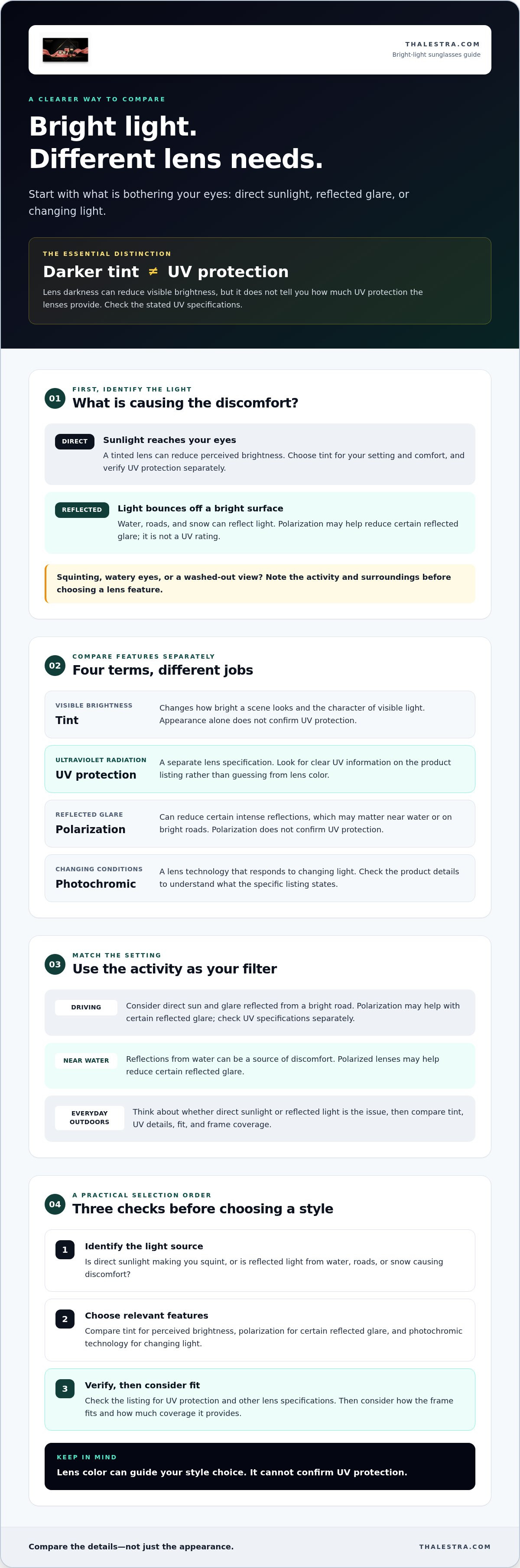
How to choose sunglasses for bright light: a practical checklist
A simple comparison process can help you select sunglasses for bright light without letting lens color or frame style make the decision for you. Start with the setting, check the lens details, then assess fit and appearance.
- Name the setting and discomfort. Note whether you’ll be outdoors in changing light, near reflective water, or on bright roads. Identify whether direct brightness or reflected glare is the main issue.
- Confirm UV specifications. Find an explicit UV protection statement in the product listing. If it’s missing or unclear, don’t assume the lens tint or a marketing phrase confirms protection.
- Check the lens features. Look for polarization if reflected glare is a concern, or photochromic details if you want lenses designed to adapt their tint as light changes. Confirm that the feature is stated for the specific pair.
- Consider coverage and fit. Check how the frame sits and whether its coverage seems appropriate for your intended use. Comfort and fit vary, so review the product measurements and details before deciding.
- Review activity-specific information, then style. If you plan to drive or use the sunglasses for another activity, check the product details for suitability rather than assuming any pair will work. Once the essentials are clear, choose a frame style you like.
Check the lens specifications before the frame style
Product photos can show tint and appearance, but they can’t establish UV protection or confirm a feature that isn’t listed. Read the written specifications for UV protection, polarization, and photochromic behavior. If an important detail isn’t provided, don’t infer it from the image, product name, or general promotional language. Compare listed features side by side.
Match coverage and fit to everyday use
Choose coverage and fit with your regular setting in mind, whether you’re walking outdoors or spending time near reflective surfaces. A frame that feels comfortable to one person may not fit another the same way. If you’re ordering online, review the available product details and return policy before buying, where those policies are provided.
Listing check: “Does this pair state its UV protection, identify the lens features I need, fit my intended activity, and offer a comfortable-looking fit and coverage?”
Use that checklist before letting style decide. Compare polarized and photochromic sunglasses and review each listing’s stated specifications.
Explore sunglasses for bright light at THALESTRA.COM
A useful selection sequence is simple: identify the light source, choose features relevant to your setting, then verify the specifications for the pair you’re considering. If direct brightness is the main issue, compare tint and fit. If reflections from water or roads are bothering you, check whether polarization is listed. For changing outdoor light, compare photochromic options and their stated details. These features address different preferences, so don’t treat one as a substitute for checking another.
Use the lens-feature descriptions as a starting point, then review each product listing for its specific details. A category name alone doesn’t establish UV protection, lens performance, or whether a particular pair suits every activity.
Compare polarized and photochromic options
Polarized and photochromic describe different lens features. Polarization is relevant to shoppers considering reflected glare; photochromic lenses are designed to adapt their tint as light changes. Don’t assume every pair combines both. Compare listings with your usual conditions in mind, such as glare near water or moving between sunny and shaded areas. Confirm which features are specified for the individual pair.
Make a specification-led choice
Before choosing by appearance, check the product details. UV protection is a separate specification from lens darkness, polarization, and photochromic behavior. If the UV information isn’t clearly stated, don’t infer it from a dark tint, a product name, or a polarized label. Review the available details and consider whether the listed features match your setting and everyday use.
Use this quick comparison checklist:
- What light source or reflection is causing discomfort?
- Which lens features are explicitly stated for this pair?
- Does the listing clearly specify UV protection?
- Do the fit, coverage, and product details suit your intended use?
Take a specification-first approach to choosing sunglasses for bright light: match the features to your surroundings, confirm the UV details, and then select a style you like. Browse sunglasses at THALESTRA.COM and compare the available product specifications.
Make your next pair a considered choice
Choosing sunglasses for bright light doesn’t have to start with the darkest lens or the trendiest frame. Begin with the conditions you usually face, compare features that match those conditions, and verify the specifications listed for the pair. That order helps separate personal comfort preferences from protection details.
THALESTRA.COM offers polarized and photochromic sunglasses through its online storefront, with product details available for international customers. Compare the stated features and UV information on each listing rather than assuming every pair offers the same combination.
Use the product details to narrow your choices, then choose a pair that fits your everyday needs.
Frequently Asked Questions
Are darker sunglasses better for bright light?
Not necessarily. Darker lenses reduce perceived brightness, but their appearance doesn’t show how much ultraviolet protection they provide. Check the product label or listing for an explicit UV protection specification instead of choosing by tint alone. Consider tint for visual comfort in your usual setting, then verify UV protection separately. These checks answer different questions, so a dark lens shouldn’t be treated as proof of protection.
Do polarized sunglasses protect your eyes from UV rays?
Not by themselves. Polarization is a feature for reducing certain reflected glare, while UV protection is a separate lens specification. A pair may be polarized, but you still need to check its stated UV details. Look for clear labeling, such as a UV400 or 100% UV protection claim, and confirm that the claim applies to the specific pair. Don’t infer UV protection from a polarized label.
What sunglasses are best for bright sunlight?
The best choice depends on whether you’re dealing with direct sun, reflected glare, or changing light. For sunglasses for bright light, first consider the setting and activity, then compare lens features and fit. Check the product listing for explicit UV protection, and consider polarization if reflections are a concern. No tint or feature is automatically best for everyone, so use listed specifications and personal comfort to narrow your options.
Can photochromic sunglasses work well in very bright light?
They may suit some bright-light routines, but performance depends on the particular lenses and conditions. Photochromic lenses are designed to adapt their tint as light changes. Don’t assume they’ll darken equally in every environment or become as dark as you prefer. Review the product’s stated lens behavior and UV protection separately. If you spend long periods in intense sun, compare the listed specifications with that use before choosing.
Are polarized sunglasses better for driving in bright conditions?
They may be worth considering if reflected glare from roads is a major source of discomfort. Polarization can reduce certain reflected glare, but it doesn’t guarantee ideal visibility in every driving situation or confirm UV protection. Check the lens details and any activity-specific suitability information in the product listing. Also consider fit and comfort for regular driving, since an uncomfortable pair may be distracting during use.
How can I tell if sunglasses have UV protection?
Look for explicit UV protection information on the product label or listing. A UV400 or 100% UV protection claim indicates blocking UVA and UVB rays. Lens darkness, color, and polarization aren’t substitutes for that specification. If a listing doesn’t clearly state UV protection, don’t assume it’s present based on a photo or general marketing language.
What is the difference between glare reduction and UV protection?
Glare reduction helps manage uncomfortable visible light reflected from surfaces, while UV protection concerns ultraviolet radiation. Polarization is a lens feature that reduces certain reflected glare; a UV rating states protection from UV rays. A pair can have one feature without the other, so check both separately in its specifications. Tint can make a scene appear less bright, but it doesn’t establish either polarization or UV protection.