
A premium label doesn’t tell you whether sunglasses will protect your eyes, fit comfortably, or come with clear buying terms. Premium sunglasses direct to consumer can be worth considering, but judge each pair by details you can check, not polished photos or broad claims.
It’s reasonable to hesitate when lens specifications are vague, frame proportions are hard to assess on screen, or seller policies are difficult to find. Make the decision more practical: check the product page for stated UV protection and lens features, compare frame measurements with sunglasses you already wear, and review the seller’s current order, shipping, and return information before buying.
This guide covers the everyday criteria that matter: lens features, fit, seller transparency, and checkout details. You’ll also find what to check when a listing leaves out key information, so you can compare options and choose a style that suits your needs.
Key Takeaways
- Premium sunglasses direct to consumer describes a sales channel, not a guarantee of lens quality, frame durability, or manufacturing origin.
- Compare lens type and stated UV protection separately. Polarized and photochromic features don’t establish a particular level of UV protection.
- Use frame measurements, fit details, and available visual tools to assess how a style may suit you before ordering.
- Check who sells the sunglasses, then review current policies and order details before checkout.
- THALESTRA.COM lists polarized and photochromic options. Compare each product page for its stated specifications.
What Does Premium Sunglasses Direct to Consumer Actually Mean?
Premium sunglasses direct to consumer describes a sales channel and a market position, not a verified quality grade. “Direct to consumer” means shoppers can buy through a seller’s own online storefront. “Premium” is a positioning term unless supported by specific, checkable product details. Neither label confirms lens performance, frame quality, who designed or made the sunglasses, or whether they’ll fit you.
A polished website and confident product language can make general claims sound like evidence. Evaluate each pair on its own: identify the seller, inspect the product information, and separate stated specifications from claims you can’t verify.
What does direct-to-consumer mean when buying sunglasses?
The term describes how a seller reaches shoppers, commonly through an online storefront where customers can browse products and place orders. It doesn’t establish where a product was designed or made. A DTC label isn’t proof that the seller made the frames, controls every part of production, or offers a particular level of support.
Start with the seller name shown on the site and at checkout. Then review the details for the specific pair instead of assuming general storefront claims apply to every listing. For a neutral overview of sunglasses, including lens types and construction, use a reference source alongside the seller’s product information.
What should premium sunglasses offer beyond a premium label?
Look for useful evidence in four areas. A detailed listing helps you assess the product, while clear seller information explains the transaction. Words such as “designer,” “high quality,” or “premium” may describe positioning, but they don’t replace specific details.
- Lens specifications: Check the stated lens type and protection claims. Treat each as a feature to verify, not something to assume from the price or label.
- Frame details: Look for stated materials and dimensions. Don’t infer construction from a photograph or style description.
- Fit information: Review measurements and any fit guidance. A product image can’t confirm how frames will sit on your face.
- Seller and policies: Identify who takes the order, how to contact the seller, and where current purchase and order information is explained.
Keep brand positioning, product specifications, customer support, and purchase policies separate. None is a substitute for another. A detailed lens description doesn’t explain the seller’s policies, and clear policies don’t verify a lens claim. Compare the evidence for each pair. If a detail is missing, treat it as a question to resolve before ordering, not as a feature you can assume.
How to Compare Premium DTC Sunglasses: Lenses, Frames, and Fit
Compare individual pairs, not just brands or storefronts. A side-by-side review can show which listings provide useful details and which leave important questions unanswered. This matters for Premium sunglasses direct to consumer, where you may need to judge lenses and fit from product information and images.
The sales model explains how a retailer reaches customers, not whether a specific pair meets your needs. For broader context on the business model, Direct-to-consumer (DTC) brands are discussed by Harvard Business Review. For a purchase decision, focus on the exact product listing and current seller information.
| Compare | What to check | If information is missing |
|---|---|---|
| Lens type | Whether lenses are described as polarized, photochromic, tinted, or another type. | Don’t assume one feature implies another. |
| Protection claims | The stated UV protection claim for that exact product. | Ask the seller or verify the claim before relying on it. |
| Frame details | Listed materials and dimensions, if provided. | Don’t infer material or size from photos alone. |
| Fit information | Measurements, fit guidance, and clear product images. | Compare with a pair you already wear, if dimensions are available. |
| Seller policies | Current return or exchange terms and purchase information. | Review the terms before ordering rather than assuming fit can be corrected later. |
Which lens details should you compare first?
Separate UV protection claims from lens characteristics. Polarized lenses are designed to reduce glare, while photochromic lenses change tint in response to light conditions. Tint describes the lens’s appearance. None of these features, by itself, confirms UV protection. Check the UV claim on the exact product page and seek clarification if the wording is unclear or unsupported. You can also consult dedicated explainers on polarized lens benefits and photochromic lenses for more detail.
How can you assess frame fit from an online listing?
Look for frame measurements, images from multiple angles, and fit descriptions. If dimensions are listed, compare them with sunglasses that already fit comfortably. Images can help you judge shape and proportions, but they can’t confirm how a frame will sit on your face. Read the seller’s current return and exchange terms before ordering. Don’t assume they allow returns for fit.
THALESTRA.COM lists polarized and photochromic options. You can compare polarized and photochromic sunglasses by checking each product page for its current specifications and purchasing details.
DTC vs. Luxury Retail Sunglasses: What the Sales Channel Tells You
A direct-to-consumer storefront and a multi-brand luxury retailer organize shopping differently. One may focus on its own catalog, while the other brings together products from multiple brands. Neither setup proves that a pair is higher quality, authentic, more durable, or better value. For Premium sunglasses direct to consumer, assess the specific product and seller instead of using the sales channel as a shortcut to judge quality.
| What to compare | What you can verify | What not to assume |
|---|---|---|
| Product details | Whether the listing provides specific lens and frame information for the pair. | A luxury label or brand-owned catalog confirms performance or construction. |
| Seller identity | The business named on the storefront, in checkout information, and in its contact details. | A direct sales channel means the seller designed or manufactured the product. |
| Support and order information | How the seller explains customer contact, order updates, and order tracking. | Every retailer offers the same support or tracking options. |
| Purchase policies | Current return, exchange, and warranty terms, if stated. | A premium position guarantees generous policies or a particular remedy. |
Does buying direct guarantee better quality or value?
No. A direct relationship between seller and shopper doesn’t, by itself, establish better materials, lens performance, durability, or value. Don’t assume a DTC seller always has lower prices or better products because there are fewer retail steps. The practical test is specific to the pair: are the product claims detailed enough to assess, and do the seller’s terms work for your purchase?
Brand language is useful only when it points to evidence. “Premium” or “designer” may describe how a product is positioned, but neither replaces clear specifications or explains what happens if an order issue arises. Compare what’s stated, not what a label suggests.
What should you verify when comparing online sellers?
Check who operates each storefront and whether the product page describes features of the exact pair. Look for accessible contact information and clear order guidance. Before checkout, read the current return and warranty information instead of relying on assumptions, snippets, or summaries on other websites. If a term isn’t clear, ask the seller for clarification before placing the order.
A multi-brand retailer may offer convenient brand-to-brand browsing; a DTC storefront may present a focused catalog and direct product pages. These are differences in shopping experience, not automatic quality rankings. Judge both using the same evidence: an identifiable seller, useful product details, and policies you can review before buying.
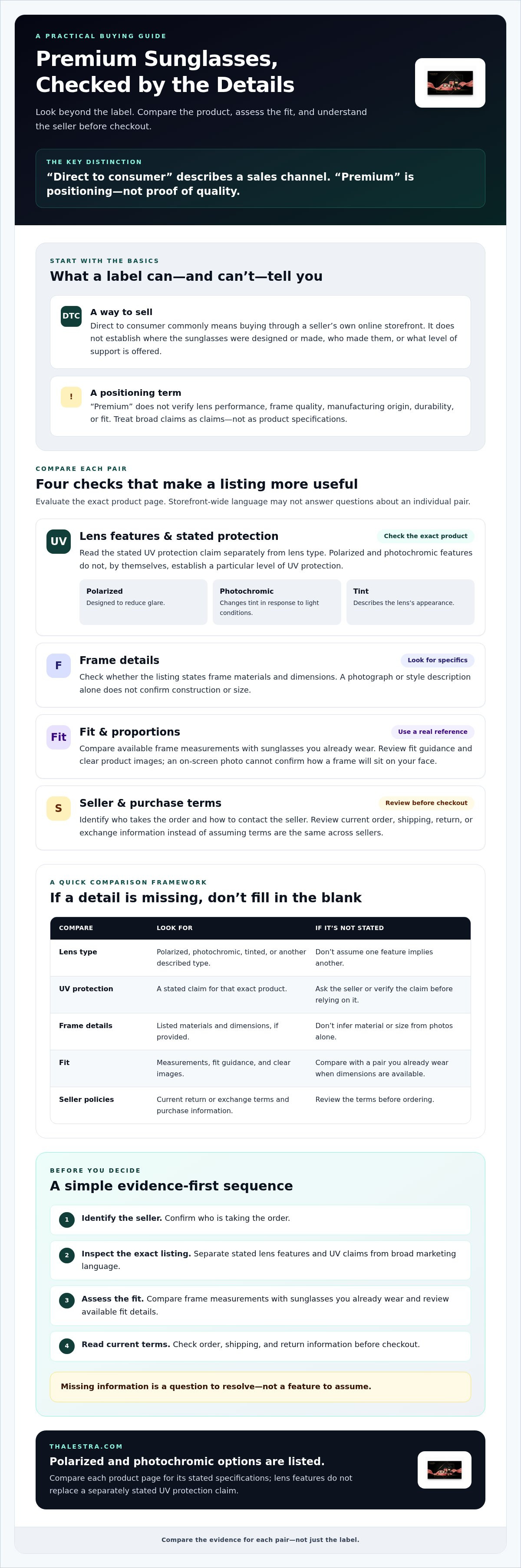
How to Evaluate Premium Sunglasses Online Before You Buy
Use the same checks for every listing, whether you’re browsing a familiar retailer or comparing Premium sunglasses direct to consumer. A consistent process makes gaps easier to spot and helps separate useful product information from broad marketing language.
What five checks belong on an online sunglasses checklist?
- 1. Read the lens description. Identify the stated lens type, such as polarized or photochromic. Check any UV protection claim on the exact product listing. Don’t assume a lens feature confirms protection.
- 2. Verify product specifications. Look for stated lens and frame materials. If a material claim or protection rating is missing, unclear, or difficult to verify, pause and ask the seller before relying on it.
- 3. Assess fit evidence. Review frame dimensions, images from different angles, and any fit guidance. If measurements are provided, compare them with a pair you already wear comfortably.
- 4. Identify the seller. Confirm which business operates the storefront and look for accessible contact details. Know who to contact if you have a question about the order.
- 5. Review purchase and order information. Read the current return, exchange, warranty, shipping, and order-tracking details where provided. Don’t assume a policy applies unless the seller states it for your purchase.
How can you reduce uncertainty about fit and product claims?
Use a familiar pair as a reference. Compare available frame measurements, such as lens width or overall frame width, only when the dimensions are listed and clearly labeled. Photos can help you judge shape and proportions, but they can’t confirm comfort or fit. Check the seller’s current return terms before relying on online fit guidance alone.
For unclear specifications, contact the seller with a direct question about the exact pair. Keep the answer with the product information so you can compare listings on the same basis. If the response doesn’t clarify a material claim or UV rating, don’t treat the claim as verified.
Retro-inspired frames need the same checks as any other style: review dimensions, product details, and seller terms rather than relying on a vintage look or label. A dedicated guide to vintage designer sunglasses can offer additional style context, but it can’t replace the product’s own specifications.
Ready to use the checklist? Compare THALESTRA.COM sunglasses listings and review each product page for current specifications and purchase details.
Explore THALESTRA’s Polarized and Photochromic Sunglasses
THALESTRA.COM is an online retailer with polarized and photochromic sunglasses, alongside styles for men and women. These categories offer different ways to compare listings, but a category name can’t replace checking the details of an individual pair. When considering premium sunglasses direct to consumer, let product-level information guide your choice, not the label alone.
Which THALESTRA.COM sunglasses categories can shoppers compare?
Polarized and photochromic describe different lens characteristics. Polarization relates to glare reduction, while photochromic lenses are described by their response to changing light. A listing may include either term or both, but neither category name confirms UV protection or other product specifications.
Examples listed by THALESTRA.COM include LIOUMO Top Quality Photochromic Polarized Sunglasses and Classic Mens Polarized Sunglasses. Their names identify listed lens categories, not verified performance details. Check each product page for the specific lens and protection claims, along with any available frame dimensions, materials, and fit information. If an important detail isn’t clearly stated, don’t fill the gap with an assumption.
What should you do before placing an online order?
Review the selected listing before adding a pair to your cart. Confirm the product name and features stated for that item, then check whether the listing gives you enough information to assess fit. Review the seller’s current purchase policies and order details as well. Terms can vary, so rely on the information presented by the store rather than assuming a policy applies.
- Match the product: Confirm that the selected listing is the pair you intended to compare.
- Check the evidence: Look for lens claims, protection details, measurements, and fit guidance.
- Review the transaction: Read current policy and checkout information before placing your order.
- Keep order details: Use the store’s available order-tracking feature to follow an order, and consult the retailer’s current instructions.
THALESTRA.COM’s product pages and online cart let shoppers browse listed options and review purchase details. Browse the THALESTRA.COM sunglasses selection, compare the polarized and photochromic listings, and check each item’s current specifications before choosing.
Choose Your Next Pair With Confidence
Assess Premium sunglasses direct to consumer by the evidence attached to each pair, not by a premium label or sales channel. Compare stated lens features and protection claims separately, use available frame measurements to judge fit, and check the seller’s identity and current purchase policies before ordering.
THALESTRA’s online storefront lets you browse listed polarized and photochromic sunglasses, including styles for men and women. Product pages, cart purchases, and order tracking support the online shopping process. Check each listing for its specific product details and current purchasing information.
Ready to compare options? Browse THALESTRA sunglasses and review each listing before choosing. A careful check gives you a clearer idea of what you’re buying and why it suits your needs.
Frequently Asked Questions
What does direct-to-consumer mean for sunglasses?
Direct-to-consumer describes a sales channel where shoppers buy through a seller’s own online storefront. The term doesn’t establish who designed or manufactured the frames, confirm a lens protection rating, or prove a product is premium. Check the exact pair’s product details and identify the seller before ordering. Review the seller’s current purchase policies too, since the channel alone doesn’t explain what support or terms apply.
Are direct-to-consumer sunglasses as good as designer sunglasses?
Neither the sales channel nor designer branding proves that sunglasses are better quality. Compare the specific pair’s lens claims, frame details, fit information, seller identity, and purchase policies. Premium sunglasses direct to consumer may be worth considering, but the label isn’t a substitute for product-level evidence. If important details are missing or unclear, ask the seller for clarification instead of assuming one category is universally superior.
How can I tell whether sunglasses offer UV protection?
Look for a clearly stated UV protection rating on the exact product listing, then check what the claim means. Dark lenses, polarization, and a premium label aren’t proof of UV protection. If the rating or supporting information is absent or ambiguous, ask the seller to clarify it before relying on the claim. You can also compare listings and favor one that explains its protection information more clearly.
Are polarized sunglasses always better for everyday use?
No. Polarization can reduce reflected glare, which some people find useful in bright outdoor settings, but it isn’t the right choice for every activity or preference. It also doesn’t confirm ultraviolet protection. Consider where and how you usually wear sunglasses, then compare those needs with the listed lens features. Check the product’s stated specifications rather than treating “polarized” as a complete description of performance.
Can photochromic sunglasses replace regular sunglasses?
Not necessarily. Photochromic lenses change tint in response to light conditions, but their performance depends on the specific lens and environment. One pair may not suit every setting or activity. Check the product listing for lens details, and consider whether your regular activities call for a dedicated tint or another lens feature. Don’t assume the photochromic label guarantees a particular result in every situation.
How should sunglasses fit when I buy them online?
Review the frame measurements, product images, and fit notes before ordering. If dimensions are listed, compare them with a pair you already find comfortable. This can offer a useful reference, but it can’t guarantee fit. Photos also can’t show exactly how frames will sit on your face. Read the seller’s current return or exchange terms, and ask for clarification if sizing information or policy details aren’t clear.
What should I check before ordering premium sunglasses online?
Verify the exact model’s lens type, stated protection claims, frame details, and available fit information. Confirm who operates the storefront, then review current contact, shipping, return, and warranty details where provided. Broad “premium” or “designer” labels don’t replace this evidence. If a specification or policy is missing, ask the seller before completing your order. Keep the product listing and order information available for reference.