
You're descending a sun-drenched mountain pass at high speed when the road suddenly plunges into a dense, shaded forest canopy. For a split second, you're flying blind; your dark lenses turn the road ahead into a wall of black ink. Every rider understands the frustration of stopping to swap lenses or squinting through a tunnel because they didn't want to carry a second set. It's a common safety risk that high-performance photochromic sunglasses for cycling now solve with rapid-shift technology.
This guide helps you master adaptive eyewear science for perfect visibility. You'll learn how 2026 standards like ISO 12312-1:2022 guarantee protection. Next-generation optics now transition from 10% to 85% light absorption in under half a second. We'll provide a framework for choosing VLT ranges and highlight affordable, high-quality gear. Expect a deep dive into TR90 frame durability, anti-fog coatings for high-intensity climbs, and carbon fiber lightweight options. You'll gain the confidence to purchase professional-grade tech that keeps vision clear from sun-drenched roads to shaded forest trails.
Key Takeaways
- Analyze transition speed mechanics. Darkening efficiency versus fading times under 20 seconds for modern performance lenses.
- Eliminate manual lens swaps with photochromic sunglasses for cycling. Automatic UV response for road glare and MTB dappled light visibility.
- Select lightweight TR90 and carbon fiber frames. Adjustable nose pads and hydrophilic rubberized grips for high-intensity stability.
- Maximize lens longevity. Dark-case storage strategies to preserve adaptive molecules and prevent premature exhaustion.
What Are Photochromic Sunglasses for Cycling?
Photochromic sunglasses for cycling are optical lenses that darken automatically when exposed to specific UV radiation levels. These adaptive lenses serve as a dynamic light management system, adjusting tint density in real-time to match environmental conditions. For a cyclist, the primary advantage is efficiency. You don't need to stop mid-ride to swap lens sets as the sun sets or clouds roll in. It's a critical safety feature for maintaining high-speed visibility. This technology has evolved significantly from early silver halide glass lenses to modern organic photochromic molecules embedded in impact-resistant polycarbonate. High-utility optics. Rapid-tint adjustment. UV400 protection.
The Science of Light-Sensitive Molecules
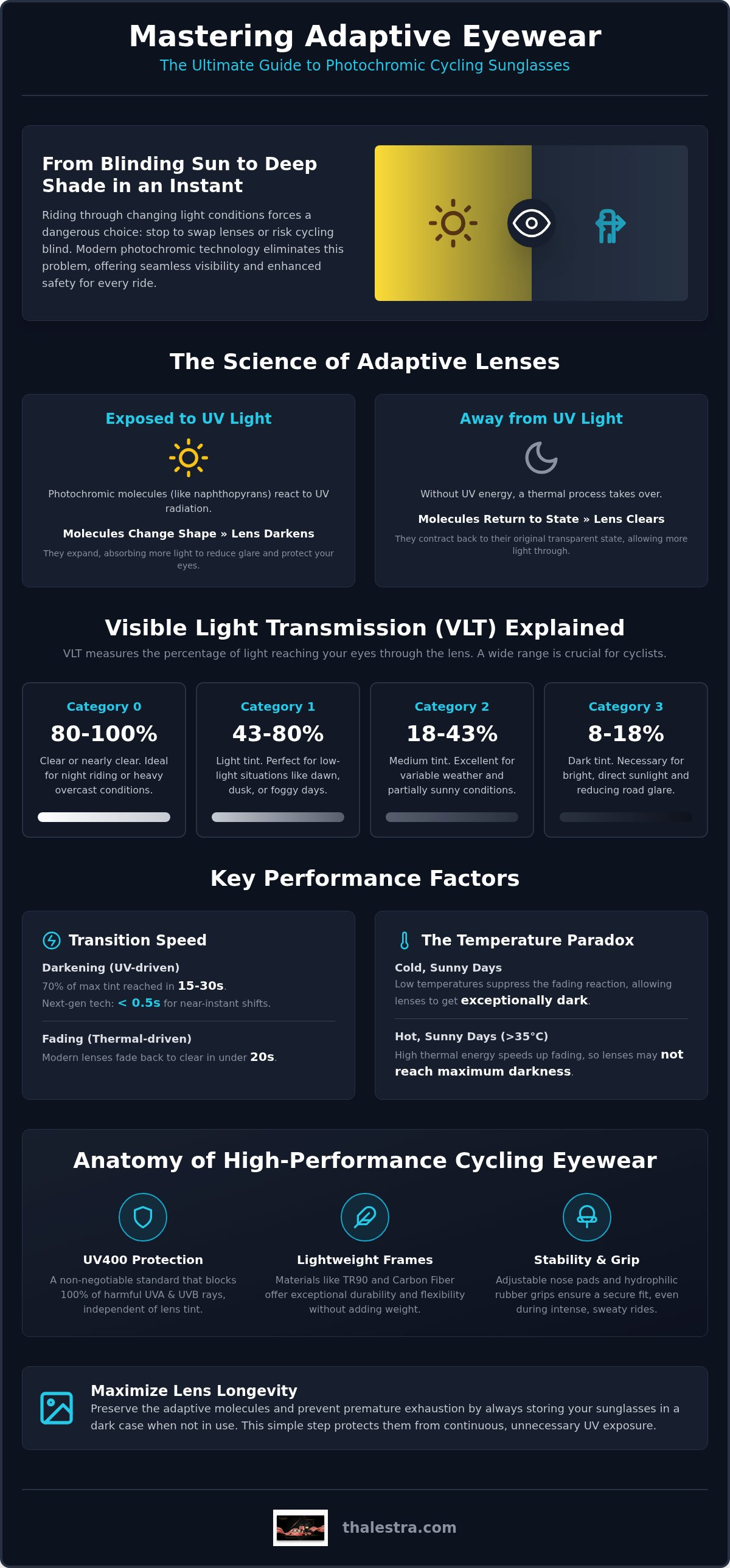
The transition process relies on a complex chemical reaction triggered by ultraviolet (UV) light. When UV rays strike the lens surface, billions of photochromic molecules change their molecular structure. Understanding What Are Photochromic Sunglasses requires analyzing these organic compounds, such as naphthopyrans. These molecules expand when activated, creating a dense shield that absorbs incoming light. When you move into a shaded area, the lack of UV energy causes the molecules to contract back to their original transparent state. Unlike older glass-based technology, modern organic plastic-based lenses are lightweight, shatterproof, and react much faster to changing light. High-performance polycarbonate construction. Lightweight organic molecules. Seamless light transition.
Visible Light Transmission (VLT) Explained
Visible Light Transmission (VLT) measures the amount of light that reaches your eyes through the lens. High-performance photochromic sunglasses for cycling typically cover a wide spectrum of VLT categories:
- Category 0: 80% to 100% VLT. Clear or nearly clear, ideal for night riding or heavy overcast.
- Category 1: 43% to 80% VLT. Light tint for low-light conditions.
- Category 2: 18% to 43% VLT. Medium tint for changing weather.
- Category 3: 8% to 18% VLT. Dark tint for bright, direct sunlight.
A broad VLT range is essential for mountain bikers who frequently transition from open ridges to dense, dark forest canopies. Without this adaptability, your eyes must constantly adjust, leading to significant ocular fatigue. For road cyclists, a lens that reaches Category 3 prevents the squinting and eye strain caused by hours of high-contrast glare on asphalt. Choosing a lens with a wide VLT transition ensures consistent visual comfort regardless of the time of day or terrain. Reduced eye fatigue. Enhanced contrast. Maximum safety.
Performance Factors: Transition Speed and the Temperature Effect
Activation speed often confuses buyers because darkening is always faster than fading back to clear. This isn't a defect; it's a matter of chemistry. Darkening is an active reaction driven by high-energy UV radiation. Fading is a passive thermal process that occurs when that energy source is removed. Modern photochromic sunglasses for cycling now achieve significant tint changes in under 20 seconds. In fact, next-generation 2026 rapid-shift lenses can transition from clear to dark in under half a second, providing near-instant visibility when exiting a tunnel or entering a forest. High-quality organic photochromic lenses typically reach 70% of their maximum tint within 15 to 30 seconds of direct UV exposure.
Most lenses react specifically to UV radiation rather than visible light. This distinction is vital for riders who use their gear for other activities. Lenses won't darken inside a vehicle with UV-blocking glass, but they'll react perfectly on the road. Understanding these Performance Factors helps you choose the right gear for your specific riding environment. High-speed adaptation. Reliable UV response. Consistent optical clarity.
The Temperature Paradox in Photochromic Tech
Heat is the primary factor that slows down the darkening process. Molecules struggle to maintain their expanded, light-absorbing state when thermal energy forces them back to a clear configuration. You'll notice your lenses get exceptionally dark on cold, sunny winter days because the "reversing" reaction is suppressed by the cold. In extreme summer heat above 35°C, the lenses might not reach their maximum darkness. High-altitude riders in cold climates benefit from the deepest tints. If you frequently ride in tropical heat, look for lenses with a lower base VLT to ensure sufficient shade during peak sun hours. Thermal stability. Cold-weather efficiency. High-altitude performance.
UV400 Protection: A Non-Negotiable Standard
Optical safety is independent of lens tint. UV400 protection blocks 100% of UVA and UVB rays up to 400 nanometers regardless of whether the lens is clear or dark. This protection is a molecular property of the polycarbonate material itself. Your eyes stay shielded from harmful radiation even during early morning rides when the lens is at its clearest 80% VLT state. Long-term eye health requires this constant barrier against solar damage. Investing in quality UV protection sunglasses prevents cumulative issues like cataracts or photokeratitis. For riders seeking professional-grade utility, LIOUMO top quality photochromic polarized sunglasses provide the ideal combination of rapid adaptation and permanent UV shielding. Lightweight frames. Impact resistance. Maximum eye safety.
Why Cycling Specific Photochromic Lenses Are Essential
Adaptive vision is a performance necessity for varying terrains. Road cycling demands constant glare management, while mountain biking requires instant clarity in shifting forest shadows. High-performance photochromic sunglasses for cycling provide a hands-free solution that maintains safety by keeping your eyes on the road. You don't have to fumble with interchangeable lenses at 30 km/h. This efficiency allows for total focus on cadence and navigation. It streamlines your equipment and ensures you are never caught with the wrong tint as conditions change. Hands-free safety. Constant visibility. Maximum focus.
Road Performance and Glare Reduction
Endurance road rides often last over four hours, exposing your eyes to varying sun angles and harsh asphalt reflections. The synergy of polarized and photochromic technology is particularly effective here. For instance, LIOUMO top quality photochromic polarized sunglasses reduce horizontal glare from wet roads while simultaneously adjusting tint as the day progresses. This combination significantly lowers eye strain and mental fatigue during long-distance efforts. Transitioning through tunnels or underpasses becomes safer because the lenses begin clearing immediately, preventing the temporary blindness common with fixed dark tints. Reduced ocular fatigue. Enhanced road detail. Superior glare control.
Off-Road Versatility for MTB and Trail
Mountain bikers face the dappled light challenge, where sunlight flickers through forest canopies at high speed. A fixed Category 3 lens is often too dark for these shaded sections, making roots and rocks invisible. Using photochromic sunglasses for cycling with a Category 1 to 3 range ensures you have enough light for technical climbs in the woods while staying protected on exposed ridgelines. Beyond light management, these lenses act as a physical shield. High-impact polycarbonate construction protects against low-hanging branches, kicked-up gravel, and trail debris. Enhanced contrast-boosting tints improve depth perception, allowing for better line choice on technical descents. Impact protection. Depth perception. Trail-ready optics.
Gravel and Open Terrain
Gravel grinding involves long stretches in open terrain with high exposure to wind, dust, and UV. The wrap-around design of modern adaptive eyewear provides a sealed environment that prevents drying and irritation. Whether you are dealing with sudden cloud cover or dust clouds from a lead rider, the lenses adjust without intervention. This set and forget utility is why specialized adaptive gear is essential for multi-surface riders. It ensures consistent optical performance across every mile of the route. Dust protection. Wind shielding. Multi-surface utility.
Selecting Your Frames: Comfort, Grip, and Ventilation
Stability at high speeds requires precision frame engineering. When choosing photochromic sunglasses for cycling, the frame must complement the lens transition speed with physical reliability. Follow this four-step selection framework to ensure maximum performance on every ride. Lightweight construction. Tactical grip integration. High-flow ventilation. Full-wrap protection.
- Step 1: Prioritize lightweight materials. Carbon fiber and TR90 thermoplastic are the industry standards. Modern ultra-lightweight frames can weigh less than 25 grams, reducing pressure on the nasal bridge during long endurance rides.
- Step 2: Check for adjustable, hydrophilic grips. Look for nose pads and temple tips made of hydrophilic rubber. This material increases its grip as you sweat, preventing the glasses from sliding down during high-vibration descents.
- Step 3: Ensure adequate ventilation. Integrated vents in the lens or frame are essential. These channels allow heat to escape, which is critical for preventing fogging during slow, high-intensity climbs.
- Step 4: Verify the wrap-around design. Wind tunnel-tested aerodynamic designs for cycling sunglasses can reduce drag by up to 15%. This design also maximizes peripheral vision and provides a physical barrier against wind-borne debris.
Carbon Fiber vs. Lightweight Polycarbonate
Carbon fiber frames offer superior rigidity and a high-strength-to-weight ratio. They provide a precise, professional fit that remains stable under helmet straps. In contrast, TR90 polycarbonate offers more flexibility, making it a durable choice for high-impact mountain biking where frames endure more stress. Both materials support the "pro" aesthetic demanded by modern cyclists. The sleek finish of these frames allows them to double as stylish 2025 vacation sunglasses for men, offering versatility beyond the bike. Whether you're seeking a sleek look for a weekend trip or a rugged build for racing, material choice dictates long-term comfort. For those prioritizing elite tech, explore the inventory of carbon fiber and lightweight frame options available now.
The Importance of Anti-Fog and Hydrophobic Coatings
Surface treatments are the final layer of optical performance. Anti-fog coatings work in tandem with photochromic technology to maintain a clear field of view in humid environments. These coatings prevent water droplets from clustering on the lens surface. Hydrophobic treatments go a step further by causing rain and sweat to bead off immediately. This ensures that your adaptive vision isn't obscured by moisture during intense efforts or sudden weather changes. Maintaining clarity in all conditions is the hallmark of professional-grade eyewear. High-utility surface tech. Permanent moisture management. Crystal-clear optics.
Maximizing Longevity: Maintenance and THALESTRA.COM Picks
High-performance photochromic sunglasses for cycling rely on active organic compounds with a finite operational lifespan. This "exhaustion" phase typically occurs after several years of consistent UV activation cycles. You can extend this duration by minimizing unnecessary UV exposure. Store your eyewear in a dedicated dark case whenever you aren't riding. This simple habit preserves the responsiveness of the light-sensitive molecules. Constant activation in a car or on a windowsill fatigues the chemical reaction. Long-term durability. Chemical preservation. Maximum lens life.
How to Store and Clean Your Adaptive Lenses
Storage environment directly impacts lens performance. Avoid leaving your glasses on a hot car dashboard. Temperatures in enclosed vehicles can exceed 60°C, causing permanent thermal damage to the lens coatings and the molecular structure of the photochromic layer. Heat stress leads to slower transition speeds and reduced maximum darkness. Maintenance requires a precision-first approach. Follow these cleaning protocols to maintain optical clarity:
- Use microfiber cloths only. Avoid paper towels, tissues, or clothing. These materials contain abrasive fibers that cause micro-scratches, degrading the adaptive effect over time.
- Apply specialized lens cleaners. Use pH-neutral solutions. Avoid harsh household chemicals or window cleaners that strip hydrophobic and anti-fog coatings.
- Rinse with lukewarm water. Remove salt from sweat and road grit before wiping to prevent surface abrasion.
- Perform routine inspections. Check temple hinges and nose pad screws for vibration-induced loosening. Verify that the frame remains aligned for a consistent wrap-around seal.
Lens integrity. Frame stability. Professional maintenance. These steps ensure your investment continues to provide perfect visibility on every ride. High-utility care. Optical precision. Lasting performance.
Curated Performance: The THALESTRA.COM Advantage
THALESTRA.COM acts as an efficient, high-volume gateway to trending cycling eyewear. The focus remains on high-utility specifications and global accessibility for a modern audience. The LIOUMO top quality photochromic polarized sunglasses represent the peak of this curated selection. These glasses integrate the rapid-shift technology and UV400 protection required for elite performance with an aggressive price-to-utility ratio. They provide a streamlined solution for cyclists seeking professional-grade gear without the complexity of traditional heritage brands.
For the modern rider, efficiency is the ultimate goal. The THALESTRA.COM inventory is synchronized with current market demands, offering a modular selection that includes classic mens polarized sunglasses and 2025 vacation sunglasses for men. This variety allows you to maintain a consistent aesthetic from the mountain trail to the post-ride lounge. Choosing a curated provider ensures you receive the latest in carbon fiber durability and adaptive vision tech. Practical performance. Trend-aware selection. THALESTRA.COM reliability.
Optimize Your Visibility for the 2026 Season
Adaptive optics are now a baseline requirement for high-speed safety. Rapid-shift technology ensures consistent visibility across shifting terrain. High-performance photochromic sunglasses for cycling eliminate the risk of sudden blindness in tunnels or forest trails. Prioritizing lightweight TR90 materials and hydrophilic grips ensures stability during peak efforts. You don't need to carry multiple lens sets; the organic molecules do the work for you. Maintenance is simple. Keep lenses in a dark case to preserve the adaptive effect. This efficiency-first approach keeps your focus on the road ahead while reducing ocular fatigue.
Ready to upgrade your gear? Explore our collection of high-performance photochromic sunglasses. Our curated inventory features UV400 Rated Protection, Lightweight Impact-Resistant Frames, and carbon fiber options for elite durability. We provide Worldwide Shipping and Order Tracking for a seamless global shopping experience. Secure your vision today and ride with total confidence in any light condition. Clear sight is your best performance advantage.
Frequently Asked Questions
Do photochromic sunglasses get dark enough for very bright cycling days?
Modern photochromic sunglasses for cycling reach Category 3 tint levels. These lenses achieve 8% to 18% Visible Light Transmission, providing sufficient protection for high-altitude road riding and direct noon sunlight. The adaptive molecules react to peak UV intensity to maximize tint density and prevent squinting. High-utility sun protection. Direct light management. UV400 rated performance. Impact-resistant polycarbonate construction. Perfect for sun-drenched roads.
How fast do cycling transition lenses change from dark to clear?
Darkening occurs in under 20 seconds. Clearing takes longer due to the passive thermal process of the molecules contracting. Next-generation 2026 models feature rapid-shift technology that initiates transition in under half a second. This speed is critical for maintaining safety when entering dark tunnels or shaded forest trails at high velocity. High-speed adaptation. Rapid-tint adjustment. Consistent visual safety. Instant environmental response.
Will photochromic lenses work behind a car windshield while driving to the trail?
Most standard lenses won't darken inside a car because modern windshields block the UV radiation required for chemical activation. Specialized lenses that react to visible light exist but are less common for high-performance sport. Your photochromic sunglasses for cycling are engineered for direct outdoor UV exposure. UV-dependent activation. Outdoor-specific performance. Windshield-blocked UV protection. Carbon fiber frame stability. Global merchant accessibility.
Are polarized photochromic sunglasses better for cycling than standard ones?
Polarized versions offer superior glare reduction from horizontal surfaces like wet roads or car windshields. Combining polarization with photochromic tech provides the highest level of visual comfort for endurance road cyclists. It reduces eye strain by managing both overall light intensity and harsh reflective glare. Dual-tech performance. Maximum glare control. Road-specific utility. LIOUMO top quality photochromic polarized sunglasses. Enhanced asphalt detail.
How long do the photochromic properties of cycling glasses last?
Adaptive molecules typically remain effective for two to three years of regular use. The chemical reaction eventually undergoes an "exhaustion" phase where the molecules lose their elasticity. Transition becomes slower and less dark over time. Storing your glasses in a dark case when not in use extends this operational lifespan significantly. Durable chemical life. Long-term utility. Molecule preservation. High-volume inventory reliability.
Do photochromic lenses work as well in the heat as they do in the cold?
Lenses get darker in cold, sunny conditions because the reversing thermal reaction is suppressed. Heat forces the molecules back to their clear state more aggressively. In extreme tropical heat, the darkening process is slightly less efficient than in winter. High-altitude riders in cold climates see the deepest tints. Thermal stability. Cold-weather performance. Temperature-dependent reaction. Specialized climate adaptation. Clear vision.
Can I use photochromic sunglasses for night cycling?
Yes, provided the lens has a Category 0 base VLT of 80% to 100%. This clear state allows for maximum light transmission in dark environments while maintaining optical clarity. It protects your eyes from wind, insects, and debris during late-night efforts. Check the specific VLT range before using them for night rides. Multi-light versatility. Night-safe optics. Clear-state protection. Lightweight frame comfort.
What is the best VLT range for mountain biking in the woods?
A Category 1 to 3 range is ideal for mountain biking in varied terrain. This allows the lens to stay clear enough for dark forest canopies while darkening for exposed ridgelines. This versatility handles dappled light better than fixed dark lenses. Trail-ready VLT. Dynamic forest visibility. Impact-resistant polycarbonate protection. TR90 frame durability. Optimized depth perception for technical trails.