
Why do standard dark lenses make a cloudy afternoon feel like driving at dusk? Most drivers assume all sunglasses perform the same, but the heaviest tints actually compromise safety when the sun disappears. You've likely felt the frustration of flat light where road textures, potholes, and lane markings blend into a single grey blur. It's an exhausting experience that leads to constant squinting and reduced depth perception. Finding the right sunglasses for overcast driving isn't about blocking light; it's about filtering it to reveal hidden contrast.
This 2026 guide shows you how to eliminate visual fatigue and sharpen road definition in low-light conditions. We examine the latest lens technologies, including amber-tinted contrast boosters and LIOUMO photochromic polarized sunglasses that adapt as clouds shift. You'll discover why Category 1 and 2 lenses are the gold standard for grey-sky safety. We provide a complete breakdown of VLT ratings, UV400 protection standards, and lightweight carbon fiber frame options for maximum comfort. Get the technical specifications and functional attributes needed for peak visibility in changing weather.
Key Takeaways
- Identify the visual hazards of flat light and why standard dark lenses reduce safety in low-contrast, grey weather conditions.
- Discover the technical benefits of amber, copper, and brown tints when selecting the best sunglasses for overcast driving to sharpen road edges.
- Compare adaptive photochromic technology with polarization to eliminate wet pavement glare and maintain visibility across changing light levels.
- Verify essential safety specifications including Category 1 or 2 VLT ratings and UV400 certification for full-spectrum eye protection.
- Explore the LIOUMO series features, including lightweight carbon fiber frames and vintage shapes optimized for maximum peripheral awareness.
Understanding the Challenges of Overcast Driving and Flat Light
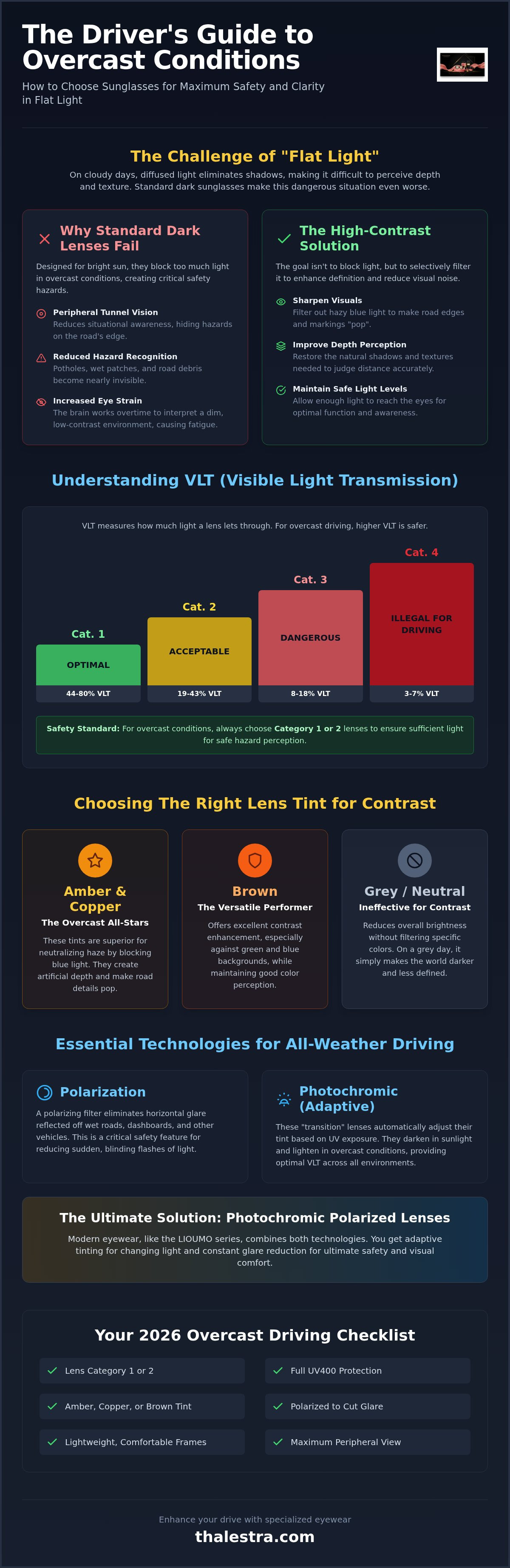
Driving under a heavy cloud layer creates a phenomenon known as flat light. Sunlight diffuses through moisture and cloud particles. This process eliminates natural shadows. Without shadows, the human eye struggles to distinguish depth, distance, and surface texture. This loss of contrast directly impacts safety by increasing cognitive load. Hazard recognition suffers. Braking distances often increase because drivers identify obstacles later than they would in clear conditions. Identifying a pothole or a slick patch of road becomes significantly harder when the surface appears as a uniform, featureless grey plane.
High concentrations of blue light scatter in overcast conditions. This creates a persistent visual haze. It obscures road edges and lane markings. Specialized sunglasses for overcast driving filter these specific short-wave lengths. This filtering process restores visual edge definition and sharpens the horizon line. Proper eye protection isn't just about comfort; it's a critical tool for maintaining high-speed situational awareness in low-visibility environments.
Many drivers fall into the dark lens trap. They reach for standard Category 3 Sunglasses to stop squinting. This is a dangerous choice for low-light environments. These lenses are engineered for peak sun exposure. In a grey environment, they reduce light transmission to unsafe levels. This triggers a peripheral tunnel vision effect. It hides low-contrast hazards like wet asphalt patches, road debris, or pedestrians in grey clothing. You need a solution that balances light intake with contrast enhancement.
The Physics of Flat Light Visibility
Light rays don't strike the road surface in a linear path on cloudy days. They bounce off atmospheric humidity and dense cloud cover. This creates omni-directional light. It erases object definition against grey road surfaces. Your brain enters a high-effort processing state. It constantly attempts to fill in missing visual data points. This leads to rapid eye fatigue. Long-distance drivers experience this as a dull headache, heavy eyelids, or reduced concentration. High-performance eyewear mitigates this by normalizing the light entering the eye.
Why Standard Sunglasses Fail in the Grey
Visible Light Transmission (VLT) ratings determine how much light reaches your eyes. Category 3 lenses transmit only 8% to 18% of light. This is far too dark for overcast skies where light is already limited. For 2026 road safety standards, Category 1 or 2 lenses are the preferred choice. Neutral grey tints are common but ineffective here. They reduce overall brightness without shifting the color spectrum. On a grey day, a grey lens simply makes the world a darker shade of grey. You need adaptive technologies or specific high-contrast tints. Amber, brown, and copper lenses improve depth perception and road clarity. These tints allow for higher VLT while blocking the specific wavelengths that cause glare and haze.
Selecting the Best Lens Tints for Low-Light and Cloudy Conditions
Optimal visibility for 2026 drivers relies on spectral filtering rather than simple light reduction. High-contrast tints like amber, copper, and brown are superior for neutralizing the visual noise of a grey sky. These specific colors work by blocking blue light wavelengths. This sharpening effect makes road edges, lane dividers, and distant hazards pop against the pavement. While the sun remains hidden behind clouds, UV400 protection is mandatory. Clouds don't block all harmful radiation. Prolonged exposure leads to significant eye strain even in flat light. You need a lens that balances light intake with precise color perception.
Safety at intersections is a major factor when choosing sunglasses for overcast driving. A lens that is too dark or poorly tinted can wash out traffic signal colors. High-quality amber and copper lenses are engineered to enhance the red and green spectrum. This ensures that brake lights and traffic signals remain distinct and clear. It prevents the "muddy" visual effect caused by cheap, neutral grey lenses that don't differentiate between the road and the sky. For a technical edge in these variable environments, consider browsing specialized polarized sunglasses designed for high-contrast performance.
Amber and Copper: The Overcast All-Stars
Amber and copper are the primary choices for professional drivers facing variable light. These tints create artificial depth on wet or misty asphalt. They reveal the "texture" of the road surface that flat light typically erases. This helps in identifying hydroplaning risks, oil slicks, or surface debris. Key benefits include:
- Enhanced Depth Perception: Sharpens the distinction between objects in low-contrast environments.
- Red/Green Boost: Improves the visibility of stop lights and emergency vehicle signals.
- Blue Light Reduction: Cuts through atmospheric haze and mist for a crisper horizon line.
Yellow Tints: Specialized Use Cases
Yellow lenses offer a distinct "brightening" effect. They are highly effective for Driving in Fog or during the transition into dusk. By filtering out the blue-grey haze, they maximize available light perception. This makes the environment appear brighter than it actually is. However, yellow tints have limitations. They don't perform well if the sun suddenly breaks through the clouds. They lack the versatility of amber for all-day use. Choose yellow for specific, heavy-overcast or low-visibility scenarios where light intake is the priority. These lenses are tools for specific conditions rather than a general-purpose solution for bright-to-dark transitions.
Transition Lenses vs. Polarized: Which Technology Wins for Overcast Roads?
Selecting the right lens technology for 2026 driving requires understanding how filters interact with automotive glass. Standard photochromic lenses often remain clear inside a vehicle because windshields block the UV rays required for activation. Advanced sunglasses for overcast driving now utilize visible-light activation. This allows the lens to adjust based on ambient brightness rather than UV exposure alone. Polarization remains a critical secondary feature. It targets horizontal light waves reflected from wet pavement and vehicle surfaces. This dual-action approach ensures high-contrast visibility in shifting weather.
According to the American Academy of Ophthalmology guide to sunglasses, selecting lenses that block 99% to 100% of UVA and UVB rays is essential for long-term eye health. This protection is mandatory even on cloudy days when UV penetration remains high. Modern hybrid lenses combine this protection with adaptive tinting and glare reduction. This modular configuration is the current industry standard for professional drivers. It provides a single-pair solution for morning mist, heavy cloud cover, and sudden sun breaks.
Photochromic Advantages for Changing Skies
Photochromic lenses provide a dynamic response to "broken cloud" scenarios. Light levels shift every minute as clouds move. LIOUMO photochromic technology offers rapid darkening and clearing cycles. This ensures your vision remains stable without manual adjustments. It eliminates the need to swap frames while driving. You get consistent performance across different light intensities. Key technical features include:
- Visible Light Activation: Functional performance behind UV-blocking automotive glass.
- Variable Tint Density: Seamless transitions between Category 1 and Category 2 light transmission.
- Rapid Recovery: Quick clearing when entering tunnels or heavy forest cover.
Polarization in Overcast Weather
Polarization is indispensable for managing "road shimmer" after rain. Wet asphalt under a grey sky creates a high-glare environment. Polarized filters block these reflections. This reveals the actual road surface beneath the water film. They also eliminate distracting dashboard reflections on the inside of the windshield. There is a technical trade-off to consider. Polarized filters can distort LCD screen visibility. Head-up displays (HUDs) may appear faint or invisible through high-efficiency polarized lenses. Check your vehicle's display compatibility before selecting full polarization for 2026 navigation systems. This technology is best for high-glare, wet-weather environments where surface detail is the priority.
How to Choose and Test Your Driving Sunglasses for Optimal Contrast
Selecting high-performance sunglasses for overcast driving requires a systematic approach to technical specifications. Don't rely on aesthetic appeal alone. Driving in flat light demands precision optics that balance light transmission with contrast levels. Follow these five steps to ensure your eyewear meets 2026 safety standards.
- Step 1: Verify VLT Ratings. Look for Category 1 (43%-80% transmission) or Category 2 (18%-43% transmission). Category 3 lenses are too dark for cloudy days and can impair hazard recognition.
- Step 2: Confirm UV400 Certification. This ensures 100% protection against UVA and UVB rays. These rays still penetrate cloud cover and cause long-term ocular damage.
- Step 3: Assess Peripheral Coverage. Choose frames with thin temples to maintain a wide field of view. This is critical for safe lane changes and intersection navigation.
- Step 4: Execute the Dashboard Test. Put on the glasses inside your vehicle. Check if digital LCD screens or head-up displays (HUDs) remain clear and visible without distortion.
- Step 5: Run the Contrast Check. View a grey, textured surface through the lens. The optics should sharpen the details rather than blurring them into a single shade.
The Contrast and Clarity Check
Use a grey textured cloth or a patch of weathered pavement to evaluate lens definition. A superior lens makes surface irregularities visible. This is critical for spotting road hazards like oil slicks, potholes, or debris. Notice how the lens separates the grey road from the grey sky. If the horizon line disappears, the tint is too neutral. Watch for color distortion. Traffic signals must remain distinct. Red, amber, and green should be saturated and clear. Avoid lenses that produce "ghosting" or blurry edges. These optical distortions cause significant eye strain over long distances. High-quality manufacturing ensures a consistent refractive index across the entire lens surface.
Frame Considerations for Long Drives
Frame materials determine long-term comfort and durability. Carbon fiber and Al-Mg (Aluminum-Magnesium) alloy temples are the preferred choice for 2026 professional drivers. These materials offer extreme lightness and high impact resistance. Lightweight frames reduce pressure on the bridge of the nose and behind the ears. This prevents the tension headaches often associated with heavy plastic frames. Adjustable nose pads are essential. They prevent the frame from slipping down during rapid head movements or "shoulder checks." Consider the frame's interaction with vehicle interior components. Bulky temples can interfere with headrests, pushing the glasses out of alignment. Seek out streamlined, lightweight designs for a secure fit that lasts for hours.
View our Classic Mens Polarized Sunglasses for durable, high-contrast frame options designed for professional road use.
Enhancing Your Drive with THALESTRA.COM’s Specialized Photochromic Collection
The LIOUMO series represents the culmination of adaptive optical technology designed specifically for the modern road. These units address the flat light visibility issues identified in earlier chapters by providing a high-speed response to shifting cloud cover. THALESTRA.COM serves as a streamlined gateway for drivers to access these high-performance sunglasses for overcast driving. The collection focuses on immediate utility. High-durability frames. Precision filters. Responsive tints. This inventory meets the demands of 2026 international commuters seeking both safety and efficiency. Carbon fiber construction ensures long-distance comfort. These frames resist high-impact stress while maintaining a negligible weight profile on the bridge of the nose.
Spotlight on LIOUMO Photochromic Technology
LIOUMO technology features high-speed adaptation to fluctuating light levels. The lenses transition between light and dark states in seconds to eliminate the visual shock of sudden sun breaks. Unlike standard photochromics, these units utilize visible-light activation. They remain functional behind UV-blocking automotive windshields. The polarized filters are specifically optimized for dashboard clarity. You maintain full visibility of LCD navigation screens and digital clusters without the black-out effect common in lower-quality polarized eyewear. Technical specifications include:
- Matte Square Frames: Low-reflection finish. Lightweight composite materials. All-day wearability.
- Rapid Recovery Lenses: High-speed clearing. Category 1 to Category 2 transition. Contrast-boosting amber base.
- Precision Polarization: Wet road glare reduction. Surface shimmer elimination. Dashboard reflection control.
Classic Style Meets Modern Protection
The THALESTRA.COM collection features vintage-inspired oval and square geometries. These shapes are strategic choices rather than simple aesthetic preferences. They prioritize maximum peripheral visibility. Thin temple designs ensure an unobstructed field of view during critical shoulder checks. You get heritage styling without compromising on the 2026 lens standards discussed previously. UV400 protection is a standard feature across the entire catalog. This ensures full-spectrum defense against UVA and UVB rays in all weather conditions. For a deeper technical breakdown, consult our 2026 Men's Photochromic Sunglasses: Buyer's & Lens Guide. THALESTRA.COM operates as a global merchant. We provide international shipping with comprehensive order tracking. Drivers in any region can access these trending safety goods through our streamlined digital marketplace.
Secure Peak Road Visibility for 2026
Finalizing your driving setup for 2026 involves moving beyond generic eyewear. As established, the primary challenge of flat light is the loss of depth and texture. Utilizing specialized sunglasses for overcast driving allows for the restoration of these visual cues through targeted filtration. This guide has detailed how amber tints and adaptive technologies mitigate the risks of grey-out contrast loss. Consistency in road definition is the primary goal for any high-performance eyewear selection.
The integration of LIOUMO adaptive lens technology provides a functional solution for shifting light intensities. When paired with the durability of carbon fiber frames, these tools offer a long-term safety advantage for daily commuters. Adherence to global UV400 safety standards remains the baseline for protecting ocular health during extended road use. These technical attributes provide the necessary stability for professional and recreational driving in variable environments. High-quality optics are a critical component of modern vehicle safety.
Ready to enhance your visual clarity? Shop the LIOUMO Photochromic Driving Collection at THALESTRA.COM to find the perfect intersection of tech and style. Experience the confidence of sharper road definition today.
Frequently Asked Questions
Are polarized sunglasses good for driving on cloudy days?
Polarized lenses are highly effective for managing horizontal glare on wet, overcast roads. They cut the shimmer caused by light reflecting off moisture; this improves surface detail visibility. While clouds diffuse light, polarization still filters the specific wavelengths that cause visual haze. This technology allows drivers to see through the surface of water patches. It's a critical safety feature for maintaining traction awareness in damp weather.
What color lens is best for driving in overcast or foggy weather?
Amber and copper tints are the superior choices for low-light environments. These colors filter blue light to sharpen road edges and improve depth perception. They provide a high-contrast view that neutral grey lenses cannot match. Yellow lenses are useful for heavy fog or late dusk but lack the versatility of amber for all-day use. Selecting high-contrast sunglasses for overcast driving ensures hazards like potholes remain visible against grey asphalt.
Do transition lenses work inside a car for driving?
Standard photochromic lenses often fail inside vehicles because windshields block the UV rays required for activation. You need specialized photochromic technology, like the LIOUMO series, which reacts to visible light rather than just UV. These lenses adapt their tint level based on ambient brightness within the cabin. This ensures the glasses darken even behind automotive glass. It provides a seamless transition as you move through changing cloud cover throughout the day.
Can I wear yellow-tinted glasses for night driving?
Wearing tinted lenses for night driving is unsafe and generally not recommended by safety standards. Lenses with a light transmission of less than 75% are unsuitable for nighttime use. While yellow tints can improve contrast in fog, they reduce the total amount of light reaching the eye. This can hide hazards in dark areas and make traffic signals harder to distinguish. Always prioritize clear or anti-reflective lenses for driving after sunset.
What does UV400 protection mean for overcast conditions?
UV400 protection ensures your lenses block 99% to 100% of UVA and UVB radiation up to 400 nanometers. This is mandatory on cloudy days because up to 80% of UV rays penetrate cloud cover. Without this protection, your eyes remain vulnerable to long-term damage and immediate strain. Clouds don't act as a filter for harmful radiation. Consistent UV protection is a non-negotiable safety standard for all 2026 driving eyewear.
Will polarized sunglasses make my car's digital dashboard hard to see?
Polarized filters can interfere with the visibility of LCD screens and head-up displays (HUDs). This happens because the polarizing film aligns with the light waves emitted by digital screens; sometimes this causes them to appear black or distorted. Modern automotive displays are often designed to minimize this effect, but it remains a common trade-off. Always perform a dashboard check with your specific vehicle to ensure your navigation and speed readouts remain perfectly legible.
What is the best VLT percentage for overcast driving sunglasses?
The ideal Visible Light Transmission (VLT) for overcast driving falls between 18% and 43% for Category 2 lenses. For heavier cloud cover or mist, Category 1 lenses with 43% to 80% transmission are preferred. These ranges allow enough light for clear vision while maintaining contrast. Avoid Category 3 lenses, which usually have 8% to 18% VLT. Those are too dark for grey skies and can lead to dangerous tunnel vision effects.
How do I clean my driving sunglasses without damaging the coating?
Use a clean microfiber cloth and a specialized lens cleaning spray to maintain your eyewear. Avoid using paper towels, clothing, or household glass cleaners. These materials contain abrasive fibers or harsh chemicals that can strip anti-reflective and polarized coatings. Rinse the lenses with lukewarm water first to remove grit. Gently pat them dry with the microfiber. Proper maintenance preserves the optical clarity of your sunglasses for overcast driving and extends the product's lifespan.