
What if the glare you want to block is also what makes some screens harder to see? Reflected light from roads, water, and other flat surfaces can make bright outdoor scenes tiring to view. The Benefits of polarized lenses for vision include reducing this kind of glare, but polarization isn’t a fix for every viewing situation.
If reflected brightness makes you squint, reducing glare may make outdoor viewing more comfortable and details easier to pick out. A polarized lens filters some reflected light; it does not, by itself, block UV rays. This guide explains how polarized lenses work, when they may help with driving and outdoor activities, and why some digital displays can look dim or distorted through them. Screen visibility varies with the display and viewing angle.
You’ll also learn why polarization and UV protection are separate features, what to look for when choosing sunglasses, and how to match a lens to your routine. Then you can compare options such as Classic Mens Polarized Sunglasses and LIOUMO Top Quality Photochromic Polarized Sunglasses with a clearer idea of what their lens type does and doesn’t tell you.
Key Takeaways
- Learn how the benefits of polarized lenses for vision relate to reflected glare, visual comfort, and viewing details in bright conditions.
- See how glare from water, roads, or snow can affect what you see, and why results vary with conditions.
- Compare outdoor glare situations with screen-based tasks to identify when polarization may be useful or less suitable.
- Use a practical decision process based on your activities, glare exposure, screen use, and UV protection needs.
- Explore THALESTRA.COM Classic Mens Polarized Sunglasses as one option when considering polarized lenses.
What Are the Benefits of Polarized Lenses for Vision?
Polarized lenses filter some reflected light that creates distracting glare. When glare makes a bright view uncomfortable, reducing it may make it easier to keep your eyes open, focus on what you’re looking at, and notice details without squinting as much. The benefit is specific to glare, not a guarantee of sharper vision in every setting.
Polarized sunglasses use a filter that reduces some horizontally oriented light reflected from surfaces. The filter doesn’t remove all bright light or make every scene clearer. Its effect depends on the light reaching the lens, your surroundings, the lens itself, and what you’re trying to see.
What does polarized mean in sunglasses?
Sunlight travels in multiple directions. After it reflects off a relatively flat surface, some of that light becomes concentrated in a horizontal direction and can appear as bright, distracting glare. A polarizing filter is designed to reduce some of this reflected light before it reaches your eyes. For example, sunlight bouncing off a polished car hood can create a bright patch in your field of view. Polarized lenses may soften that patch while leaving the rest of the scene visible.
This filtering action differs from simply making a lens darker. Polarization targets a type of reflected light instead of reducing all incoming light equally. The overview of polarized lenses in sunglasses describes their use in reducing glare from reflective surfaces. The effect still varies with the light’s angle, your position, and the surface involved.
Which vision benefits can polarized lenses provide?
The main potential benefit is less distracting glare when reflected light interferes with comfortable viewing. With less glare in the view, you may find it easier to keep your eyes relaxed and focus on the scene. Reduced squinting can also contribute to comfort when bright reflections are what make you narrow your eyes.
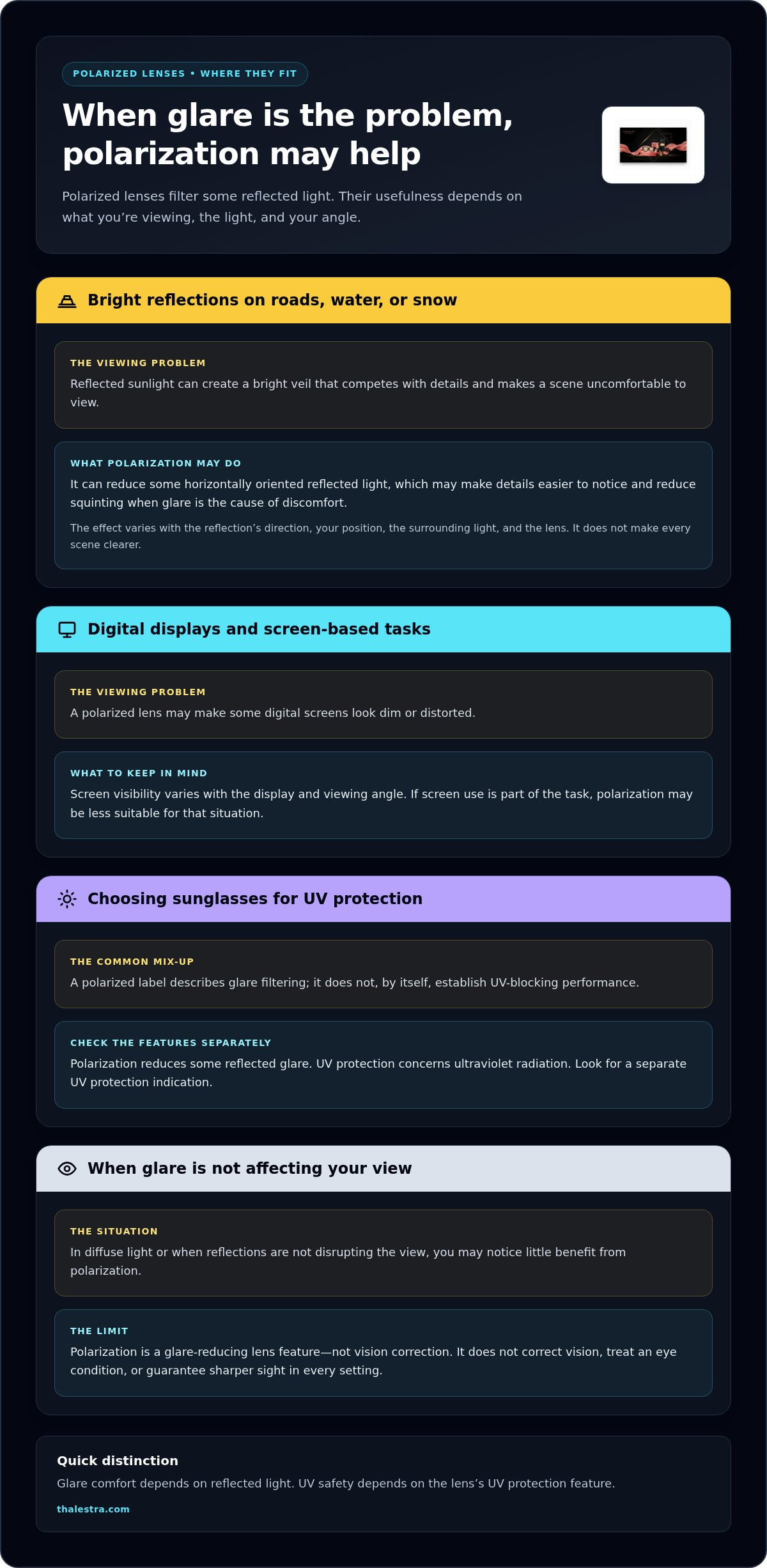
Polarization doesn’t correct vision, treat an eye condition, or prevent eye disease. It’s a lens feature that may improve comfort when glare is the problem. You may notice little benefit in diffuse light or during tasks where reflections aren’t disrupting your view. The Benefits of polarized lenses for vision are conditional: they depend on whether reflected glare is present and whether filtering it helps with the activity.
How Polarized Lenses Reduce Glare Without Blocking All Bright Light
Sunlight can travel directly to your eyes or reflect off a surface first. When it bounces off a relatively flat surface, such as a road, water, or snow, some reflected light becomes horizontally oriented. That concentrated reflection can appear as glare, a bright veil that competes with details in the scene. A polarizing filter is designed to reduce some of this reflected light before it reaches your eyes.
Polarized lenses don’t shut out all brightness. They target a portion of reflected light while allowing other light through. The visual change depends on the reflection’s direction, your viewing angle, the surrounding light, and the lens. Glare on a wet road, for example, may look different as the sun moves or your position changes. Water and snow also reflect light differently, so the effect isn’t identical in every setting.
The American Academy of Ophthalmology’s overview of polarized lenses explains their glare-reducing function. Filtering a bright reflection may make details behind or beside it easier to notice. It doesn’t guarantee sharper vision, replace prescribed correction, or diagnose why a scene looks unclear. Persistent visual difficulty deserves attention beyond a change in sunglasses.
Why reflections create visual glare
Glare is bright light that makes a scene harder to view comfortably or draws attention away from other details. Sunlight reflecting from a car windshield into your line of sight, for example, can compete with the road and nearby objects. Polarization may reduce some of that reflected brightness, depending on the angle and conditions. It doesn’t replace an eye examination or vision correction when either is needed.
Polarization and UV protection are different lens features
Polarization reduces some reflected glare; UV protection concerns ultraviolet radiation. They are separate lens features, so a polarized label or product name alone doesn’t establish UV-blocking performance. Look for a separate UV protection indication when choosing sunglasses. For more UV safety information, consult the guide on sunglasses without UV protection.
Keep the distinction simple: polarization filters some reflected glare, while UV protection blocks ultraviolet radiation. Less glare may feel more comfortable, but comfort isn’t proof of UV protection. The Benefits of polarized lenses for vision depend on whether reflected light interferes with your view; UV safety depends on the lens’s UV protection feature.
If reflected light is a regular part of your outdoor routine, explore THALESTRA.COM polarized sunglasses as options for glare-conscious viewing. Consider the activities and conditions where glare bothers you, and evaluate UV protection separately from polarization.
When Polarized Lenses Help and When They May Not
Polarized lenses are most useful when reflected brightness interferes with what you need to see. They may make outdoor viewing more comfortable near water, on snowy ground, or on bright roads, but the effect varies with the light, your angle, and the activity. For screen-based tasks or scenes without noticeable reflections, polarization may offer little benefit and can sometimes make displays harder to read.
Bright reflected-light situations: Near water, snow, or sunlit roads, polarized lenses may reduce distracting reflections and make surrounding details more comfortable to view.
Display-dependent or low-glare tasks: Some LCD displays can look dim, distorted, or difficult to read through polarized lenses, especially at certain viewing angles. If screens are central to your routine, consider their visibility.
Where glare reduction may make a noticeable difference
Outdoor activities involve changing light and viewing angles. A reflection across a lake may interrupt your view of the water; glare from snow or a bright road can compete with details in the scene. Polarization may reduce some of that reflected brightness, though results depend on conditions and position. For fishing-specific context, the article’s guide to polarized fishing sunglasses can help connect lens choice with that activity.
Consider whether reflected glare actually disrupts your view. If it does, reducing glare may make the scene more comfortable to look at. It doesn’t guarantee better visibility in every outdoor setting, and a change in angle or light can change the effect.
When polarized lenses may be inconvenient
Screens are worth considering. A phone, dashboard display, or other LCD screen may appear darker or less clear through polarized lenses, depending on its orientation and your viewing angle. If you switch often between outdoor activities and checking displays, consider whether you can still read the screen comfortably. This is a task-specific limitation, not a reason to rule out polarized lenses for all driving or outdoor use.
Low-glare settings may also offer little noticeable advantage. If your usual activities involve indoor viewing or diffuse light rather than strong reflections, glare reduction may not address a problem you experience. The Benefits of polarized lenses for vision are most relevant when reflected light regularly distracts you, not simply because a lens is polarized.
Best-fit use case: Polarized lenses may suit activities where reflected outdoor glare disrupts your view, provided screen visibility and other task needs remain comfortable.
Before choosing, list the settings where glare bothers you and the displays you rely on. Comparing those needs can help you decide whether glare reduction is likely to be useful for your routine, rather than assuming one lens type suits every activity.
How to Decide Whether Polarized Lenses Fit Your Vision Needs
Choose based on when glare affects your view, not just the word “polarized” on a label. Start with your usual surroundings and tasks, then consider screen visibility and UV protection as separate needs. This helps distinguish glare comfort, everyday function, and eye protection.
A four-step check for your daily activities
- Identify your glare situations. Think about when reflected light regularly makes it uncomfortable to keep your eyes open or focus on details. Note the setting and what you’re looking at, such as a bright road or an outdoor view near water. If glare rarely disrupts your vision, polarization may not address a priority for you.
- Consider your outdoor screen use. Do you often read a phone, dashboard, or other LCD display while wearing sunglasses? Some displays can look dim or distorted through polarized lenses, depending on the screen and viewing angle. If screen access is essential to your routine, weigh that possibility alongside glare reduction.
- Set your main lens priority. Decide whether reflected glare is a frequent annoyance or whether you mainly need comfortable general sunwear. The Benefits of polarized lenses for vision are most relevant when glare interferes with your view. A short list of regular activities can help clarify whether that benefit fits your day.
- Assess UV protection separately. Polarization describes glare filtering, not protection from ultraviolet radiation. Look for a separate UV protection claim in the lens information. Don’t assume a polarized label, dark tint, or product name proves UV protection.
What polarized lenses cannot do
Polarized lenses don’t correct nearsightedness, farsightedness, or other refractive errors, and they don’t replace prescription eyewear when you need it. Reduced glare may make a particular scene more comfortable, but it doesn’t promise universally sharper vision, prevent eye disease, or guarantee safety during an activity.
If vision remains blurry, uncomfortable, or difficult in different settings, polarized sunglasses aren’t a substitute for professional eye-care advice. Persistent concerns deserve an assessment rather than the assumption that glare is the only cause. This is especially relevant if the difficulty occurs even when reflections aren’t present.
Once you’ve identified glare as a regular part of your routine, compare polarized options with those priorities in mind. THALESTRA.COM offers Classic Mens Polarized Sunglasses. For a closer look at polarized sunglasses, explore THALESTRA.COM polarized styles and consider how glare filtering fits your activities, display use, and separate UV needs.
Explore THALESTRA.COM Polarized Sunglasses for Glare-Conscious Viewing
After weighing where glare affects your view, how often you rely on screens, and your separate UV protection needs, compare polarized sunglasses with a clearer purpose. THALESTRA.COM offers polarized options for readers considering glare reduction. Their names identify the lens types without implying that one option suits every activity or guarantees a particular visual result.
Compare the confirmed polarized sunglasses options
- Classic Mens Polarized Sunglasses: A polarized sunglasses option for readers exploring polarized lenses.
- LIOUMO Top Quality Photochromic Polarized Sunglasses: The name identifies this option as photochromic and polarized.
These names provide a starting point for comparing lens categories. The first identifies polarized sunglasses; the second identifies a photochromic polarized option. Product names alone don’t establish UV protection, materials, performance in a particular setting, or compatibility with every screen. Use the product information to assess the details provided, and don’t assume unlisted specifications from the lens type alone.
Choose based on glare, routine, and lens priorities
Start with your regular activities. If reflected glare repeatedly makes outdoor viewing uncomfortable, polarization may be relevant to your needs. If you often depend on LCD screens, remember that some displays can be harder to read through polarized lenses, depending on the screen and viewing angle. Your routine matters more than a broad claim that one lens type works best for everyone.
Keep UV protection as a separate decision. Polarization filters some reflected glare; it doesn’t prove that a lens blocks ultraviolet radiation. Look for UV protection information independently, and weigh it alongside your glare and display needs. This distinction helps you compare lens options without confusing visual comfort with UV protection.
The Benefits of polarized lenses for vision are best considered in context: identify when reflections disrupt your view, then decide whether glare filtering fits your typical use. THALESTRA.COM’s polarized options give you a place to begin that comparison, including a photochromic polarized option.
Browse THALESTRA.COM sunglasses to explore polarized options and choose with your glare, routine, and lens priorities in mind.
Make Your Next Sunglasses Choice With Confidence
Let your usual routine guide your choice. Think about the settings where glare interrupts your view, whether you rely on screens while wearing sunglasses, and what UV protection you need. This practical check helps you focus on the Benefits of polarized lenses for vision that matter to you without expecting one lens feature to cover every need.
If polarized styles fit your priorities, THALESTRA offers options including Classic Mens Polarized Sunglasses and LIOUMO Top Quality Photochromic Polarized Sunglasses. Compare them with your intended use in mind, and consider UV protection separately from polarization.
Ready to explore? Browse THALESTRA polarized sunglasses and find an option to consider for your glare-conscious routine. A clear understanding of your needs makes choosing your next pair simpler.
Frequently Asked Questions
Do polarized lenses improve vision?
They can improve visual comfort when reflected glare makes a scene hard to view, but they don’t correct blurry vision or change your prescription. The Benefits of polarized lenses for vision are most noticeable when glare is the main distraction, such as a bright reflection that makes details hard to pick out. If vision stays blurry in different lighting, sunglasses aren’t a substitute for an eye-care assessment.
Are polarized lenses better for your eyes than regular sunglasses?
Not automatically. Polarization can reduce distracting reflections, while other sunglasses may provide UV protection without polarization. These features serve different purposes, so “polarized” alone doesn’t mean a pair is more protective or healthier for your eyes. Choose based on whether glare affects your comfort, and assess UV protection separately. If sunlight causes unusual discomfort or vision changes, seek advice from an eye-care professional rather than relying on lens type alone.
Do polarized lenses block UV rays?
Not necessarily. Polarization filters some reflected glare, but the word “polarized” doesn’t confirm that a lens blocks ultraviolet radiation. Look for a separate UV protection label, such as UV400 or 100% UVA/UVB protection, rather than judging by lens darkness or product name. This distinction matters even if the lenses feel comfortable outdoors. Glare reduction and UV protection are separate features, so check each independently when choosing sunglasses.
Can polarized lenses make it harder to see a phone or car screen?
Yes, some displays can look dim, uneven, or difficult to read through polarized lenses, depending on screen design and viewing angle. If your phone looks dark, try changing its angle while stationary or briefly removing the sunglasses in a safe setting. For dashboard screens, check legibility before driving. Don’t adjust a screen or sunglasses while the vehicle is moving; keep your attention on the road.
When do polarized sunglasses work best?
They’re generally most useful in bright conditions where reflections interfere with comfortable viewing, such as outdoors near reflective surfaces. The effect may change as the sun, your position, or the reflected surface changes. If a scene is bright but has little reflected glare, polarization may not feel especially different from other sunglasses. Think about the specific situations that bother you instead of expecting the same result everywhere.
Are polarized lenses suitable for driving?
They can be suitable for some daytime driving, particularly if reflected light makes roads uncomfortable to view. However, screen visibility varies: a digital dashboard or navigation display may appear darker from certain angles. Before relying on polarized lenses for driving, make sure you can comfortably see the displays and road information you use. Lens choice doesn’t replace safe driving habits, and sunglasses should be appropriate for the lighting conditions.
What is the difference between polarized lenses and UV-protective lenses?
Polarized lenses are designed to reduce some reflected glare; UV-protective lenses filter ultraviolet radiation. One feature doesn’t prove the other is present, and sunglasses can have either feature or both. A pair may reduce reflections without a stated UV rating, or offer UV protection without polarization. Check the lens information for a clear UV claim separately from any polarization label to understand what each pair provides.