
The darkest or most glare-cutting lens isn’t automatically the best choice for a run. Sunglasses for running need to work with your pace, route, and changing light while staying comfortable as you move. A lens that feels useful on an open road may be less suited to a shaded trail, where seeing changes in terrain matters.
Start with clear vision and a secure, comfortable fit. Slipping frames can distract you, while glare or sudden shifts between sun and shade can affect how comfortable a pair feels. Polarized and photochromic lenses handle light differently, but neither is a universal match for every run.
This guide breaks down the features that shape running comfort, from fit and lens type to UV protection and lighting conditions. You’ll learn how route and run style can influence your choice, compare fixed-tint, polarized, and photochromic options, and assess sunglasses by practical features rather than brand claims alone.
Key Takeaways
- Choose Sunglasses for running by weighing your route, lighting, and comfort together, not by relying on a running label alone.
- Assess how securely the frames sit, where they touch your face, and whether lens coverage suits your surroundings.
- Compare fixed-tint, polarized, and photochromic lenses by how they handle glare and changing light.
- Use your route as a guide: open roads, shaded trails, and urban runs can call for different lens choices.
- Explore THALESTRA’s polarized and photochromic sunglasses as lens categories to compare with your running conditions.
Running Sunglasses: What Makes a Pair Suitable?
Running sunglasses are eyewear chosen for outdoor visibility, a comfortable and stable fit, and the conditions of a particular run. They’re not defined by a label alone: a pair marketed for running may still feel uncomfortable or move on your face. The useful question is whether its fit, coverage, and lens characteristics suit you and the places you run.
Everyday fashion sunglasses can also work for some runs, but their appearance alone doesn’t tell you how they’ll feel through repeated movement or changing conditions. The Wikipedia article on sunglasses provides a broader overview of sunglass types and functions. For running, focus on the practical experience: do the frames stay comfortably in place, and does the view remain useful as the route shifts from sun to shade?
How running changes what you need from sunglasses
Walking or standing still may not reveal a loose fit. Running adds repeated movement, which can make slipping, pressure points, or frames that need frequent adjustment more noticeable. Sweat can also change how the frame feels against your nose or temples. Wind and direct sun may make coverage more valuable, while changing light can affect how easily you see the path ahead.
The demands vary by route. A short road loop in steady daylight may involve fewer changes in exposure than a longer route that crosses open stretches, tree cover, and uneven terrain. On mixed terrain, the view can shift quickly between bright sections and shade. Consider these conditions before assuming one pair will feel equally suitable everywhere.
Which runners benefit from comparing dedicated options?
Comparing eyewear is especially useful if you regularly train in direct sun, run through exposed areas, or move between bright and shaded sections. Individual fit matters just as much as route: face shape, frame contact, and personal comfort preferences affect whether a pair feels secure without distracting pressure. The same sunglasses may sit differently on different runners.
Weather and run length can change the experience, too. A comfortable pair on a cool, short outing may feel different during a longer run in warm conditions, when sweat becomes more noticeable. Treat your usual route and conditions as part of the selection, not as an afterthought.
- Notice movement: Pay attention to slipping, bouncing, pressure, or repeated readjustment as you run.
- Consider coverage: Think about how much your eyes are exposed to wind and bright light, while keeping your surroundings in view.
- Match the setting: Compare the needs of open roads, shaded paths, and mixed routes instead of choosing by label alone.
- Prioritize your comfort: A frame’s fit is personal, so a feature that suits one runner may not feel right to another.
Sunglasses for running are best judged as a combination of wearer, route, and conditions. This gives you a practical starting point for comparing lens and frame options without assuming that a marketing label means a pair will suit every run.
Running Sunglasses Features: Fit, Lens Coverage, and Clear Vision
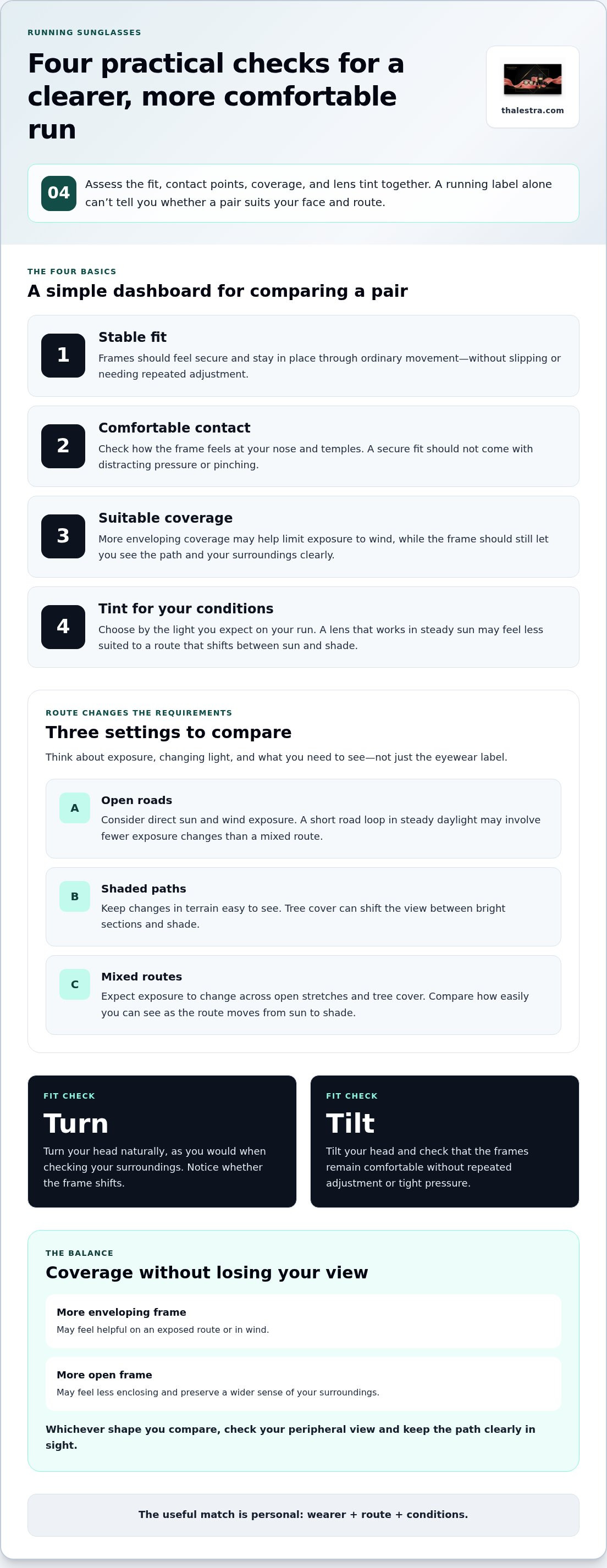
A useful comparison starts with four basics: stable fit, comfortable contact points, suitable coverage, and a lens tint that works for your conditions. No single frame shape or tint suits every runner. Consider how the glasses sit on your face, how much of your view they cover, and whether the lens keeps the route easy to see in the light you expect.
Fit affects more than comfort. Frames that pinch at the temples or press on the nose may become distracting, while loose frames can shift and interrupt your view. Lens size and shape matter, too. Broader coverage may reduce exposure to wind from the sides, but a frame that feels too large or blocks your peripheral view may not suit your route. Keep the ground and your surroundings clearly in view.
How to assess fit and stability before a run
Check that the frames feel secure without tight pressure at the nose or temples. Notice whether the contact points remain comfortable, since face shape and personal preference affect what feels right. When comparing options, try them with your usual running posture rather than judging only by how they look while standing still.
Test the fit by turning and tilting your head naturally, as you would while checking your surroundings on a run.
Then check whether the frame stays in place through ordinary movement without repeated adjustment. No design guarantees a stable fit for every wearer, so assess the actual feel instead of relying on labels or broad performance claims. For general guidance on sunglass features and eye protection, consult the American Academy of Ophthalmology's guide to sunglasses.
Coverage, ventilation, and visibility on the route
Coverage is a balance. A more enveloping lens may feel helpful on an exposed route or in wind, while a more open frame may feel less enclosing and preserve a wider sense of your surroundings. Check how the frame sits in your peripheral view and whether its shape feels comfortable when you look ahead, down at the path, and to either side.
Fogging can affect visibility, but lens tint alone doesn’t determine whether it happens. Exertion, humidity, temperature, and airflow around your face all play a part. A hard effort in humid conditions, for example, may feel different from an easy run in cooler, breezier weather. If fogging is a concern, consider the conditions you usually run in and how enclosed the frame feels, rather than assuming one tint will solve it.
- Fit: Look for secure positioning without pinching or slipping.
- Contact: Assess comfort at the nose and temples.
- Coverage: Balance wind and sun exposure with peripheral awareness.
- Visibility: Consider tint, route lighting, and conditions that may contribute to fogging.
Sunglasses for running should feel comfortable in motion and support a clear view of your route. For a lens-category comparison, browse polarized and photochromic sunglasses and consider which lens behavior better matches your conditions.
Polarized vs. Photochromic Running Sunglasses: Which Lens Fits Your Conditions?
Lens choice depends on the light you expect and how it changes along your route. Fixed-tint lenses provide a consistent shade; polarized lenses reduce reflected glare; photochromic lenses adjust their tint as light changes. These options address different needs, so “more advanced” doesn’t automatically mean more suitable. For Sunglasses for running, compare lens behavior with your route, not just the label.
Use this quick comparison as a starting point. The result can vary with lens design, tint, and conditions.
| Lens type | Potential use and benefit | Limitation to consider |
|---|---|---|
| Fixed tint | Steady light; provides a consistent tint throughout the run. | Doesn’t adapt if you move between bright sun and shade. |
| Polarized | Bright surroundings with reflected glare; reduces glare from reflective surfaces. | Not ideal for every route; some runners may find shadows and trail features harder to distinguish. |
| Photochromic | Routes with changing exposure; adjusts tint as light conditions shift. | Transition speed and tint range depend on the lens, and changing tint may not suit every lighting pattern. |
When polarized lenses may suit a run
Polarization filters reflected light, which can be useful around bright roads or other flat, reflective surfaces. Its benefit is more comfortable glare management, not a promise of faster running or better performance. Conditions matter: on a trail, the interplay of shade, roots, and rocks may make contrast important, and some runners prefer a non-polarized lens to read those details. Compare glare reduction with how clearly you can interpret your route. The same question applies in other sports, as explored in this guide to polarized fishing sunglasses.
When photochromic lenses may help with changing light
Photochromic lenses are designed to change tint in response to light, making them an option for routes that move between open sun and shade. That convenience depends on the specific lens: transition speed, the range from lighter to darker, and its response to conditions all vary. Don’t assume every photochromic lens reacts identically or changes immediately. For a related outdoor-sport example, see this overview of photochromic cycling sunglasses.
Match the lens to your most common conditions first. A steady, bright route may favor a consistent tint, while strong reflected glare makes polarization worth comparing. Frequent shifts in exposure may make photochromic lenses appealing, but the individual lens behavior still matters. No category is a universal winner.
How to Choose Running Sunglasses for Your Route, Weather, and Run Length
Start with the runs you actually do, not a universal rule about lens color or frame style. An open road, a tree-covered trail, and a city route with buildings that cast shade can create very different light and visibility needs. Sunglasses for running are easier to compare when you follow a simple sequence: map the route, consider the light, choose the lens behavior, then assess comfort and fit.
- Describe the route. Note open, exposed sections, tree cover, reflective surroundings, and places where the path changes direction or surface.
- Assess the light. Consider whether the run is mostly bright, mostly shaded, or likely to shift between the two.
- Choose lens behavior. Compare a consistent fixed tint, glare-reducing polarization, or photochromic lenses that adapt to light. Your conditions and preferences determine which is worth considering.
- Evaluate fit. Check comfort and clear vision with the glasses in place, including how they feel during natural movement.
Match lens choice to route and light
On a bright, exposed road, glare and direct sun may make a tinted lens appealing. If reflected glare is a recurring distraction, polarized lenses are one option to compare, though polarization isn’t automatically best for every route. In wooded areas, light can alternate between shade and sun. Photochromic lenses may appeal on routes with those transitions, but how quickly and how far they change depends on the specific lens. Consider the full route: a short shaded stretch may not call for the same choice as repeated changes in exposure.
Urban routes add another pattern. Buildings, open intersections, and shaded blocks can produce frequent shifts, and the route may also require awareness of people and obstacles around you. There’s no fixed tint for every city or trail. Choose based on the conditions you encounter and how you prefer the view to look.
Use a simple pre-run fit and visibility check
Run length matters because small comfort issues can become more noticeable the longer you wear a pair. A frame that feels fine for a brief outing may create pressure or require readjustment during a longer session. Weather and effort can also affect comfort, so consider the conditions you typically train in rather than judging only in a cool room.
Before leaving, check that the glasses feel comfortable and secure, then move your head naturally and look ahead, down, and to each side for clear, unobstructed vision. This quick check can reveal pressure, shifting, or coverage that distracts you, though it can’t guarantee how a pair will feel over every distance or in every condition.
Once you know your route and preferred lens behavior, compare options by category. Explore polarized and photochromic sunglasses as lens choices to consider alongside your typical running conditions.
Explore Sunglasses for Running and Compare THALESTRA Lens Options
Use your route, lighting, comfort preferences, and the stated product details to narrow your choices. A pair doesn’t need a running label to be worth comparing, and a lens category alone can’t tell you whether its frame will feel right. Start with what matters most on your runs, then compare the available details without assuming that one type suits every setting.
Compare available lens categories with your needs
THALESTRA offers polarized and photochromic sunglasses as distinct lens categories. Polarized lenses are designed to reduce reflected glare, while photochromic lenses are designed to adapt their tint as light changes. These functions aren’t interchangeable. Compare the stated lens and frame details with your typical route, the light you encounter, and your personal comfort preferences.
For example, if reflected glare is a regular concern, the polarized category may be relevant to your comparison. If your route moves between sun and shade, consider whether the details provided for a photochromic option align with that pattern. Assess frame information separately, too. Don’t infer a particular fit, UV rating, or running-specific performance from the category name alone.
Make a confident final choice
Keep your decision order simple: fit first, route conditions second, lens behavior third, and the stated product specifications alongside each choice. If a frame’s listed details don’t address a priority you have, avoid filling the gap with assumptions. The goal is a practical match between your needs and the information provided for each option.
Eye protection is another factor to consider alongside tint and glare. For broader context on UV protection, read this guide to UV-protected sunglasses. Treat UV information as a separate product detail to evaluate, rather than assuming that a darker lens or a particular lens category provides a specific level of protection.
- Fit: Prioritize comfort and stable placement for your face.
- Route: Consider exposure, shade, reflective surroundings, and changes along the way.
- Lens: Compare fixed-tint, polarized, or photochromic behavior with the light you encounter.
- Details: Use each item’s stated lens and frame information to assess your priorities.
This framework makes the final comparison more focused. Instead of choosing by a broad performance claim, weigh the practical trade-offs: lens behavior suited to your light conditions, a frame that feels comfortable, and product details that match what you’re looking for. The best fit for one runner may not be the best fit for another.
Once you’ve set your priorities, browse THALESTRA’s eyewear options and compare the polarized and photochromic categories with your route needs.
Make Your Next Run a More Informed Choice
Let your regular runs guide the final decision. Think about where the light changes, how long you’ll wear your sunglasses, and what feels comfortable on your face. Those priorities give you a practical way to compare Sunglasses for running without letting a product label make the choice for you.
As you browse, use the stated lens and frame details to narrow your options. THALESTRA’s global online eyewear store includes polarized and photochromic sunglasses, giving you categories to compare with your route and lighting preferences. Focus on the information that matters to your own use, and avoid assuming a lens category guarantees a particular fit, protection level, or running performance.
Browse THALESTRA sunglasses and compare lens options to find styles that align with the priorities you’ve set. A considered choice starts with your needs, not a claim. Take that clarity into your next run with confidence.
Frequently Asked Questions
Are polarized sunglasses good for running?
They can be useful when reflected glare is a regular distraction, such as on bright roads or near water, but they aren’t the best choice for every route. On a trail, shadows and surface details may matter more than glare reduction. Compare how the lens affects your view in the places you run, and check the specific pair’s stated UV protection separately. Polarization alone doesn’t confirm UV protection.
What should I look for in sunglasses for running?
Look for comfort that holds up during movement, then consider coverage and whether the lens suits your usual surroundings. Sunglasses for running should let you see the route without constant adjustment or an obstructed side view. If possible, wear the pair while walking, turning your head, and looking down as you would on a run. Review the specific frame and lens details rather than relying only on a running label.
Can I wear photochromic sunglasses for running?
Yes, photochromic sunglasses can be an option for runs with shifts between bright and shaded sections. Before choosing, consider how quickly you need the tint to change and how much shade you prefer at either end of the transition. Those characteristics vary by lens. A route with short, frequent changes, for example, may feel different from one long stretch in shade followed by open sun.
Do running sunglasses stop slipping when you sweat?
No pair can be assumed to stay in place for every runner just because it’s described as secure or made for sport. Fit depends on your face, the frame’s contact points, sweat, and movement. Before a run, try turning your head, looking down, and moving at an easy pace. Notice whether the glasses shift or press uncomfortably, then use specific product details to inform your comparison.
Are sunglasses necessary for running on cloudy days?
Not necessarily, but cloud cover alone doesn’t determine whether sunglasses will be comfortable or useful. Brightness, glare, and how exposed your route is can still influence your choice. Check the pair’s stated UV protection independently of lens darkness or polarization. Look for labels such as UV400 or 100% UV protection, and consult a qualified eye-care professional if you have personal concerns about eye protection.
Are running sunglasses different from regular sunglasses?
Not always by construction or label. The practical difference is whether a particular pair feels comfortable and stays useful during your activity. Everyday sunglasses might work for a short, familiar route if they don’t shift or interfere with your view. The same pair may feel distracting during a longer run. Judge the actual frame and lens details against your planned use rather than assuming a category guarantees suitability.
How do I choose sunglasses for running in changing light?
Start by noticing where your regular route moves between sun and shade, and how long those sections last. Then compare a consistent tint with photochromic lenses, using the stated transition behavior and tint range for the specific lens. If you’re unsure, observe the route on a typical run and note where visibility feels uncomfortable. That gives you a more useful basis for comparing options than choosing by lens name alone.