
The darkest lenses aren’t automatically the safest choice. When choosing Sunglasses for bright sun protection, remember that lens darkness reduces visible brightness but does not tell you whether the lenses block harmful UV rays. That distinction matters when strong sunlight and glare make it uncomfortable to see.
With tints, lens technologies, and frame styles to compare, it can be hard to know where to start. The right pair depends on more than appearance: UV protection and glare control do different jobs, and your usual setting affects which features are useful. Polarized lenses can help reduce glare from reflective surfaces, while photochromic lenses provide another option to consider.
This guide explains how to assess UV protection separately from tint, match lens features to everyday settings and activities, and compare sunglasses using practical criteria. You’ll have a clearer way to weigh comfort, visibility, and style in bright sun without relying on lens darkness alone.
Key Takeaways
- Choose Sunglasses for bright sun protection by prioritizing clearly stated UV information, then comparing comfort and style.
- Separate glare control from UV protection to understand what polarized lenses can help with and what they don’t indicate.
- Match lens features to your setting, from everyday streets and driving to open water and changing outdoor conditions.
- Use a simple checklist to compare protection details, glare needs, lens type, and fit before choosing a pair.
- Compare polarized and photochromic sunglasses by their general functions to find options suited to your routine.
Sunglasses for bright sun protection: what protection actually means
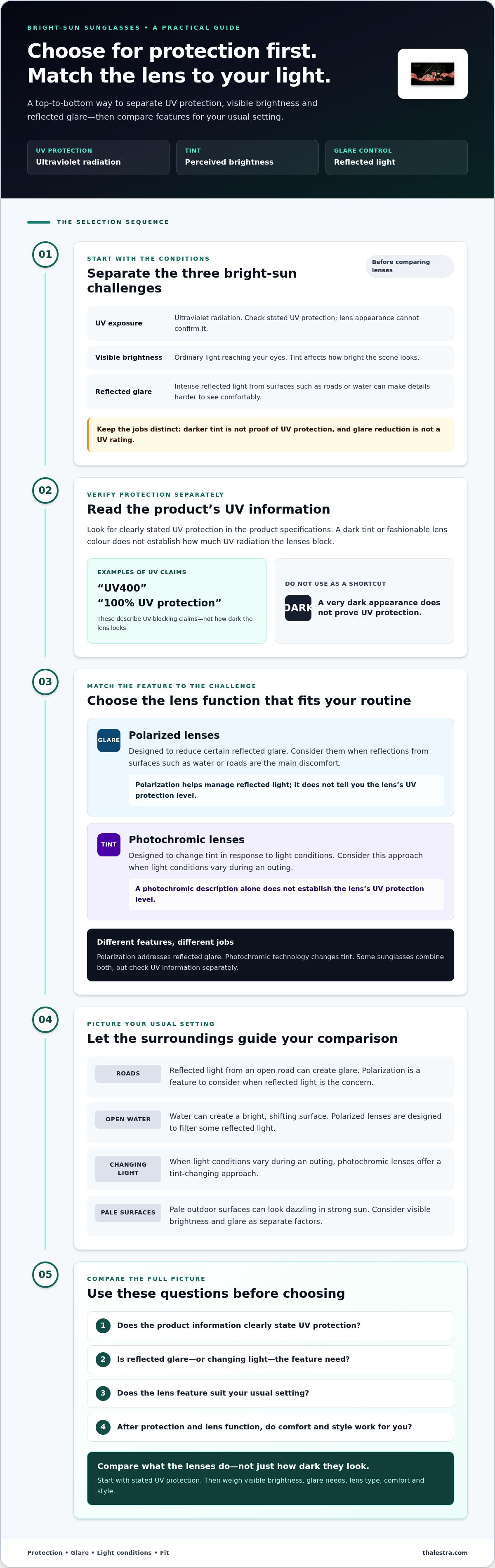
Bright conditions can bring three different challenges: ultraviolet (UV) exposure, intense visible light, and reflected glare. They often occur together, but they are not the same. A lens can make a scene look dimmer without providing UV protection, while reflected light can remain uncomfortable even when you are not looking toward the sun. Choosing Sunglasses for bright sun protection starts with separating these factors, then matching lens features to the conditions you face.
UV protection blocks ultraviolet radiation; visible-light reduction makes the scene look dimmer. Glare is intense reflected light that can make it harder to see comfortably. The Sunglasses overview describes common lens types and their different purposes, which is useful context when comparing product features.
UV protection and lens darkness are not the same
A dark tint or fashionable lens colour does not establish how much UV radiation a pair blocks. Check the product specifications for clearly stated UV protection instead of using appearance as a shortcut. Terms such as “UV400” or “100% UV protection” describe UV-blocking claims, not how dark a lens looks. For a brief overview of why UV information matters, see the dangers of non-UV-protected sunglasses.
Why bright surroundings can still feel uncomfortable
Direct sunlight comes from the sun itself. Reflected brightness comes from light bouncing off nearby surfaces. An open road can reflect light into your eyes, water can create a bright, shifting surface, and pale outdoor surfaces can look dazzling in strong sun. These conditions can feel harsh even when you are not looking toward the sun.
That reflected intensity is glare. It can interfere with visual comfort and make details harder to pick out, especially when light reaches your eyes from an angle. Glare reduction is separate from UV protection. A feature that helps manage reflected light does not, by itself, tell you how well a lens blocks UV rays.
Keep two questions in mind as you compare pairs: does the product information clearly state UV protection, and do the lens features suit the brightness and reflections in your usual setting? Start with protection details, then consider glare and visible brightness. Only after that should lens darkness or colour guide your choice. A very dark appearance may feel reassuring, but it is not proof of UV protection.
This distinction also makes lens descriptions easier to interpret. UV protection refers to filtering ultraviolet radiation. Visible-light reduction refers to how much ordinary light passes through the lens, affecting perceived brightness. Polarization is another feature to assess for glare, not a substitute for checking UV information. Comparing these functions separately helps you choose based on what the lenses do, not just how they look.
How sunglasses reduce glare and help manage bright light
Lens features affect bright light in different ways. Visible-light reduction controls how much ordinary light reaches your eyes, changing how bright the scene appears. A darker tint can reduce that brightness, but darkness alone does not tell you whether a lens blocks UV rays. Treat tint, UV protection, and glare management as separate points when comparing Sunglasses for bright sun protection.
Polarization and photochromic technology address different needs. Polarized lenses are designed to reduce certain kinds of reflected glare; photochromic lenses change tint in response to light conditions. Neither description, by itself, tells you the lens’s UV protection level. The American Academy of Ophthalmology also discusses these distinct features in its advice on Choosing the best sunglasses for bright sun.
What polarized sunglasses do in bright conditions
Reflections from surfaces such as water or roads can create distracting glare. Polarized lenses are designed to filter some of this reflected light, which may make outdoor viewing more comfortable in glare-prone settings. For a specific example of how the feature is considered for time near water, see this guide to polarized sunglasses for fishing.
Polarization can help manage reflected glare, but it doesn’t tell you how much UV protection a lens provides. Check UV information separately instead of treating a polarized label as proof of UV blocking. Polarization describes a glare-related lens function, not a complete measure of protection or overall performance.
How photochromic lenses respond to changing light
Photochromic lenses are designed to change tint in response to light conditions. This is different from polarization: changing tint affects visible-light reduction, while polarization is intended to manage reflected glare. A photochromic description alone does not establish how quickly or how darkly a lens changes, or its UV protection level. For a cycling-focused discussion, see the guide to photochromic cycling sunglasses.
For a practical comparison, consider the challenge you want to address. If reflected light is the main discomfort, polarization is a feature to consider. If light conditions vary during an outing, photochromic lenses offer a tint-changing approach. Some sunglasses combine both categories, but feature names still do not replace checking the protection information provided for the lens.
THALESTRA.COM offers polarized and photochromic sunglasses, including the LIOUMO Top Quality Photochromic Polarized Sunglasses and Classic Mens Polarized Sunglasses. Compare their general lens functions with the stated product details to find options aligned with your routine. You can compare polarized and photochromic sunglasses as part of your search.
Which sunglasses work best for different bright-sun settings?
The most useful lens features depend on the light you encounter. A walk through shaded streets has different demands from time beside open water, and driving brings changes between sun and shadow. Use the comparison below as a starting point, not a universal prescription. Prioritize clearly stated product specifications; appearance alone cannot show how lenses perform in a particular setting.
| Setting | Likely light challenge | Feature to consider |
|---|---|---|
| Everyday streets | Direct sun alternating with shade, plus reflections from windows or pavement | UV information and a tint suited to your comfort across changing brightness |
| Driving | Strong sun, road reflections, and transitions between sun and shadow | Clear product information about protection and intended driving use |
| Open water | Bright reflected glare from the water’s surface | Polarization as a glare-management feature, alongside separate UV information |
| Changing outdoor conditions | Light levels shifting during an outing | Photochromic lenses as an option to compare for changing tint |
Everyday use, travel, and driving in strong sunlight
On a city walk or trip, consider how often you move from full sun into building shade, tree cover, or a vehicle. Direct sun and reflected glare can affect comfort differently, so identify which you encounter most. For driving, do not assume a lens is suitable based on darkness, polarization, or style. Compare the product’s stated specifications and driving guidance, keeping clear vision in changing conditions in mind.
Water, open landscapes, and variable outdoor light
Near water or across open, pale landscapes, reflected light may be a central comfort concern. Polarization is one feature to compare in glare-prone settings, but it does not establish UV protection. In steady bright conditions, consistent light reduction may be a priority. During an outing with changing light, photochromic lenses offer a different approach by changing tint in response to light conditions.
These conditions can overlap. A day outdoors may include exposed paths, shaded sections, and reflective surfaces, so consider the full route rather than one moment in direct sun. Decide whether glare, changing brightness, or both are the main challenge, then compare features that address those needs. Do not infer a feature or intended use from frame shape or lens colour alone.
For Sunglasses for bright sun protection, compare stated UV information first, then weigh glare management and changing light against your usual setting. This keeps the decision practical: choose features for the conditions you face, and treat any recommendation as a starting point rather than a guarantee of suitability.
How to choose sunglasses for bright sun: a practical checklist
A clear selection order makes lens features easier to compare. Start with where you’ll wear the sunglasses, then assess protection information, glare needs, lens type, and fit. This helps you focus on useful features instead of choosing by appearance or assuming more features automatically mean a better match. For Sunglasses for bright sun protection, prioritize clearly stated UV information before tint or frame style.
- Identify your regular setting. Think about your usual conditions: city streets, driving, open water, or outdoor activities with changing light. Consider whether you’ll move between sun and shade or spend most of your time in steady brightness.
- Check the UV information. Look for an explicit statement about UV protection in the product details. Do not use lens darkness, colour, or frame shape as a substitute.
- Assess your glare concerns. Reflections from water, roads, and other bright surfaces may make glare a key comfort issue. Consider whether glare management is a priority in the places you spend time.
- Compare lens types. Polarized and photochromic lenses serve different general functions. Decide whether reflected glare or changing light is more relevant to your routine, then compare the stated product details.
- Assess fit and coverage. Consider whether the sunglasses feel comfortable and stay secure during normal wear. Check how the frame sits around your face and whether its coverage feels appropriate for your activities.
Check protection information before choosing a look
Start with the product specifications, not the mirror. An explicit UV-protection statement gives you useful information to compare, while a dark tint or fashionable frame shape describes appearance. Keep the criteria separate: review the stated protection details first, then weigh colour and style. This order makes it easier to compare sunglasses without treating a dramatic look as proof of function.
Match lens features and fit to your routine
Next, identify your main comfort concern. If reflected glare is common in your setting, consider polarization. If light changes during your regular activities, compare photochromic options. You do not need to choose every feature; focus on those that fit your usual conditions. A comfortable fit and coverage that feels suitable matter too, especially if you expect to wear the pair for extended periods.
Use the checklist to narrow your priorities, then compare product details against them. THALESTRA.COM offers polarized and photochromic sunglasses, including the LIOUMO Top Quality Photochromic Polarized Sunglasses and Classic Mens Polarized Sunglasses. Explore sunglasses at THALESTRA.COM to compare options for your routine.
Bright-sun sunglasses at THALESTRA.COM: compare polarized and photochromic options
A confident choice comes from matching lens features to the light you actually encounter. Start with the product’s stated UV protection, then consider your setting, whether reflected glare or changing light is your main comfort concern, and how the frames fit. Keep these criteria distinct: a lens category describes a function, not every detail of a particular pair.
THALESTRA.COM offers polarized and photochromic sunglasses to compare. Polarized lenses are generally considered for glare-management needs, while photochromic lenses are designed to change tint in response to light conditions. These functions can overlap in one product, but neither category name tells you the full UV-protection details or every aspect of lens performance.
Compare confirmed polarized and photochromic categories
If reflections are a regular source of discomfort, polarization may be a feature to consider. If light levels change during your routine, a photochromic option may be relevant. THALESTRA.COM’s range includes the Classic Mens Polarized Sunglasses and LIOUMO Top Quality Photochromic Polarized Sunglasses. Compare their stated product details rather than assuming a specific rating, tint, or outcome from the names.
The LIOUMO product name includes both photochromic and polarized, making it an option to compare if you’re considering both categories. That does not make it the automatic choice for every setting. Think about which features matter for your day, then review the product information with those priorities in mind. A single feature label cannot replace a look at the complete specifications.
Turn the checklist into a confident shopping choice
Before deciding, return to four practical points: clearly stated UV protection, your regular setting, your need for glare management or changing tint, and a comfortable fit. Give protection information priority over lens darkness or frame appearance. Then narrow your options by the features that relate to your routine, instead of choosing every available feature by default.
Fit matters because sunglasses should feel comfortable and stay in place during ordinary wear. Consider how the frames sit and whether their coverage feels appropriate for the activities you have in mind. These are personal wear considerations, so compare the available details and include your own comfort in the decision.
Use the product names as starting points, not universal recommendations. The Classic Mens Polarized Sunglasses are an option to explore if you’re considering polarization, while the LIOUMO Top Quality Photochromic Polarized Sunglasses includes both category terms in its name. For either option, rely on the stated specifications for protection details and weigh them against your setting and fit preferences.
Ready to compare options against your priorities? Browse THALESTRA.COM sunglasses.
Make your next pair a confident choice
Use your everyday routine as the starting point for your next search. Think about where you’ll wear your sunglasses most, what tends to affect your comfort, and which product details matter to you. This gives you a practical shortlist instead of leaving the decision to lens darkness or a passing style trend. For Sunglasses for bright sun protection, a deliberate comparison can help you choose a pair that makes sense for the way you spend time outdoors.
THALESTRA.COM sunglasses range includes polarized and photochromic options, with styles for men and women. Browse the categories with your priorities in mind, and compare product information as you go. A focused shortlist can make a crowded set of choices feel simpler and help you find an option that fits your routine and personal style.
Browse sunglasses at THALESTRA.COM and take the next step toward a pair that feels right for your bright-sun days.
Frequently Asked Questions
Do dark sunglasses protect your eyes better from UV rays?
No. A dark tint reduces visible brightness, but darkness alone does not show how much UV protection a lens provides. Look for explicit UV information in the product details instead. A dark lens without an effective UV filter can be a poor choice because darker surroundings may cause your pupils to widen without blocking UV rays. Choose based on stated protection, not tint alone.
Can polarized sunglasses protect your eyes from UV rays?
They can offer UV protection if the lenses are made with UV-blocking properties, but polarization itself does not confirm that protection. The features address different concerns. For example, when comparing sunglasses for a bright walk near reflective surfaces, check the UV statement and treat polarization as an additional glare-related feature. Do not assume one label guarantees the other.
Are polarized sunglasses better for bright sunlight?
They can be helpful when reflected glare is part of the problem, such as near water or on a sunny road. They are not automatically the best choice for every bright setting: direct sunlight, shade changes, and the need to see clearly also matter. For Sunglasses for bright sun protection, compare UV information separately, then decide whether polarization suits the reflections you commonly encounter.
What should I look for in sunglasses for driving in bright sun?
Check for clearly stated UV protection and product information about driving use. Road conditions can shift from direct sun to shadow, so consider whether the lenses let you see comfortably through those changes. Do not infer suitability from a dark tint or polarized label alone. If the product details warn that the lenses may not be suitable for driving, follow that guidance and choose another option for the road.
Can photochromic sunglasses work in changing sunlight?
Photochromic lenses are designed to change tint in response to light, so they’re a category to consider when your surroundings shift between brighter and dimmer conditions. Their response can vary by lens, and the name alone does not tell you how quickly or how darkly a particular pair changes. Some photochromic lenses are designed to react to visible light in a car, so check the specific product information rather than assuming.
How can I reduce glare from water or other bright surfaces?
Polarized lenses are one option to compare for reflected glare. You can also change your position relative to a reflective surface, seek shade when practical, or use a brimmed hat to reduce overhead light. Near water, moving your viewing angle may change how intense the reflection appears. These steps address comfort; they do not replace checking sunglasses’ stated UV protection.
What happens if sunglasses reduce brightness but do not state UV protection?
You cannot tell from brightness reduction alone whether the lenses block UV rays. Without clearly stated UV information, treat their UV performance as unknown and choose sunglasses with explicit protection details instead. This is especially important for very dark lenses, since tint can reduce visible light without filtering UV. Do not rely on a dark appearance as a substitute for product specifications.