
The “right” sunglasses for your face shape may not be the pair a chart recommends. Face-shape guides are a useful starting point, but they can’t account for your features, personal style, or how a frame sits. If you’ve struggled to identify your face shape or found conflicting advice, you’re not alone. Learning how to choose sunglasses for face shape is less about following strict rules and more about comparing proportions, fit, and the look you prefer.
This guide explains how to assess your facial proportions, compare frame shapes and measurements, and estimate fit when shopping online. You’ll also learn what to check for comfort, coverage, and lens protection, so appearance isn’t the only factor in your decision.
Use the shape suggestions as a shortlist, not a set of rules. Compare specific frame designs, check the measurements in each listing, and choose a pair that suits your face and everyday needs.
Key Takeaways
- Use your forehead, cheekbones, jawline, and face length to understand proportions, not to lock yourself into a face-shape label.
- Learn how to choose sunglasses for face shape by treating frame suggestions as options to explore, not rules you have to follow.
- Compare total frame width, lens width, bridge width, and temple length in each product listing before buying online.
- Balance visual contrast with a stable, comfortable fit and a silhouette that suits your personal style.
- Check lens features and product specifications alongside appearance before choosing a pair.
How to Choose Sunglasses for Your Face Shape: Start with Proportions
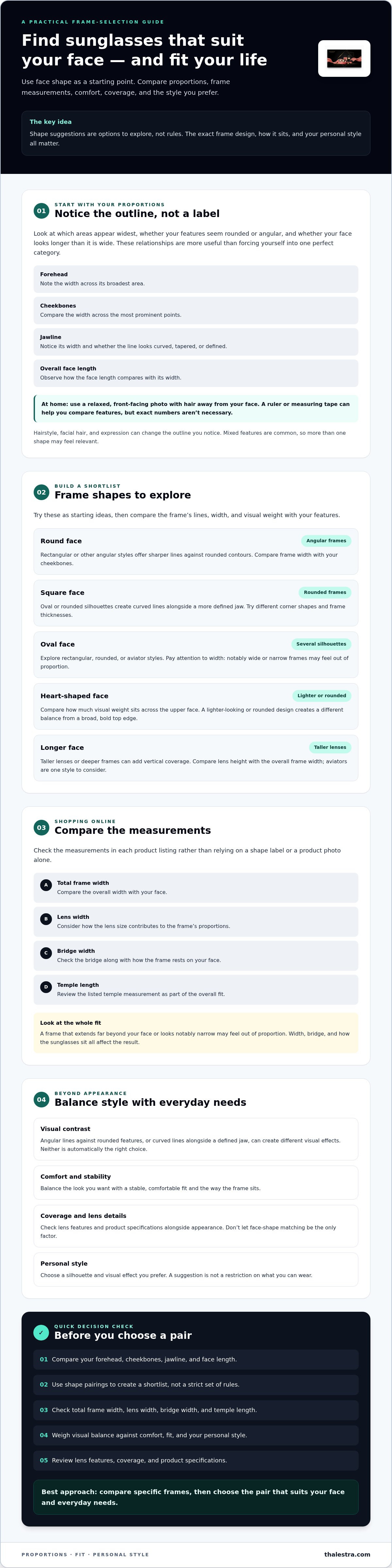
Face shape is a visual guide, not a rulebook for choosing frames. Your forehead, cheekbones, jawline, and overall face length create a pattern of proportions. Notice which areas look widest and whether your features appear rounded, angular, or elongated. This gives you a practical basis for comparing frame designs.
Face shape is a starting point for comparing frame proportions, not a verdict on what you can wear. A style suggestion can change depending on the exact frame design, how it fits, and what you like. For background on the different types of sunglasses, including their designs and construction, see Wikipedia’s general overview.
How to identify your face shape at home
Start with a front-facing photo, with your hair away from your face and your expression relaxed. Look at the outline rather than focusing on small details. You can also compare measurements using a ruler or measuring tape:
- Face length: Measure from the hairline to the bottom of the chin.
- Forehead: Note the width across its broadest area.
- Cheekbones: Compare the width across the most prominent points.
- Jaw: Observe its width and whether the line looks curved, tapered, or more defined.
Exact numbers aren’t necessary. Compare the measurements: are your cheekbones wider than your forehead and jaw, or are all three similar? Does your face look longer than it is wide? These relationships are more useful than trying to force your features into a perfect category. Mixed features are common, so your proportions may suggest more than one shape.
Why face-shape labels are only a starting point
Labels simplify a varied set of features. Hairstyle can make the forehead look narrower or wider, while facial hair can change how prominent the jaw appears. Even your expression may affect the outline you notice. A label based on one photo or a quick measurement may not tell the whole story.
Think of visual balance as an option, not a requirement. A frame with contrasting angles creates a different effect from one that echoes your natural curves, but neither is automatically the right choice. If your measurements or face-shape label feel ambiguous, compare several silhouettes rather than ruling any out. Then weigh those style impressions against frame shape and fit.
Which Sunglasses Shapes Suit Different Face Shapes? Compare the Options
Use shape pairings as ideas to test, not fixed matches. Consider how a frame’s lines, width, and visual weight interact with your features. If you’re deciding how to choose sunglasses for face shape, use the options below to build a shortlist, then judge each frame by its design and fit.
| Face shape | Frame styles to explore | What to compare |
|---|---|---|
| Round | Rectangular or other angular frames | Sharper lines against rounded contours |
| Square | Oval or rounded frames | Curved lines against a defined jaw |
| Oval | Rectangular, rounded, or aviator styles | Frame width relative to your face |
| Heart-shaped | Rounded or lighter-looking designs | Width and visual weight across the face |
| Longer | Taller lenses or deeper frames | Lens height and overall proportions |
Frame ideas for round, square, and oval faces
For a round face, rectangular frames are one way to add visual contrast. Their straighter edges can make the overall look feel more defined, especially when the frame width works with your cheekbones. For a square face, oval or rounded silhouettes offer a softer counterpoint to a more angular jaw. Neither pairing is mandatory. Compare different frame thicknesses and corner shapes to see which feels balanced to you.
Oval faces can explore a range of silhouettes. Check the width rather than assuming every shape will suit: frames that extend far beyond your face or look notably narrow may feel out of proportion. The bridge and how the frame rests also affect the overall impression. For practical guidance beyond shape matching, REI’s guide to how to select sunglasses covers fit alongside lens considerations.
Frame ideas for heart-shaped and longer faces
With heart-shaped features, compare how much visual weight sits across the upper face. A broad or bold top edge can draw attention upward, while a lighter-looking or rounded frame creates a different balance. For longer faces, taller lenses can add vertical coverage. Compare lens height with the full frame width so the sunglasses don’t look undersized. Aviators are one shape to consider. Explore the proportions in this guide to men’s aviator sunglasses.
Use the table to shortlist a few shapes, then compare available sunglasses frame styles by their specific designs and measurements. A visual match still needs to feel comfortable and stay in place.
Do Face-Shape Rules Matter More Than Frame Fit and Personal Style?
Face-shape charts can suggest a direction, but they can’t identify one universally correct frame. A recommendation such as “choose angular frames” doesn’t account for frame width, bridge shape, how the temples rest, or whether you like the look. Face-shape guidance can narrow your options, but it can’t replace a fit check.
When face-shape recommendations help, and when they do not
Use a face-shape suggestion to create a shortlist, then compare those options with your own preferences. The same silhouette can look different in a narrow, lightweight design than in a wider frame with a thick rim. Lens size, brow line, and frame thickness also change the effect, even when the basic shape is similar.
Fit matters as much as appearance. Frames should feel stable without pinching at the temples or slipping as you move. If two styles both suit your proportions, choose the one you prefer wearing. Celebrity looks and style stereotypes can’t tell you whether a frame will fit your face; comfort, measurements, and personal taste are more useful guides.
Balance style with lens needs and eye protection
Frame shape describes appearance, not lens protection. A dark tint doesn’t automatically block more ultraviolet light, so check the product specifications for a clear label stating UV400 or 100% UVA and UVB protection. If the listing doesn’t provide this information, don’t infer protection from lens color or darkness. See this guide to UV-protected sunglasses guidance for more on checking lens safety.
Keep lens features separate from style decisions. Polarized and photochromic lenses describe features to assess in the product specifications; neither tells you whether a frame shape complements your face. Consider your intended use and preferences, then verify which features the specific listing states. Don’t assume every pair in a category has the same lens details.
A practical order of priorities is simple: shortlist shapes you’re curious about, compare the listed frame measurements, confirm the stated lens protection and features, then decide whether the look and feel suit you. That makes how to choose sunglasses for face shape less about obeying a chart and more about finding a pair that works for your face and needs.
How to Check Sunglasses Fit Before You Buy Online
Photos help you judge a frame’s appearance, but measurements offer a more practical way to estimate fit before ordering. Listings may show sizing in a specifications, details, or product description section. Layouts vary, so check the specific listing rather than assuming every pair uses the same measurement format.
Which frame measurements should you compare?
Compare the key dimensions with a pair of sunglasses you already find comfortable:
- Total frame width: Compare the full width across the front. This helps you judge whether a frame may feel too narrow or extend too far beyond your face.
- Lens width: Check the width of one lens from side to side. This contributes to the overall scale of the frame.
- Bridge width: Review the space between the lenses where the frame rests over your nose. A difference here can affect how the glasses sit.
- Temple length: Compare the arms that extend from the hinges toward your ears. Their length can influence how securely the frame rests.
Before ordering, compare total frame width, lens width, bridge width, and temple length with a pair that already fits comfortably. If your existing sunglasses have measurements printed on the inside of an arm, use them as a reference. Otherwise, check whether the listing explains how its measurements are recorded. Measurement conventions and specifications can vary, so compare like with like. A lens-width figure, for example, is not the same as total frame width.
How to assess comfort and coverage from product details
Consider whether the frame looks proportionate to your face and offers the coverage you want. A wider or taller lens may create a bolder look, while a compact frame may feel more understated. Product photos from the front and side can help you inspect the silhouette, arm shape, and lens proportions. Treat them as clues, not proof of fit: camera angle and model proportions can make a frame appear larger or smaller.
For another point of style comparison, explore vintage designer frame silhouettes. Compare the design with the listed dimensions, then review the specific product details for measurements and lens features. This connects your style preferences with a more informed estimate of fit.
Use these checks as you browse sunglasses styles online. Comparing specific products makes it easier to apply how to choose sunglasses for face shape while keeping size and comfort in view.
Choose Your Sunglasses: A Simple Face-Shape and Fit Checklist
A face-shape label can help narrow the field, but your final choice should bring together proportions, frame design, measurements, comfort, and lens features. Use this checklist to compare options without treating any one style as the only right answer.
A quick decision checklist before choosing a frame
- Note your proportions: Identify one or two tendencies, such as a longer face or a more defined jaw. Mixed features are fine; you don’t need to settle on a single label.
- Pick silhouettes to compare: Shortlist several frame shapes that offer the visual balance you want, whether that means contrast or a look that echoes your features.
- Compare measurements: Check total frame width, lens width, bridge width, and temple length against a pair that already fits comfortably. Review how each listing defines its measurements.
- Consider comfort and stability: Look for product details and angles that help you assess how the frame may rest across your nose and temples. Photos can inform your decision, but they can’t confirm fit on your face.
- Review lens features: Check the listing for stated UV protection and any other lens features you want. Don’t infer protection or function from the frame shape or lens darkness.
How to browse styles without overthinking face shape
Style categories can make browsing more focused, but assess each frame’s proportions independently. Two rectangular frames, for example, can differ in width, lens height, rim thickness, and overall visual weight. Those details can change how a familiar silhouette looks on you.
Keep frame appearance and lens specifications as separate checks. Polarized and photochromic describe lens features, not face-shape matches, so confirm the details in each product listing rather than assuming every frame offers the same features. Before adding a pair to your cart, double-check its measurements and specifications, especially if you’re comparing it with sunglasses you already own.
The practical answer to how to choose sunglasses for face shape is to use your proportions to guide a shortlist, then let fit and personal preference shape the decision. A chart offers direction; your measurements, comfort needs, and preferred look help determine which option works for you.
Ready to compare options? Browse sunglasses styles and check each listing’s measurements and lens details as you decide.
Choose a Pair That Fits Your Face and Your Life
Face-shape guidance is most useful for building a shortlist, not deciding for you. Notice your proportions, compare a few silhouettes, then check frame width, lens width, bridge, and temple measurements against a pair you already find comfortable. Your preferred look matters, too.
As you consider how to choose sunglasses for face shape, keep appearance and function in view. Confirm lens features in each product listing rather than guessing from color or frame design. THALESTRA.COM’s online assortment includes polarized and photochromic sunglasses, with styles for men and women. Check the specifications for the pair you’re considering before adding it to your cart.
Ready to compare frame options? Browse sunglasses styles and use your measurements and preferences to guide your selection. Choose the pair that suits your features, feels comfortable, and fits the way you want to wear it.
Frequently Asked Questions
How do I determine my face shape for sunglasses?
Compare your face length with the width of your forehead, cheekbones, and jaw. A front-facing photo with your hair away from your face can make the outline easier to assess. Notice which area looks widest and whether your features appear more rounded, angular, or elongated. You may have a mix of characteristics, so treat a face-shape label as a guide rather than a fixed category.
What sunglasses suit a round face?
Angular or rectangular sunglasses are one option for a round face because their straighter lines create contrast with rounded contours. Compare frame widths and corner shapes, since a narrow rectangle and a broad, bold frame can create different effects. A face-shape chart can help you choose styles to explore, but it can’t determine fit or personal preference. Check the frame measurements and choose a design you feel comfortable wearing.
Which sunglasses look best on a square face?
Rounded or oval sunglasses can soften the look of a defined jaw by adding curved lines. That’s a styling option, not a rule. Frame thickness, lens size, and width all affect the result, so compare different versions of rounded styles rather than relying on the shape name alone. Choose a pair that sits comfortably, feels stable, and suits your taste as well as your facial proportions.
Can I wear any sunglasses shape if I have an oval face?
Yes, an oval face can work with a range of silhouettes, including rounded, rectangular, or aviator-inspired frames. Compare proportions rather than assuming every shape will look or fit the same. Check whether the frame width feels balanced with your face, then review the bridge and temple dimensions. Your preferred style matters, too, so use face-shape suggestions to guide your choices, not limit them.
How do I choose sunglasses online without trying them on?
Compare the listing’s frame width, lens width, bridge width, and temple length with a pair you already find comfortable. Check the product description or specifications for those measurements, and review photos from more than one angle if available. Photos can help you judge proportions, but they can’t guarantee fit. Before ordering, confirm the specific product’s dimensions and lens features rather than relying on its style category alone.
Should sunglasses be wider than your face?
Not necessarily. Frame width should look balanced with your face and feel secure, without pressing uncomfortably at the temples or extending noticeably beyond the sides. Compare the listed total frame width with sunglasses that already fit well. If a listing gives lens width but not total frame width, remember that lens measurements alone don’t tell you how wide the complete frame is. Check the product’s measurement details before deciding.
Does face shape affect which sunglasses protect your eyes?
No. Face shape and frame style don’t establish a lens’s UV protection. Check the product specifications for a label stating UV400 or 100% UVA and UVB protection. Lens darkness isn’t a reliable indicator of UV protection, so don’t judge safety by tint alone. Choose a frame based on fit and style, then verify the protection information for that specific pair before buying.