
The darkest premium lens might still fail against blinding road reflections, while a clear-base adaptive lens offers superior protection in shifting environments. Constant eye strain in bright sunlight and annoying glare while driving create significant visual fatigue. You likely feel the frustration of switching glasses when moving indoors or navigating tunnels. Understanding the technical difference between polarized and photochromic lenses is the primary requirement for selecting high-performance eyewear. This 2026 lens guide promises to help you select the perfect eyewear for your lifestyle through a functional comparison of light quality management versus light quantity adaptation.
We provide direct insights into ANSI Z80.3-2025 standards, ISO transmittance categories, and specialized LIOUMO photochromic polarized series performance. This overview covers horizontal glare suppression, rapid fade-back speeds, and digital cockpit display compatibility. Learn to achieve clear vision in all light conditions with single-pair convenience. Modern trend-aware curation meets technical utility for reduced eye fatigue and maximum environmental awareness. Discover how to optimize your visual experience using 2025 vacation sunglasses and advanced driving optics for professional environments.
Key Takeaways
- Identify the core engineering distinction between light filtration for glare control and light adaptation for variable brightness levels.
- Master the technical difference between polarized and photochromic lenses to select the optimal eyewear for high-glare vacation environments or shifting driving conditions.
- Evaluate the impact of vertical polarizers on digital screen visibility to ensure compatibility with modern vehicle HUDs and mobile devices.
- Analyze how temperature, UV intensity, and lens age affect the transition speed and darkness levels of light-adaptive technology.
- Explore the utility of hybrid LIOUMO series lenses that combine polarization efficiency with automatic light-reactive tinting for all-day convenience.
Understanding Polarized and Photochromic Lens Technologies
Modern eyewear engineering for 2026 focuses on precision light management through advanced chemical and molecular applications. The core difference between polarized and photochromic technology lies in how the lens interacts with incoming light. Polarized lenses are designed for light filtration, specifically targeting quality by removing glare. Photochromic lenses prioritize light adaptation, managing the quantity of light by adjusting darkness levels. High-performance models like the LIOUMO series leverage these distinct mechanisms to ensure visual clarity, safety, and comfort across diverse global environments.
Current production standards, including ANSI Z80.3-2025, mandate specific UV400 protection and transmittance requirements. For the modern professional, the choice isn't just about style but functional utility. Efficiency-oriented users require optics that mitigate eye fatigue without the burden of multiple pairs. This functional overview categorizes lenses based on their technical specifications and immediate performance outcomes.
What are polarized lenses?
Polarized lenses feature a fixed chemical filter. This polyvinyl alcohol (PVA) iodine-stretched film is oriented vertically within the lens material. It acts as a microscopic shutter, neutralizing blinding horizontal reflections from flat surfaces like wet roads, snow, or water. Our Classic Mens Polarized Sunglasses provide this consistent light filtration regardless of ambient brightness.
- Primary Purpose: Suppression of horizontal glare and reflection management.
- Visual Outcome: Enhanced contrast, deep color saturation, and eliminated visual "noise."
- Optimal Utility: High-albedo environments, beach vacations, and marine activities.
What are photochromic lenses?
Photochromic technology utilizes UV-sensitive molecules, often using naphthopyran chemistry, embedded directly into the lens monomer. These molecules change shape when exposed to ultraviolet radiation and short-wave visible light. This reaction causes the lens to darken automatically, moving from a clear state to Category 3 darkness as defined by ISO 12312-1:2022 standards.
- Primary Purpose: Dynamic adjustment to changing ambient light levels.
- Visual Outcome: Seamless transition between indoor and outdoor lighting without manual switching.
- Optimal Utility: Driving, urban commuting, and hybrid work environments.
While standard photochromics manage brightness, they don't inherently block horizontal glare. Understanding this functional difference between polarized and photochromic lenses is vital for selecting the 2025 Vacation Sunglasses For Men that best fit your specific environmental demands.
The Mechanics of Glare Reduction: How Polarized Lenses Work
Polarized lenses represent the gold standard for light quality management in high-albedo environments. Unlike adaptive lenses, these optics utilize a physical vertical filter to eliminate visual noise. The fundamental difference between polarized and photochromic eyewear is that polarization remains constant regardless of UV exposure. This fixed filtration is essential for activities where horizontal surface reflections create "white-out" conditions. By absorbing scattered light, these lenses enhance depth perception and maintain high color accuracy for the wearer. This results in a more saturated visual experience where greens and blues appear more vivid and natural.
Blocking horizontal light waves
Light waves from the sun travel in all dimensions. When these waves strike a flat surface, they "bounce" and become horizontally polarized. This concentrated light creates blinding glare that obscures fine details. Polarized filters act as a microscopic venetian blind for your eyes. Only vertical light waves pass through the vertical chemical filter. Polarization is the process of using a vertical chemical filter to block horizontal light waves reflected from flat surfaces. This mechanism ensures that 2025 Vacation Sunglasses For Men provide superior visual comfort during peak sunlight hours without the distortion typical of non-polarized lenses.
Best environments for polarized eyewear
Specific environments demand dedicated glare suppression that standard photochromic lenses cannot provide. High-glare zones include open water, snow-covered paths, and wet asphalt. These surfaces reflect up to 80% of incident light, causing immediate eye strain and reduced reaction times. For maritime activities, our specialized polarized sunglasses for fishing are indispensable for seeing beneath the water's surface. High-altitude trekking and road driving also benefit from this consistent horizontal light wave absorption. Professional drivers often prefer fixed polarization to manage the intense reflections off vehicle hoods and windshields.
Classic polarized sunglasses are a vacation essential because they provide immediate relief from environmental reflections. They offer 100% UV400 protection while maximizing contrast in bright conditions. For those prioritizing visual clarity during outdoor excursions, our Classic Mens Polarized Sunglasses deliver professional-grade performance. Choosing a fixed polarized lens ensures that your vision remains sharp and glare-free even when temperatures or UV levels fluctuate. This reliability makes them a primary tool for any global traveler seeking functional efficiency and streamlined style.
Smart Light Adaptation: The Science Behind Photochromic Lenses
Adaptive vision technology focuses on photon density management. Photochromic lenses manage total light quantity, adjusting their tint based on environmental exposure. The primary difference between polarized and photochromic optics is that polarization filters light quality (glare), while photochromic tech regulates light volume (brightness). These lenses offer a dynamic response to shifting conditions, providing a seamless experience for users moving between indoor and outdoor spaces. Modern 2026 formulations prioritize rapid transition speeds and color stability for maximum visual efficiency.
UV-reactive molecules and darkening speeds
Modern photochromic dyes utilize advanced naphthopyran chemistry embedded directly into the lens monomer. These organic molecules change structure when exposed to UVA radiation and short-wave visible light. Earlier halide and silver chloride reactions are largely replaced by in-mass integration for better scratch resistance. Current 2026 benchmarks, such as Transitions GEN S, activate outdoors to Category 3 darkness in approximately 25 seconds. Fade-back to 70% light transmission occurs in under two minutes at standard temperatures. Temperature sensitivity remains a critical variable. Lenses reach maximum density in cold, bright conditions. In extreme heat above 95°F, molecules revert faster, which can prevent the lens from reaching full darkness. Advanced photochromics now provide up to 39.5% improved contrast sensitivity during these molecular shifts.
Indoor vs. outdoor transitions
The "single pair" solution remains the most significant advantage for hybrid desk workers and commuters. This eliminates the frustration of switching glasses when moving from office environments to the street. Standard photochromic lenses typically remain clear behind vehicle windshields because modern automotive glass blocks nearly 99% of ambient UV rays. For high-performance activity, refer to our photochromic cycling sunglasses guide to understand adaptive vision in sport contexts. Recent visible-light photochromic monomers allow some lenses to darken moderately to Category 2 levels even inside a car. These adaptive optics offer 40% faster visual photostress recovery compared to older generations. They represent a high-utility gateway for users seeking constant UV400 protection without manual lens changes. While they don't provide the same horizontal glare suppression as fixed polarized lenses, their versatility in varied light levels is unmatched.
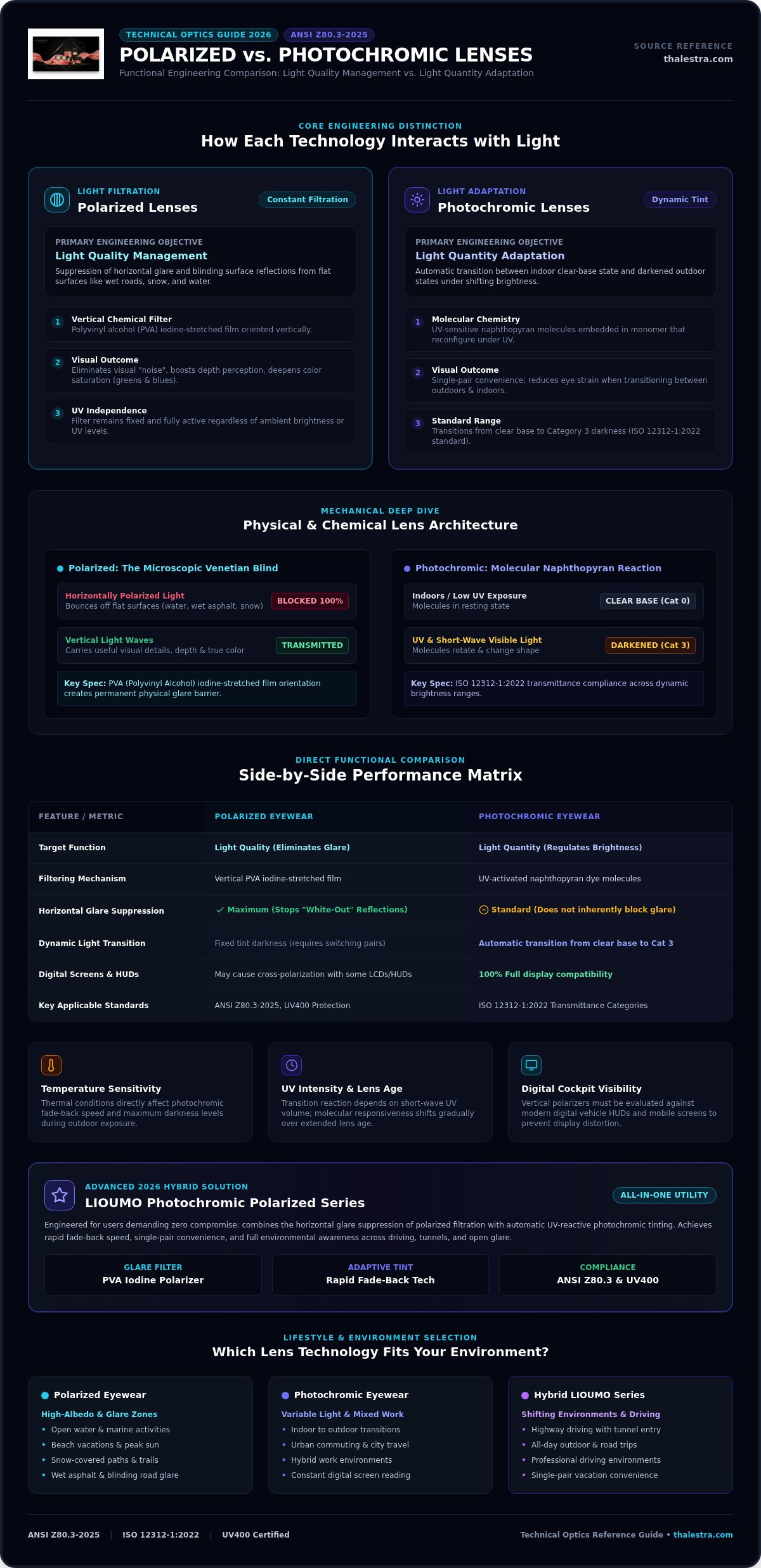
Polarized vs. Photochromic: A Direct Functional Comparison
Selecting the optimal lens for 2026 requires a head-to-head analysis of environmental stressors. The primary difference between polarized and photochromic technology centers on static filtration versus dynamic adaptation. Polarized options offer high-contrast, fixed glare suppression. Photochromic lenses provide variable shading based on incident light volume. For users requiring maximum efficiency, understanding how these technologies interact with digital interfaces and changing light levels is essential for long-term comfort.
Visibility vs. brightness control
Polarized lenses excel in high-glare environments where horizontal reflections dominate. They are superior for clarity in harsh light conditions, such as midday beach excursions or high-altitude skiing. These lenses maintain a constant darkness level regardless of UV intensity. Conversely, photochromic lenses are superior for variable cloud cover and mixed light. They provide seamless adjustment during urban commutes where light levels fluctuate between shadows and open streets. Comparing classic polarized sunglasses vs adaptive tech reveals that fixed polarization is more reliable for water-based activities, while adaptive lenses offer better versatility for all-day wear in shifting weather.
Driving performance and safety
Safety metrics for 2026 emphasize the importance of visibility during rapid light transitions. Managing road glare requires polarization, but managing tunnel transitions often favors photochromic response speeds. A significant factor is the "Digital Screen Problem." Polarized filters often cause "blackout" or rainbow birefringent distortion on LCD dashboards and modern Heads-Up Displays (HUDs). Standard adaptive lenses avoid screen blackout entirely, presenting a distinct advantage for digital cockpit interaction. For those prioritizing road safety, we recommend specialized transition sunglasses for driving to handle changing light without manual intervention.
Modern lens fabrication utilizes high-index 1.67 and 1.74 monomers to ensure both lens types remain thin and lightweight. Weight considerations for modern frames are now negligible due to in-mass dye integration. Price point analysis indicates that premium photochromic upgrades typically range from $100 to $250, while polarization add-ons range from $50 to $150. For users seeking a unified solution, our LIOUMO Top Quality Photochromic Polarized Sunglasses combine both technologies into a single high-utility frame. This hybrid approach eliminates the need for multiple pairs, maximizing investment value and daily convenience.
Choosing the Right Lens for Your 2026 Lifestyle
Pragmatic lens selection depends on activity-based requirements. The fundamental difference between polarized and photochromic technology dictates performance in high-glare versus high-variability environments. Modern users require streamlined solutions that prioritize eye comfort and safety. Efficiency-oriented shoppers focus on immediate functional utility. Our online-only storefront provides a curated selection of trend-aware optics designed for global reach and rapid delivery.
When to choose polarized
High-albedo zones require fixed filtration. Water sports, beach vacations, and long-haul daytime driving benefit from consistent horizontal light suppression. Polarized lenses are the primary choice for sensitive eyes prone to glare-induced migraines. They offer 100% UV400 protection and superior contrast in static, bright conditions. Our men’s vacation sunglasses 2025 guide highlights polarized models as the top selection for maritime utility and intense sun exposure. These lenses remain the standard for high-performance glare neutralization.
The ultimate hybrid: LIOUMO Photochromic Polarized tech
The specialized LIOUMO series integrates dynamic photochromic dyes with a fixed polarizing layer. This combination manages both light quality and light quantity simultaneously. It's the preferred choice for 2026 trend-aware curators who demand versatility. Hybrid lens technology eliminates the need for two pairs by providing permanent glare protection and variable light shading in a single frame. This ensures Category 3 darkness in open sunlight while maintaining clear-base visibility in shaded areas or tunnels. It represents the ultimate driving accessory for the modern digital cockpit.
Ensuring UV400 protection is mandatory for all Thalestra shoppers. All featured lens types block 100% of UVA and UVB rays up to 400 nanometers. This technical standard remains non-negotiable for long-term eye health. Use the following buyer checklist to finalize your selection based on the difference between polarized and photochromic capabilities:
- Environmental Glare: Choose polarized for open water, snow, or wet asphalt.
- Light Variability: Choose photochromic for urban commuting and office-to-street movement.
- Device Interaction: Choose photochromic or hybrid for LCD dashboards and HUD compatibility.
- Activity Level: Choose Classic Mens Polarized Sunglasses for dedicated outdoor vacations.
- Convenience: Choose LIOUMO hybrid series for all-day, multi-environment wear.
Thalestra focuses on international DTC sales with a trend-aware catalog. We don't offer in-store fittings or prescription lens fitting, ensuring a streamlined, high-volume merchant experience. Select your 2025 Vacation Sunglasses For Men based on these technical specifications for maximum visual efficiency.
Optimize Your Visual Performance for 2026
Visual efficiency in 2026 requires a precise understanding of lens utility. Selecting the correct optics ensures long-term eye comfort and safety across diverse environments. The primary difference between polarized and photochromic technology dictates performance in high-albedo zones versus shifting urban light conditions. Polarized lenses remain essential for maritime and vacation utility. Photochromic lenses provide seamless transitions for commuters and digital cockpit drivers. Hybrid models like the LIOUMO series unify these functions for maximum daily convenience.
Thalestra provides streamlined access to high-utility optics for a global audience. All featured lens types include UV400 Certified Protection to ensure maximum safety. Our curated catalog features advanced Carbon Fiber Frame Options for durability and lightweight performance. Benefit from Global Worldwide Shipping on all orders. Secure your ideal eyewear today to achieve clear vision in all light conditions. Shop the 2026 LIOUMO Photochromic Polarized Collection and upgrade your lifestyle optics immediately. Experience the professional standard in adaptive vision technology now.
Frequently Asked Questions
Can I get sunglasses that are both polarized and photochromic?
Yes, hybrid lenses combine both technologies into a single optical solution. The LIOUMO Top Quality Photochromic Polarized Sunglasses utilize this integration to manage both light quality and quantity simultaneously. This specific combination allows for horizontal glare suppression while the lens tint adjusts dynamically based on UV exposure levels. These models provide the benefits of both systems without requiring the user to carry multiple pairs for changing environmental conditions.
Do photochromic lenses work while driving a car?
Standard photochromic lenses typically remain clear while driving because automotive windshields block approximately 99% of UV rays required for activation. However, specialized 2026 formulations like visible-light photochromic monomers allow certain lenses to darken moderately behind glass. These are often categorized as Category 2 filters under ISO 12312-1:2022 standards. For consistent performance during long-haul daytime driving, many users prefer dedicated polarized optics that don't rely on UV activation.
Are polarized lenses better for your eyes than regular ones?
Polarized lenses are superior for reducing eye fatigue caused by horizontal glare from surfaces like water or wet roads. While standard lenses only reduce overall brightness, polarized filters eliminate blinding reflections that cause squinting and migraines. Both types must meet UV400 standards to ensure full protection against UVA and UVB radiation. The primary difference between polarized and photochromic lenses in this context is the consistent glare management provided by the polarized filter.
Why do polarized sunglasses make it hard to see my phone screen?
Polarized sunglasses use a vertical chemical filter that interacts with the polarized light emitted by LCD and OLED screens. When the alignment of the lens filter conflicts with the screen's polarization, it results in a blackout effect or rainbow birefringent distortion. This makes it difficult to read mobile devices, GPS displays, or modern vehicle Heads-Up Displays (HUDs) at certain angles. Users prioritizing digital interface visibility often select non-polarized photochromic lenses instead.
How long do photochromic lenses take to change back to clear?
Modern 2026 photochromic technology allows lenses to fade back to approximately 70% light transmission in under two minutes at standard temperatures. Activation to Category 3 darkness occurs much faster, typically within 25 seconds of UV exposure. These speeds are highly dependent on ambient temperature; colder environments slow the fade-back process while intense heat can prevent the lenses from reaching maximum darkness levels. Efficiency-oriented users value these rapid transitions for office-to-street movement.
Do polarized lenses provide UV400 protection?
Yes, all high-quality polarized lenses sold through Thalestra provide 100% UV400 certified protection. It is a common misconception that polarization itself blocks UV rays; polarization handles glare while a separate chemical treatment filters harmful UVA and UVB radiation up to 400 nanometers. Every pair in our 2025 Vacation Sunglasses For Men collection meets these safety standards. Always verify the UV400 label to ensure long-term eye health during outdoor activities.
Which lens type is better for skiing and snow sports?
Polarized lenses are generally better for snow sports because they neutralize the intense horizontal glare reflected off snow-covered paths. This reflection can reach 80% of incident light, causing severe visual discomfort. However, photochromic lenses are useful in alpine environments where light conditions shift rapidly between sun and cloud. For maximum utility, hybrid models like the LIOUMO series provide both glare suppression and adaptive darkening, ensuring clear vision regardless of altitude or weather fluctuations.
How can I tell if my sunglasses are actually polarized?
You can verify polarization by holding the glasses in front of a digital LCD screen and rotating them 90 degrees. If the lenses are polarized, the screen will appear to darken or turn completely black at a specific angle. Another method involves looking at a reflective surface, such as a car hood, and tilting your head; the glare should noticeably disappear and reappear. This simple test confirms the presence of the vertical chemical filter in your eyewear.