
Squinting at the road isn't just a nuisance; it's a critical failure in your driving safety system. You've likely experienced that split second of total blindness when the midday sun hits wet pavement or when your own dashboard reflects across the windshield. These high-glare moments cause immediate eye strain and dangerous reaction delays. Finding the right anti-glare sunglasses driving enthusiasts need requires moving beyond basic tinting into advanced light filtration. This 2026 guide helps you master the science of road visibility.
You'll learn how to select optimal anti-glare lenses for every condition, from low-light rain to intense desert sun. We provide a definitive framework for buying driving-specific eyewear. The focus remains on technical specifications: polarized photochromic lenses, carbon fiber frames, and high-contrast road visibility. By the end, you'll know exactly how to achieve clearer road contrast and reduced ocular fatigue for a safer, more efficient journey. This is about functional performance, modern appeal, and curated selection for the global driver.
Key Takeaways
- Identify the mechanics of veiling glare and how light reflecting off horizontal surfaces like asphalt and water compromises driver safety.
- Compare polarized lens performance against anti-reflective coatings to eliminate both external road reflections and internal lens ghosting.
- Learn to match specific lens tints like gray, brown, and copper to light levels and contrast requirements for faster hazard detection.
- Use a technical 5-step selection process to secure 100% UV400 protection and the correct lens category for your anti-glare sunglasses driving environment.
- Explore adaptive photochromic and polarized solutions engineered for seamless visibility transitions during dawn-to-dusk transit.
Understanding Road Glare and Driver Safety
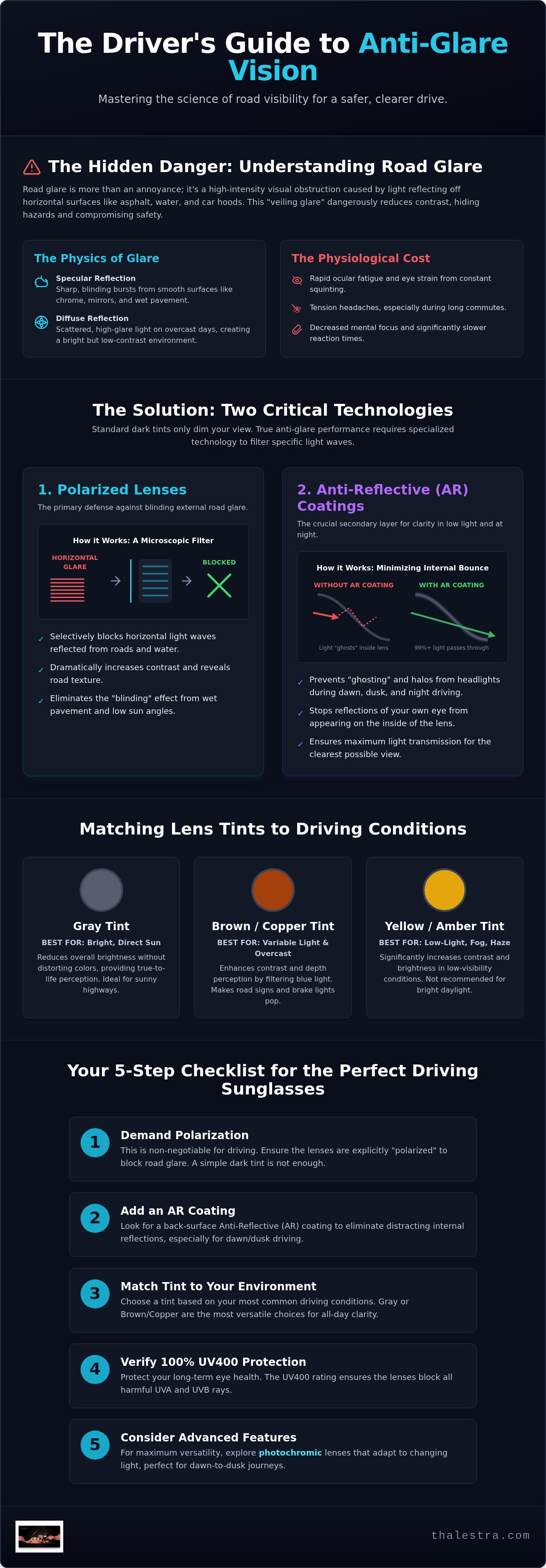
Road glare is a high-intensity visual obstruction. It occurs when light reflects off horizontal surfaces such as asphalt, car hoods, and standing water. This reflected light travels in a specific horizontal orientation, creating a concentrated wash of brightness. Utilizing anti-glare sunglasses driving gear is essential for maintaining clear sightlines and avoiding hazardous "blind spots" on the road.
A major risk factor is "veiling glare." This phenomenon reduces the contrast of the entire visual field. It effectively hides road hazards, including pedestrians, debris, and brake lights. The result is a dangerous decrease in situational awareness. Relying on standard dark sunglasses often fails because they merely dim the view without filtering the specific glare-causing light waves.
The physiological cost of unprotected driving is significant. The "squint reflex" causes constant muscular tension around the eyes. This leads to:
- Rapid ocular fatigue and strain.
- Frequent tension headaches during long commutes.
- Decreased mental focus and slower reaction times.
- Temporary "blindness" when transitioning between light and shadow.
The Physics of Horizontal Glare on the Road
Light waves become polarized when they strike flat road surfaces. This process concentrates the energy into a horizontal plane. Midday sun combined with wet pavement creates the highest glare intensity. The water acts as a mirror, amplifying the light. During sunrise and sunset, the low angle of the sun hits windshields directly. This creates a wall of light that can completely obscure the road ahead.
Specular Reflection vs. Diffuse Reflection
Drivers encounter two main glare types. Specular reflection originates from smooth, mirror-like surfaces. Chrome bumpers, mirrors, and rear windshields produce these sharp, blinding bursts. Diffuse reflection occurs on overcast days. Light scatters through cloud cover, creating a high-glare environment even without direct sunlight. Both types increase eye strain. High-speed highway transit demands near-instant reaction times. Glare-induced delays can add several meters to stopping distances. Effective anti-glare sunglasses driving technology filters these reflections to ensure consistent road contrast.
Polarization vs. Anti-Reflective Coatings: Which Do You Need?
Many retail listings use "anti-glare" as a generic marketing term. This is often misleading. A simple dark tint reduces overall light volume but does not filter the specific horizontal waves causing road blindness. High-performance anti-glare sunglasses driving eyewear must utilize specific physical filters or chemical coatings to actually eliminate reflections. True road protection requires understanding the technical distinction between polarization and anti-reflective (AR) treatments.
Polarization is the industry standard for managing external light. AR coatings focus on internal lens clarity. Combining these technologies creates a synergy that provides 360-degree vision protection. This dual-layer approach ensures that light is filtered before it hits the lens and managed once it passes through. Without these specific features, sunglasses are merely "darkened," which can actually impair vision by dilating pupils while failing to block concentrated glare points.
How Polarized Filters Block Road Blindness
Think of a polarized filter as a microscopic set of Venetian blinds. These blinds only allow vertical light waves to pass through while blocking the horizontal waves that bounce off the asphalt. This technology is vital for seeing through a wet windshield or past the surface of a puddle. A polarized driving lens features a specialized chemical film layer laminated between lens materials to selectively absorb glare. This filter ensures you see the actual road texture rather than the light reflecting off it. It's the difference between seeing a hazard and being blinded by it.
The Role of AR Coatings in Low-Light Driving
While polarization handles external light, anti-reflective (AR) coatings manage internal lens behavior. These microscopic layers prevent "ghosting," where light bounces between the front and back surfaces of the lens. This is especially useful for reducing the halo effect from modern LED headlights during dawn or dusk transits. Back-surface AR coatings are equally critical. They prevent your own eye and cheek from reflecting on the inside of the lens, which is a common distraction in side-lit conditions. Don't confuse AR with hydrophobic layers; hydrophobic coatings repel water and oil, whereas AR coatings specifically manipulate light transmission.
For drivers seeking a professional-grade solution, our Classic Mens Polarized Sunglasses integrate these essential filtration layers for maximum road safety. This combination reduces visual noise and allows for faster identification of road hazards in all lighting conditions. Selecting a lens that features both polarization and AR coating provides the most efficient visual experience for long-distance travel.
Mapping Lens Tints to Driving Conditions
Selecting the correct lens tint is a functional decision based on environment and light intensity. Different colors filter specific wavelengths to improve visual acuity and safety. For high-glare midday conditions, gray lenses offer neutral color perception. They reduce overall brightness without distorting the appearance of traffic signals or brake lights. Green lenses provide a similar balance, maintaining high color accuracy while reducing glare in varied, high-contrast terrain like mountain roads or forested highways.
Yellow and amber tints excel in low-light "flat light" conditions. They are optimal for fog, haze, and heavy overcast. These colors filter out high-energy blue light, which often causes "visual noise" or blurring in misty weather. By enhancing contrast, they make it easier to distinguish between the road surface, the shoulder, and oncoming vehicles. This specific filtration helps prevent the eye fatigue associated with navigating through low-visibility environments.
High-Contrast Tints for Highway Safety
Copper and brown lenses are the preferred choice for professional drivers. These tints provide superior contrast enhancement, making it easier to spot road debris and sudden brake lights against the asphalt. They filter short-wave blue light, which increases depth perception and image sharpness at high speeds. When selecting anti-glare sunglasses driving professionals use, consider the Visible Light Transmission (VLT) category. Category 3 lenses, which allow 8% to 18% light transmission, are ideal for bright, direct sun. Category 2 lenses allow 18% to 43% transmission, offering more flexibility for variable cloud cover or late afternoon transits.
Adaptive Lenses: The Photochromic Advantage
Adaptive lenses offer a streamlined solution for changing road environments. Photochromic technology allows lenses to darken in response to light exposure, which is useful for transits involving tunnels or shifting cloud density. However, standard photochromic lenses often fail behind car windshields because modern glass blocks the UV rays required for activation. Drivers should seek specialized driving-specific photochromics, like those found in the LIOUMO series, which are designed to react to visible light through the windshield. You can find a detailed technical breakdown in our guide on polarized vs photochromic for driving to understand which adaptive tech fits your specific commute.
How to Choose Your Driving Sunglasses: A 5-Step Process
Selecting the right anti-glare sunglasses driving enthusiasts require involves more than picking a style. It's a technical assessment of filtration, protection, and physical ergonomics. Use this five-step framework to secure high-performance eyewear for your next transit.
- Step 1: UV400 Verification. Ensure lenses provide 100% UV400 protection. This blocks all light rays with wavelengths up to 400 nanometers. It prevents long-term retinal damage and ocular health issues.
- Step 2: Environment Matching. Select the appropriate lens category based on your typical route. Category 3 is for bright, direct sun. Category 2 suits variable cloud cover or late afternoon commutes.
- Step 3: Peripheral Coverage. Choose frames that wrap slightly around the face. This prevents side-entry glare from hitting your eyes. Ensure the design doesn't create new blind spots.
- Step 4: Polarization Test. Hold your glasses in front of a digital screen and rotate them 90 degrees. If the screen darkens or turns black, the polarization filter is active and functional.
- Step 5: Material Selection. Prioritize lightweight materials like carbon fiber. These reduce pressure on the nose bridge and ears during multi-hour journeys.
Frame Ergonomics and Peripheral Vision
Frame design directly impacts road safety. Wide temples or thick side arms can create artificial blind spots. These obstructions can hide vehicles or pedestrians in adjacent lanes. Opt for slim-profile arms or wrap-around styles that offer a wide field of view. Proper weight distribution is also critical. Heavy frames cause nose-bridge fatigue and slippage during 4+ hour drives. Lightweight carbon fiber frames provide the necessary structural integrity without the weight of traditional acetate or heavy metals. This ensures the eyewear stays in place during sudden maneuvers.
The Digital Dashboard Trade-off
Polarization can interfere with modern vehicle interfaces. These filters may dim LCD, GPS, or infotainment screens depending on the screen's own polarization angle. If your dashboard becomes unreadable, find the "sweet spot" by slightly tilting your head or adjusting the screen brightness. Some modern Head-Up Displays (HUDs) projected onto the windshield may disappear entirely when viewed through polarized lenses. For cars with extensive glass-cockpit displays, some drivers prefer high-contrast non-polarized lenses to maintain full digital visibility. However, for most highway environments, the safety benefit of blocking road glare outweighs these digital inconveniences.
Explore our range of LIOUMO Top Quality Photochromic Polarized Sunglasses to find a pair that balances digital clarity with professional-grade road protection.
Thalestra Driving Solutions: Engineered for the Road
THALESTRA.COM provides a curated selection of high-performance eyewear designed for immediate road utility. The inventory focuses on technical specifications that address the specific needs of modern drivers. From adaptive lens technology to advanced frame materials, each product prioritizes functional excellence and visual clarity. Selecting the right anti-glare sunglasses driving professionals trust involves matching these specifications to your specific transit requirements. Our global merchant model ensures high-volume availability of trending, high-utility goods for a worldwide audience.
LIOUMO Top Quality Photochromic Polarized Sunglasses represent the pinnacle of adaptive road technology. These lenses adjust dynamically to shifting light levels, providing a seamless transition for dawn-to-dusk travel. They eliminate the need to switch frames when entering tunnels or driving through variable cloud cover. For those requiring time-tested protection, the Classic Mens Polarized Sunglasses offer 100% UV400 security and high-intensity glare reduction. These models provide the essential filtration needed to eliminate blinding horizontal reflections during peak sun hours, ensuring consistent road contrast and reduced squinting.
Carbon Fiber: The Professional Driver’s Choice
Carbon fiber frames represent a significant advancement in driver comfort and frame longevity. This material's exceptional strength-to-weight ratio ensures that square-frame glasses remain lightweight even during extended multi-hour use. It's a high-tech, trend-aware choice for users who prioritize efficiency and durability. Unlike traditional plastic or acetate, carbon fiber frames offer superior heat resistance. They won't warp, melt, or lose their shape when left in a hot car interior, maintaining a precise fit for years of service. For more information on combining technical performance with timeless aesthetics, view our Men’s Aviator Sunglasses Guide.
Adaptive Vision for Cross-Country Travel
Cross-country travel demands lenses that react as fast as the driver. THALESTRA.COM's efficiency-oriented approach prioritizes the immediate delivery of trend-aware, functional goods to a global demographic. The photochromic transition technology in the LIOUMO series provides an unmistakable advantage for long-distance transit. It's a pragmatic solution for changing light zones, offering clarity without manual adjustment. This streamlined gateway to high-tech eyewear is supported by multilingual technical specifications to ensure global accessibility. We focus on the immediate presentation of value and product availability for the modern, fast-moving driver.
Finalizing your selection requires a focus on immediate performance and long-term durability. Whether you choose the adaptive LIOUMO series or the lightweight carbon fiber models, the objective remains safer vision and reduced ocular fatigue. This is eyewear engineered for the specific geometry of the road. Explore THALESTRA.COM’s Polarized Driving Collection to secure your 2026 road visibility solution and experience the difference of professional-grade filtration.
Secure Your Precision Road Vision Today
Achieving optimal road visibility requires more than basic shading. It's about deploying specific technical filters to eliminate blinding reflections and veiling glare. You've learned to navigate the differences between polarization and AR coatings while matching lens tints to shifting weather conditions. High-performance anti-glare sunglasses driving gear must deliver consistent road contrast and reduced squinting for safer transits. This technical approach ensures situational awareness remains high during every journey.
Prioritize UV400 certified lenses and lightweight carbon fiber technology for maximum protection and long-haul comfort. Thalestra provides streamlined access to these professional-grade specifications with global shipping and order tracking for every transaction. This is about functional performance, modern appeal, and curated selection for the global driver. Our focus remains on the immediate presentation of value and product availability for your specific driving needs.
Shop Thalestra’s High-Performance Driving Sunglasses to upgrade your 2026 driving experience. Master the science of road visibility and enjoy a clearer, safer journey ahead.
Frequently Asked Questions
Are polarized sunglasses better for driving than regular ones?
Yes, polarized lenses specifically filter horizontal light waves that cause road glare. Regular tinted sunglasses only reduce total light volume, which doesn't address blinding reflections from asphalt or other vehicles. By using anti-glare sunglasses driving becomes safer as you regain contrast and depth perception. This technology is superior for high-glare environments where standard dark lenses merely dim the view without improving visual acuity or safety.
Can I wear anti-glare sunglasses for night driving?
You shouldn't wear dark tinted anti-glare lenses at night because they restrict too much visible light. While some drivers seek "night driving" glasses, standard sunglasses reduce your ability to see hazards in the dark. Instead, look for clear or very lightly tinted lenses with anti-reflective (AR) coatings. These specifically target headlight halos and internal reflections without compromising the low-light visibility necessary for safe nighttime navigation on public roads.
Do polarized lenses affect my ability to see the dashboard or GPS?
Polarized filters can dim or distort LCD and GPS screens because these digital displays also use polarized light. If the alignment of your lens filter conflicts with the screen's orientation, the display might appear black or patchy. Modern vehicles often use glass-cockpit designs that are less affected, but you may need to tilt your head or adjust the screen brightness. This is a common trade-off for superior road glare reduction.
What is the best lens color for driving in rainy or foggy conditions?
Yellow, amber, or copper tints are the most effective for rainy or foggy environments. These colors filter high-energy blue light, which often causes a "haze" effect in mist or low-light conditions. By increasing contrast and defining the edges of the road, these tints help you spot lane markings and hazards more quickly. They provide a sharper image than neutral gray lenses when light levels are flat or diffused by weather.
How can I tell if my sunglasses actually have an anti-glare coating?
You can verify polarization by looking at a digital screen and rotating your sunglasses 90 degrees. If the screen darkens significantly or turns completely black, the polarized filter is active. For anti-reflective (AR) coatings, look at the reflection of a light bulb on the lens surface. A standard lens shows a white reflection, while an AR-coated lens typically shows a faint green, blue, or purple tint in the reflected light.
Is UV400 protection different from anti-glare polarization?
Yes, these are two distinct technologies with different functions. UV400 protection is a health feature that blocks 100% of harmful ultraviolet rays to prevent retinal damage. Anti-glare polarization is a visibility feature that filters reflected horizontal light to improve road clarity. While many high-quality anti-glare sunglasses driving models include both, you should always check the technical specifications to ensure your eyewear provides both ocular health protection and glare reduction.
Why do some anti-glare glasses make the road look rainbow-colored?
This "rainbow effect" or stress pattern occurs when polarized lenses interact with tempered glass, such as a car's side windows or some windshields. The polarization reveals internal stress points created during the glass manufacturing process. It's a physical phenomenon rather than a lens defect. While it can be distracting, it doesn't impair the lens's ability to block road glare or protect your eyes from intense sunlight and reflections.
Are lightweight frames like carbon fiber worth it for daily commuting?
Carbon fiber frames are highly recommended for daily commuters due to their exceptional strength-to-weight ratio. These frames reduce pressure on the nose bridge and ears, preventing the fatigue and headaches associated with heavy eyewear during long drives. Additionally, carbon fiber is heat-resistant and won't warp if left inside a hot car. This durability ensures your driving sunglasses maintain their precise fit and alignment over years of frequent use in varying temperatures.